Self Assessment and Marriage — How It Affects Your Tax
Getting married is a big life event — and while tax probably isn't the first thing on your mind when you're planning a wedding, it's worth understanding how tying the knot affects your finances. Unlike some countries, the UK doesn't have joint tax filing for married couples, but marriage (and civil partnership) does open up some tax planning opportunities that you'd be wise to take advantage of.
If you're self-employed and filing Self Assessment, there are several ways marriage can interact with your tax affairs. Let's walk through all of them.
Does Getting Married Change How You File Self Assessment?
The short answer: no, not really. In the UK, married couples and civil partners are taxed as individuals. You each file your own tax return, and you each have your own personal allowance, tax bands, and liabilities.
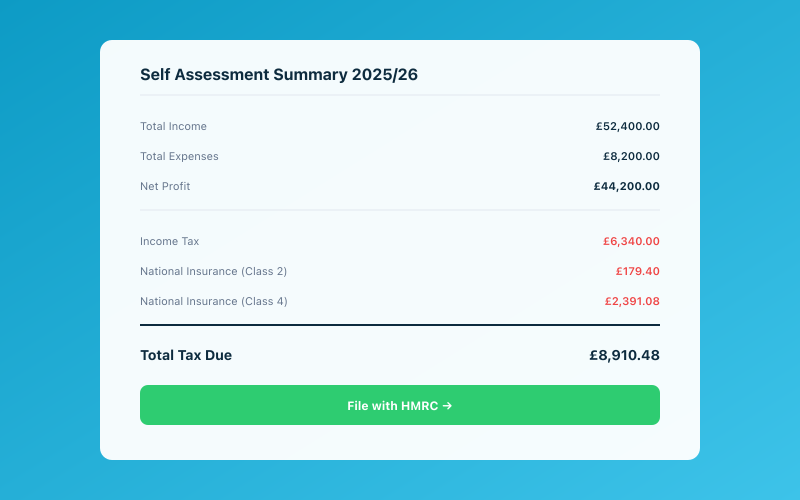 Your Accounted dashboard shows your real-time tax position
There's no "married filing jointly" option like you'd find in the United States. Your Self Assessment return stays the same format whether you're single, married, or in a civil partnership.
That said, HMRC does need to know your marital status because it can affect certain allowances and reliefs. When you complete your Self Assessment, there's a section where you can declare your relationship status — and doing so accurately is important for claiming the benefits you're entitled to.
The Marriage Allowance — Free Tax Savings
This is the big one that every married couple (and civil partners) should know about. The Marriage Allowance lets one partner transfer up to £1,260 of their unused personal allowance to the other, reducing the recipient's tax bill by up to £252 per year.
Who Can Claim It?
The Marriage Allowance works when:
- One partner earns less than £12,570 (the personal allowance) — meaning they don't use all their tax-free amount.
- The other partner is a basic rate taxpayer (earning between £12,571 and £50,270).
If the higher-earning partner pays tax at the higher rate (40%) or additional rate (45%), you can't use the Marriage Allowance. It's specifically designed for couples where one person is a basic rate taxpayer and the other earns below the personal allowance.
How to Apply
You can apply for the Marriage Allowance online at gov.uk. It's a straightforward process — you'll need both partners' National Insurance numbers and details about your income. Once approved, HMRC adjusts the basic rate partner's tax code to reflect the transferred allowance.
The transfer applies for the whole tax year. You can also backdate your claim for up to four previous tax years, which means you could receive a lump sum refund of up to around £1,000 if you were eligible but hadn't claimed.
How It Interacts with Self Assessment
If you're self-employed and filing Self Assessment, the Marriage Allowance is factored into your tax calculation. You don't need to do anything special on your return — HMRC applies the adjustment automatically once the Marriage Allowance has been set up.
However, if your income fluctuates year to year (as it often does for sole traders), keep an eye on whether you still qualify. If the basic rate partner's income rises above £50,270, you'll lose the benefit for that year.
Marriage and Jointly Owned Assets
Marriage can also affect how income from jointly owned assets is taxed — and this is where things get interesting for couples who own property or investments together.
The 50/50 Rule
By default, HMRC assumes that married couples (and civil partners) share income from jointly owned assets equally — 50/50. This applies to:
- Rental income from jointly owned property.
- Interest from joint savings accounts.
- Dividends from jointly held shares.
This is the case regardless of who actually owns what proportion of the asset. If you own a rental property 90/10 but you're married, HMRC will still split the income 50/50 for tax purposes — unless you elect otherwise.
Form 17: Changing the Split
If the actual ownership split is different from 50/50, you can submit Form 17 to HMRC to have the income taxed according to the actual ownership shares. This can be a useful tax planning tool.
For example, if one partner pays tax at 40% and the other at 20%, shifting more of the rental income to the lower earner reduces the couple's overall tax bill. But you can only use Form 17 if the underlying ownership genuinely reflects the split you're declaring — you can't use it to artificially shift income.
This is one of those areas where getting advice from an accountant can save you real money.
Capital Gains Tax and Marriage
Married couples and civil partners can transfer assets between each other without triggering Capital Gains Tax (CGT). This is known as a "no gain, no loss" transfer.
This creates planning opportunities. If one partner has already used their CGT annual exempt amount (£3,000 for 2025/26) but the other hasn't, you could transfer an asset to the partner with the unused allowance before selling it. The gain would then be assessed against their allowance instead of yours.
It's worth noting that transfers between spouses must be genuine — you can't transfer an asset, sell it, and then transfer the proceeds back without HMRC taking a dim view. But legitimate transfers between partners are a perfectly normal and legal part of tax planning.
Inheritance Tax and Marriage
While inheritance tax (IHT) isn't directly relevant to Self Assessment, it's worth mentioning because marriage has a significant impact.
Assets passed between spouses and civil partners are exempt from inheritance tax, regardless of value. This means that if one partner dies, the surviving partner inherits everything without an IHT bill.
Additionally, any unused portion of the nil-rate band (currently £325,000) can be transferred to the surviving spouse's estate. In effect, this means a married couple can potentially pass on up to £650,000 (or up to £1 million including the residence nil-rate band) without any IHT liability.
Pensions and Marriage
Marriage also matters when it comes to pension planning, though again this isn't something that directly appears on your Self Assessment return.
Spouse's Pension Benefits
Many pension schemes provide a spouse's pension if the member dies — something that isn't available to unmarried partners in many cases. If you're self-employed and contributing to a personal pension (which you absolutely should be), check the terms of your scheme regarding spouse's benefits.
Pension Contributions and Tax Relief
Each partner can contribute to their own pension and receive tax relief up to their annual allowance (£60,000 for 2025/26, or 100% of earnings, whichever is lower). If one partner isn't working, they can still contribute up to £2,880 per year (grossed up to £3,600 with basic rate tax relief).
This means a non-working spouse can still build up pension savings with a government top-up, which is well worth considering.
Practical Tips for Married Self Assessment Filers
Here are some practical things to think about if you're married and filing Self Assessment.
Coordinate Your Returns
Even though you file separately, it makes sense to prepare your returns together. This way, you can ensure you're claiming everything you're entitled to and not duplicating anything. If you both have income from a jointly owned property, for instance, make sure you're both declaring the same split.
Review Your Marriage Allowance Annually
As a sole trader, your income can vary significantly from year to year. A good year might push you above the basic rate threshold, making you ineligible for the Marriage Allowance. A quieter year might bring you back into eligibility. Review this each year to make sure you're not missing out — and don't forget you can backdate claims.
Think About Business Structure
If your spouse helps in your business, there may be legitimate ways to pay them a salary or share of profits. This needs to be genuine — they need to actually do real work for the business — but it's a recognised way of making use of both partners' personal allowances and basic rate bands.
HMRC has rules about settlements and income shifting, so this is another area where professional advice is valuable. The key test is whether the arrangement reflects a genuine commercial reality.
Keep Your Records Separate
While you should coordinate, make sure your business records are clearly separated from household finances. If you're using Accounted or similar bookkeeping software, having your own dedicated business account and records makes everything cleaner — both for your return and in case HMRC ever asks questions.
What About Divorce or Separation?
It's not a pleasant topic, but it's worth mentioning. If you separate or divorce during a tax year, things change:
- The Marriage Allowance continues until the end of the tax year in which you separate (unless you cancel it earlier).
- Asset transfers between separating spouses are tax-free up to the end of the third tax year following the tax year of separation (the rules were updated in April 2023).
- You'll need to update HMRC about your change in circumstances.
If you're going through a separation and you're self-employed, it's especially important to get professional advice, as dividing business assets can have complex tax implications.
Claiming What You're Owed
Many couples miss out on the Marriage Allowance simply because they don't know it exists. HMRC estimates that around 2.4 million eligible couples haven't claimed it. At £252 per year — and with the ability to backdate up to four years — that's potentially over £1,000 going unclaimed.
If you haven't checked your eligibility, do it today. It takes five minutes to apply online, and once it's set up, it renews automatically each year. For more guidance on making sure your Self Assessment is complete and correct, check out our guide on common Self Assessment mistakes to avoid.
Related reading:
- Self Assessment Deadlines for 2025/26
- How to File Your Self Assessment Tax Return in 2026
- Self Assessment When You Have Multiple Income Sources
Accounted helps UK sole traders stay on top of their bookkeeping and tax. Start your free 30-day trial at getaccounted.co.uk
Related Reading
Start your free trial and let Penny handle your bookkeeping automatically.
Accounted files your Self Assessment directly to HMRC, with your return pre-populated from your records. See Self Assessment filing →
Tax & Compliance Specialists
Our tax specialists have decades of combined experience in UK sole trader and small business taxation, MTD compliance, and HMRC submissions. All content is reviewed against current HMRC guidance before publication and updated quarterly to reflect legislative changes.
Ready to try Accounted?
Join UK sole traders who are simplifying their bookkeeping and tax.
Start your 14-day free trial