Student Loan Repayments When Self-Employed — Plan 1, 2, 4 Explained
Student Loans and Self-Employment — A Different System
If you've got a student loan and you're self-employed, your repayments work differently from someone in regular employment. There's no employer deducting payments from your salary each month. Instead, your student loan repayment is calculated and collected through your Self Assessment tax return.
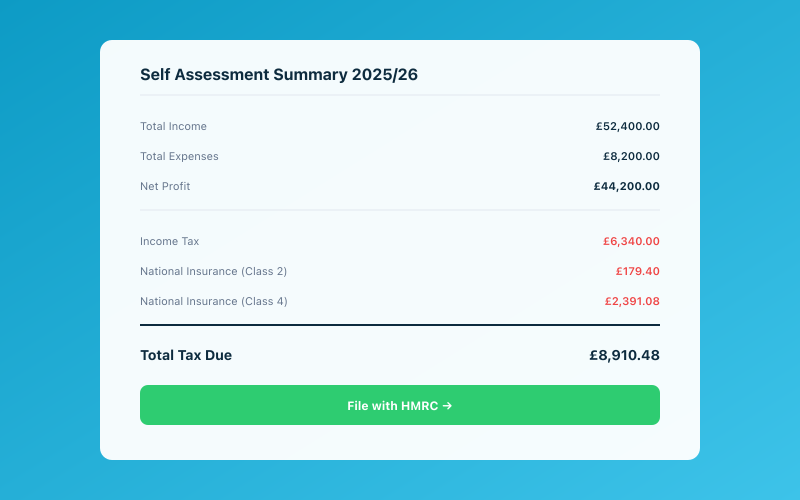 Your Accounted dashboard shows your real-time tax position
This means you pay once or twice a year rather than monthly, which can mean larger lump sums and a few surprises if you're not prepared. But it also means you have more control over the process — and understanding how it works can help you plan better.
Let's break down everything you need to know.
How Repayments Work for the Self-Employed
When you're employed, your employer calculates your student loan repayment each month based on your salary and deducts it through PAYE. It happens automatically.
When you're self-employed, there's no employer to do this. Instead:
- You file your Self Assessment tax return at the end of the tax year
- HMRC calculates your student loan repayment based on your profit
- The repayment is added to your Self Assessment bill
- You pay it by 31 January (and possibly 31 July as a payment on account)
The repayment is based on your self-employed profit for the tax year — that's your income minus your allowable business expenses. If your profit is below your plan's threshold, you don't make any repayment that year.
The Different Plans Explained
Which plan you're on depends on when and where you studied. Here's a breakdown of each one with the current thresholds for 2025/26.
Plan 1
Who's on it: Students who started their course before 1 September 2012 in England and Wales, or any time in Northern Ireland.
Threshold: £22,015 per year Rate: 9% of income above the threshold
Example: If your self-employed profit is £32,015, you'd repay 9% of £10,000 (the amount above £22,015) = £900 for the year.
Plan 1 loans generally have lower balances than Plan 2 because tuition fees were lower when these students studied. Many Plan 1 borrowers are close to paying off their loans or already have.
Plan 2
Who's on it: Students who started their course on or after 1 September 2012 in England and Wales.
Threshold: £27,295 per year Rate: 9% of income above the threshold
Example: If your self-employed profit is £37,295, you'd repay 9% of £10,000 = £900 for the year.
Plan 2 is the most common plan for people currently in their 20s and 30s. The loans are typically larger (tuition fees up to £9,250 per year), and the interest rate can be significant — up to RPI + 3% while studying, then variable based on your income.
Plan 2 loans are written off 30 years after the April following graduation. For many borrowers, the realistic question isn't "will I pay it off?" but "how much will I pay before it's written off?"
Plan 4 (Scotland)
Who's on it: Students who studied in Scotland (loans from the Student Awards Agency Scotland — SAAS).
Threshold: £27,660 per year Rate: 9% of income above the threshold
Example: If your self-employed profit is £37,660, you'd repay 9% of £10,000 = £900 for the year.
Plan 4 has a slightly higher threshold than Plan 2. Scottish student loans are generally smaller than English ones because tuition fees are lower (or free for Scottish students studying in Scotland).
Plan 5
Who's on it: Students who started their course on or after 1 August 2023 in England.
Threshold: £25,000 per year Rate: 9% of income above the threshold
Example: If your self-employed profit is £35,000, you'd repay 9% of £10,000 = £900 for the year.
Plan 5 was introduced with new repayment terms. The threshold is lower than Plan 2, but loans are written off after 40 years rather than 30. Interest is also capped at RPI only (no RPI + 3%).
Postgraduate Loan
Who's on it: Students who took out a postgraduate Master's or Doctoral loan.
Threshold: £21,000 per year Rate: 6% of income above the threshold
Example: If your self-employed profit is £31,000, you'd repay 6% of £10,000 = £600 for the year.
The postgraduate loan is separate from your undergraduate loan. If you have both, you repay both simultaneously. Yes, that means you could be paying 9% + 6% = 15% of your income above the respective thresholds. This can be a significant amount.
Multiple Plans — How They Stack
If you have loans on multiple plans (for example, Plan 2 for your undergraduate degree and a postgraduate loan), you make repayments on each one separately.
Example: Self-employed profit of £40,000
- Plan 2 repayment: 9% of (£40,000 - £27,295) = 9% of £12,705 = £1,143.45
- Postgraduate repayment: 6% of (£40,000 - £21,000) = 6% of £19,000 = £1,140.00
- Total student loan repayment: £2,283.45
That's on top of your Income Tax and National Insurance. It's a meaningful chunk of money, and it underlines why keeping accurate records of your business expenses matters — every legitimate expense you claim reduces your profit, which reduces your student loan repayment.
When Payments Are Due
As a self-employed person, your student loan repayment is included in your Self Assessment bill. The payment timeline is:
- 31 January — Payment of your Self Assessment bill for the previous tax year (including student loan repayments)
- 31 July — Second payment on account (if applicable)
Payments on account apply if your Self Assessment bill (including student loan) was over £1,000. HMRC essentially asks you to pay half of last year's bill in advance towards next year.
This means in January you might be paying:
- The balance from last year's tax return
- The first payment on account for the current year
And in July: 3. The second payment on account for the current year
These can add up to substantial amounts. Planning ahead and setting money aside throughout the year is essential.
What If Your Income Fluctuates?
Self-employed income is rarely consistent. The good news is that student loan repayments adjust automatically. If your profit drops below the threshold in a given year, you make no repayment. There's no minimum annual repayment and no penalty for low-income years.
This is actually an advantage of the Self Assessment system. With PAYE, a single high-earning month can trigger repayment even if annual income is below the threshold. With Self Assessment, it's based on annual profit, which smooths out fluctuations.
Overpayment and Refunds
Overpayment happens more often than you'd think, especially if you're both employed and self-employed. Here's how it can occur:
Employed and Self-Employed
If you have a job alongside your self-employment, your employer deducts student loan repayments from your salary through PAYE. HMRC then calculates an additional repayment based on your self-employment profit through Self Assessment.
The problem is that HMRC sometimes double-counts. Your PAYE repayments should be taken into account when calculating your Self Assessment bill, but errors happen. Always check that your Self Assessment return correctly shows PAYE student loan deductions already made.
When Your Loan Is Nearly Paid Off
If you're close to clearing your balance, you might overpay because the Student Loans Company (SLC) and HMRC don't communicate in real time. You could make a Self Assessment repayment in January for a loan that was actually cleared in November.
Getting a Refund
If you've overpaid, contact the Student Loans Company directly. They handle refunds, not HMRC. You'll need to provide evidence of the overpayment (your Self Assessment calculation showing the repayment amount).
Refunds can take several weeks to process, but the SLC will refund the overpayment in full.
Should You Pay Off Your Student Loan Early?
This depends on your plan. For most Plan 2 borrowers with average incomes, you're unlikely to repay the full balance before the 30-year write-off. In that case, voluntary overpayments are money you'll never see again.
For Plan 1 borrowers with smaller balances and higher incomes, paying it off can make sense — you save on interest and clear the debt sooner.
Consider whether the money might work harder invested elsewhere, especially if your loan interest rate is lower than potential returns. And remember: student loans don't affect your credit score, don't require minimum payments if your income drops, and are eventually written off. They're unique among debts.
Interaction with Employed Income
If you're employed and self-employed simultaneously, your employer deducts student loan repayments from your salary through PAYE automatically. When you file Self Assessment, HMRC looks at your total income (employment plus self-employment) and calculates the full repayment due. PAYE repayments already made are deducted, and any remaining amount is added to your Self Assessment bill.
Make sure your Self Assessment return accurately reflects employment income and PAYE student loan deductions already made. Getting this wrong leads to overpayment.
Practical Tips for Self-Employed Borrowers
1. Know Which Plan You're On
Check with the Student Loans Company if you're not sure. Your plan determines your threshold and repayment rate. The SLC website (gov.uk/sign-in-to-manage-your-student-loan-balance) shows your balance and plan type.
2. Budget for the Repayment
Your student loan repayment is part of your Self Assessment bill. When you're planning for your tax bill, include the student loan amount. A tool like Accounted can help track your profit throughout the year so there are no surprises.
3. Claim All Legitimate Expenses
Every business expense you claim reduces your profit, which reduces your student loan repayment. Make sure you're claiming everything you're entitled to — Penny in Accounted can help identify expenses you might miss and keep your receipt records organised.
4. Check Your Balance Annually
Log into the SLC website each year and check that your repayments are being correctly applied. Errors do happen, and catching them early is much easier than sorting them out years later.
5. Don't Ignore It
Student loan repayments are a legal obligation, collected by HMRC through Self Assessment. Not including them on your tax return doesn't make them go away — it creates a debt with HMRC.
A Quick Reference Table
| Plan | Threshold | Rate | Write-off | |------|-----------|------|-----------| | Plan 1 | £22,015 | 9% | 25 years after April following graduation | | Plan 2 | £27,295 | 9% | 30 years after April following graduation | | Plan 4 | £27,660 | 9% | 30 years after April following graduation (Scottish loans) | | Plan 5 | £25,000 | 9% | 40 years after April following graduation | | Postgraduate | £21,000 | 6% | 30 years after April following graduation |
The Bottom Line
Student loan repayments when self-employed aren't complicated once you understand the mechanics. The key points: you pay through Self Assessment rather than PAYE, repayments are based on annual profit, and the amount is 9% (or 6% for postgrad) of everything above your plan's threshold.
The most important practical step is keeping accurate records of your income and expenses throughout the year. This ensures your profit figure — and therefore your repayment — is correct. Tools like Accounted make this straightforward by tracking everything automatically through Penny.
And remember: your student loan is unique among debts. It adjusts to your income, doesn't affect your credit score, and eventually gets written off. It's worth understanding, but it's not worth losing sleep over.
Related Reading
Start your free trial and let Penny handle your bookkeeping automatically.
Accounted files your Self Assessment directly to HMRC, with your return pre-populated from your records. See Self Assessment filing →
Tax & Compliance Specialists
Our tax specialists have decades of combined experience in UK sole trader and small business taxation, MTD compliance, and HMRC submissions. All content is reviewed against current HMRC guidance before publication and updated quarterly to reflect legislative changes.
Ready to try Accounted?
Join UK sole traders who are simplifying their bookkeeping and tax.
Start your 14-day free trial