National Insurance When You're Employed and Self-Employed
Running a side business alongside your day job is increasingly common. Whether you're freelancing in the evenings, selling products online, or building a consultancy on weekends, having both employed and self-employed income raises some specific questions about National Insurance.
The short answer is: yes, you may end up paying NI on both sources of income. But the way the different classes interact can work in your favour if you understand the rules. Let's break it all down.
The Different Classes of National Insurance
When you have both employment and self-employment income, you could be liable for up to three classes of National Insurance simultaneously:
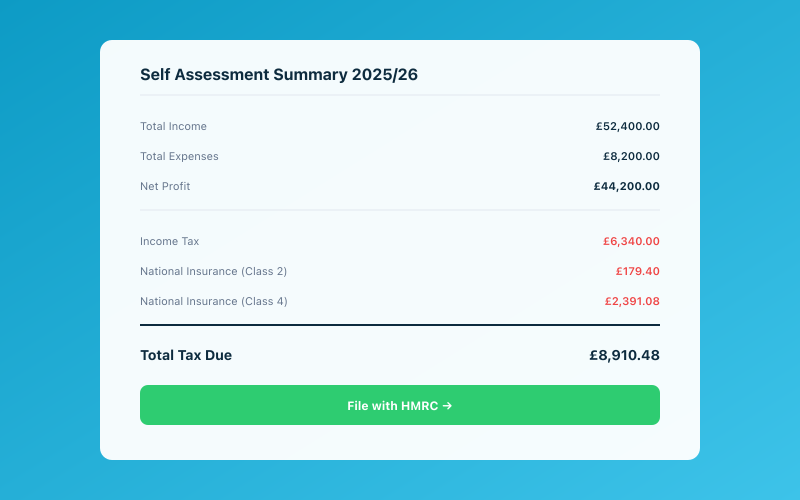 Your Accounted dashboard shows your real-time tax position
Class 1 — paid on your employment income. This is split between you (the employee) and your employer. In 2025/26, you pay 8% on earnings between £12,570 and £50,270, and 2% on earnings above £50,270. Your employer pays 13.8% on earnings above £5,000 (following the threshold reduction in Autumn 2024). Class 1 is deducted from your wages automatically through PAYE.
Class 2 — paid on your self-employment. This is the flat-rate contribution of £3.45 per week (£179.40 per year) that counts towards your state pension and benefits. It's collected through your Self Assessment tax return.
Class 4 — also paid on your self-employment profits. In 2025/26, you pay 6% on profits between £12,570 and £50,270, and 2% on profits above £50,270. Like Class 2, it's collected through Self Assessment.
If you're wondering how Class 2 and Class 4 work for self-employed people specifically, our guide to Class 2 and Class 4 NI explained covers the details.
How NI Works When You Have Both Income Types
Let's walk through a practical example.
Sarah works as a marketing manager earning £40,000 per year. She also runs a freelance copywriting business that brings in £15,000 profit.
Here's her NI position:
From employment (Class 1):
- 8% on earnings from £12,570 to £40,000 = £2,194.40
- This is deducted from her salary through PAYE
From self-employment (Class 2):
- £3.45 per week = £179.40 for the year
- Collected via Self Assessment
From self-employment (Class 4):
- 6% on profits from £12,570 to £15,000 = £145.80
- Collected via Self Assessment
Sarah's total NI: £2,519.60
Notice that the Class 4 threshold starts fresh at £12,570 — it doesn't stack on top of her employment earnings for Class 4 purposes. This is a common misconception. Your employment NI and self-employment NI are calculated separately, each with their own thresholds.
However, there is an important exception for high earners, which we'll cover in the next section.
The Annual Maximum and Deferment
There's a cap on the total amount of NI you pay in a year. This prevents people with high employment earnings from being hammered with additional Class 4 on their self-employment profits.
The rules work like this:
If your combined Class 1 and Class 4 contributions exceed the annual maximum, you can apply for a refund or defer your Class 4 payments in advance. The annual maximum is calculated based on the number of weeks you've been employed and self-employed during the year.
When deferment makes sense:
If you earn significantly above the Upper Earnings Limit (£50,270) in employment, you're already paying Class 1 at the 2% rate on everything above that. Adding Class 4 on top could push you over the annual maximum. In this case, you can apply to HMRC to defer your Class 4 contributions.
HMRC then works out the correct amount after the end of the tax year and either charges you the right amount or refunds any overpayment.
In practice, deferment is mainly relevant if your employment salary is above £50,270 AND you have substantial self-employment profits. If your combined income is more modest, the annual maximum won't bite, and you'll simply pay both classes in full.
To apply for deferment, you need to write to HMRC's National Insurance Contributions Office before the start of the tax year, or as soon as you know you'll have dual income.
Do You Get Double Pension Credit?
This is a question people often ask, and the answer is: not quite.
You only need one qualifying year per tax year for state pension purposes. Whether that comes from Class 1 (employment), Class 2 (self-employment), or both, you can't "double up" on qualifying years.
So if your employment already gives you a qualifying year (because you earn above the Lower Earnings Limit of £6,396), paying Class 2 on your self-employment doesn't add an extra qualifying year. You still only get one.
That said, paying Class 2 isn't entirely wasted in this scenario. It maintains your entitlement to certain contributory benefits and provides a safety net if your employment income drops in future years. At £3.45 a week, it's cheap insurance.
For more on how your NI record feeds into your pension entitlement, see our article on how National Insurance affects your state pension forecast.
Tax Returns When You Have Both Income Streams
When you're employed and self-employed, you need to file a Self Assessment tax return even though your employment taxes are handled through PAYE. Your tax return brings everything together:
- Your employment income (shown on your P60)
- Your self-employment profits (from your bookkeeping records)
- Class 2 NI
- Class 4 NI
- Any adjustment needed for PAYE tax already paid
The Self Assessment calculation works out your total tax and NI liability, subtracts what you've already paid through PAYE, and gives you the remaining amount to pay — typically by 31 January following the end of the tax year.
If your Self Assessment bill is over £1,000, you'll also need to make payments on account — advance payments towards next year's bill — on 31 January and 31 July.
Keeping your self-employment bookkeeping separate from your employment income is essential. You need clear, accurate records of your business income and expenses to calculate your trading profit correctly. This is where Accounted comes in — it gives you a clean, simple way to track your self-employed income and expenses so that when tax return time arrives, your numbers are ready.
Common Scenarios and What to Watch Out For
You start a side business mid-year
If you become self-employed partway through the tax year, your Class 2 and Class 4 liabilities are pro-rated. You'll only pay Class 2 for the weeks you were actually self-employed, and your Class 4 is based on the profits from the self-employment period.
Your side hustle makes a loss
If your self-employment makes a loss, there's no Class 4 to pay (since Class 4 is based on profits). You can still choose to pay Class 2 voluntarily, which maintains your benefits eligibility and provides a pension safety net. And you can carry the loss forward to offset against future self-employment profits.
Your employment is part-time with low earnings
If your employment income is below the Lower Earnings Limit (£6,396 in 2025/26), your employment won't generate a qualifying year for pension purposes. In this case, Class 2 from your self-employment becomes particularly valuable — it may be your only route to a qualifying year.
You have multiple employments plus self-employment
With multiple jobs, each employer deducts Class 1 NI independently based on their payroll. This can lead to overpayment if your combined earnings cross the Upper Earnings Limit. At the end of the year, HMRC should refund any excess — but it's worth checking. Add self-employment NI on top, and the annual maximum rules become even more relevant.
Practical Tips for Managing Dual-Income NI
-
Keep your records separate. Don't mix personal, employment, and self-employment finances. A dedicated business bank account and proper bookkeeping make everything cleaner.
-
Know your thresholds. The key numbers for 2025/26 are: £12,570 (Primary Threshold for Class 1, Lower Profits Limit for Class 4), £50,270 (Upper Earnings Limit / Upper Profits Limit), and £6,845 (Small Profits Threshold for Class 2).
-
File your tax return on time. You have until 31 January following the end of the tax year (so 31 January 2027 for the 2025/26 tax year). But filing early gives you more time to plan and pay.
-
Consider deferment if you're a high earner. If your employment salary is above £50,270, talk to an accountant about deferring Class 4.
-
Track your profits in real time. Knowing your self-employment profit position throughout the year means no nasty surprises on your tax return. Accounted updates your profit figure as you go, and Penny can help you understand how your NI is shaping up.
If you're juggling employment and self-employment, our broader guide to tax when you're employed and self-employed covers income tax, NI, and everything else you need to know.
The Bottom Line
Having both employment and self-employment income doesn't mean you pay double NI — but it does mean you need to understand how the different classes interact. In most cases, you'll pay Class 1 on your employment earnings and Class 2 plus Class 4 on your self-employment profits, with protections in place to prevent you from paying over the annual maximum.
The key is keeping accurate records of both income streams and filing your Self Assessment return correctly.
Accounted helps UK sole traders stay on top of their bookkeeping and tax. Start your free 30-day trial at getaccounted.co.uk.
Related Reading
- Tax When You're Employed and Self-Employed
- What Is Class 2 and Class 4 NI?
- National Insurance for Sole Traders
- The Tax Benefits of Working from a Garden Office
- Trust Taxation Basics — When Trusts Pay Tax
Penny, your AI bookkeeper, tracks your tax position in real time and flags opportunities to reduce your bill. Meet Penny →
Tax & Compliance Specialists
Our tax specialists have decades of combined experience in UK sole trader and small business taxation, MTD compliance, and HMRC submissions. All content is reviewed against current HMRC guidance before publication and updated quarterly to reflect legislative changes.
Ready to try Accounted?
Join UK sole traders who are simplifying their bookkeeping and tax.
Start your 14-day free trial