Trust Taxation Basics — When Trusts Pay Tax
Trusts are one of those areas of UK tax that can seem impenetrably complex. They involve their own set of tax rules, their own tax rates, and their own reporting requirements. But at their core, trusts are simply a way of holding assets for the benefit of others — and understanding the basics of how they are taxed is essential if you are a trustee, a beneficiary, or someone considering setting up a trust.
In this guide, we will walk through the fundamentals of trust taxation in the UK, covering income tax, Capital Gains Tax, and Inheritance Tax. We will keep things practical and focus on what you actually need to know.
What Is a Trust?
A trust is a legal arrangement where one person (the settlor) transfers assets to another person or group of people (the trustees) to hold and manage for the benefit of someone else (the beneficiaries). The trustees are the legal owners of the assets, but they must manage them according to the terms of the trust for the benefit of the beneficiaries.
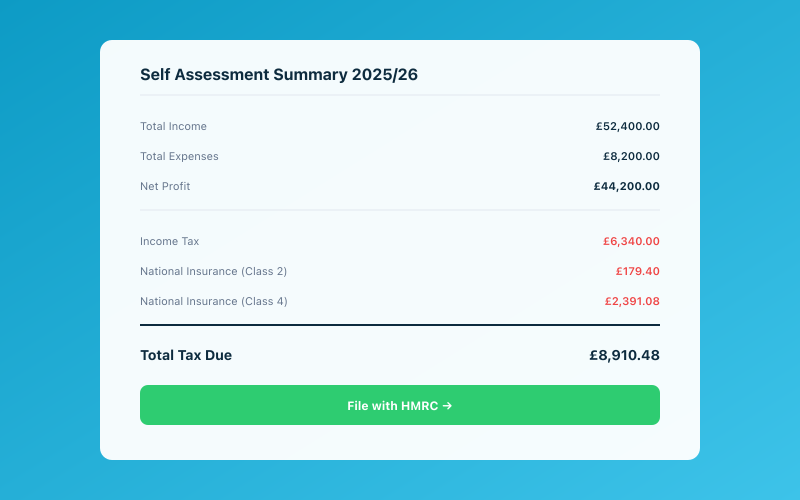 Your Accounted dashboard shows your real-time tax position
Trusts are used for many purposes: protecting assets for children, managing wealth for vulnerable individuals, estate planning, charitable giving, and business succession. The tax treatment depends largely on the type of trust involved.
Types of Trust
There are several types of trust, each with different tax implications:
Bare Trusts
In a bare trust, the beneficiary has an absolute right to the capital and income. The trustee holds the assets on behalf of the beneficiary but has no discretion over how they are distributed. Bare trusts are often used for children — for example, a grandparent holding investments for a grandchild until they reach 18.
For tax purposes, income and gains from a bare trust are treated as belonging to the beneficiary directly. They are taxed at the beneficiary's own rates, not at trust rates.
Interest in Possession Trusts (Life Interest Trusts)
An interest in possession trust gives one beneficiary (the life tenant) the right to receive the income from the trust during their lifetime. When the life tenant dies, the capital passes to other beneficiaries (the remaindermen).
Income is taxed at the basic rate (20% for non-dividend income, 8.75% for dividend income) in the trust, with the life tenant receiving a tax credit for tax already paid. If the life tenant is a higher rate taxpayer, they will have additional tax to pay.
Discretionary Trusts
In a discretionary trust, the trustees have full discretion over how income and capital are distributed among the beneficiaries. No beneficiary has an automatic right to anything — the trustees decide who gets what and when.
Discretionary trusts face the highest tax rates, which we will discuss below.
Accumulation Trusts
Accumulation trusts allow trustees to accumulate income within the trust rather than distributing it. They are taxed similarly to discretionary trusts.
Income Tax on Trusts
The income tax treatment depends on the type of trust.
Bare Trusts
Income is taxed as the beneficiary's own income. If the beneficiary is a child and the trust was set up by a parent, special rules apply — the parental settlement rules mean that income exceeding £100 is taxed on the parent rather than the child.
Interest in Possession Trusts
The trustees pay tax at:
- 20% on interest, rental income, and other non-dividend income
- 8.75% on dividend income
The life tenant includes the trust income in their own tax return and receives credit for the tax already paid by the trustees.
Discretionary and Accumulation Trusts
These trusts pay the highest rates:
- 45% on interest, rental income, and other non-dividend income
- 39.35% on dividend income
There is a standard rate band — currently £1,000 (divided by the number of trusts created by the same settlor, with a minimum of £200) — within which income is taxed at the basic rate (20% or 8.75% for dividends) rather than the trust rate.
When income is distributed to a beneficiary, they receive a 45% tax credit. If the beneficiary is a basic rate taxpayer, they can reclaim the excess tax. If they are a higher rate or additional rate taxpayer, there may be further tax to pay or a refund to claim, depending on their circumstances.
Capital Gains Tax on Trusts
Trusts are subject to CGT when they dispose of chargeable assets. The rates for 2025/26 are:
- 24% for residential property gains
- 20% for other chargeable gains (the higher rate applies because trusts are treated as if they are higher rate taxpayers)
Trusts have their own CGT annual exempt amount, which is half the individual amount — so £1,500 for 2025/26 (half of the £3,000 individual exemption). This is further divided if the settlor has created multiple trusts, with a minimum of £300 per trust.
For more on the CGT annual exempt amount and how it works, see our CGT annual exempt amount guide for 2025/26.
Holdover Relief
When assets are transferred into a discretionary trust, holdover relief under section 260 TCGA 1992 is usually available. This defers the CGT until the trustees dispose of the asset, effectively passing the gain to the trust. Similarly, when trustees distribute assets to beneficiaries, holdover relief may be available.
This is a powerful planning tool, but it requires a formal election and both parties must agree.
Inheritance Tax on Trusts
IHT is where trust taxation gets particularly complex. The rules depend on when the trust was created and what type of trust it is.
Relevant Property Trusts (Including Discretionary Trusts)
Most discretionary trusts and post-March 2006 interest in possession trusts are "relevant property trusts" for IHT purposes. They are subject to three IHT charges:
-
Entry charge — When assets are transferred into the trust, there may be an IHT charge if the value exceeds the nil-rate band (currently £325,000). The rate is 20% on the excess (half the 40% death rate, because this is a lifetime transfer).
-
Ten-year anniversary charge — Every ten years, the trust is subject to an IHT charge on the value of the trust fund. The maximum rate is 6% (calculated as 30% of the lifetime rate of 20%), but the actual rate depends on the value of the fund, the nil-rate band, and other factors.
-
Exit charge — When capital leaves the trust (distributed to beneficiaries), an IHT charge applies, calculated by reference to the last ten-year anniversary charge, proportioned for the time since the last anniversary.
Pre-March 2006 Interest in Possession Trusts
Trusts created before 22 March 2006 with a qualifying interest in possession are treated differently. The trust fund is treated as part of the life tenant's estate for IHT purposes. When the life tenant dies, the trust fund is added to their estate and taxed accordingly.
For guidance on how IHT interacts with business assets, see our guide on inheritance tax and business property relief.
Reporting Requirements
Trustees have their own tax reporting obligations:
- Self Assessment — Trustees must register with HMRC and file a trust tax return (SA900) each year if the trust has income or gains above certain thresholds.
- Trust Registration Service (TRS) — Most UK trusts (and some non-UK trusts with UK connections) must register on the Trust Registration Service, even if they have no tax liability.
- IHT reporting — Ten-year anniversary and exit charges must be reported to HMRC, even if no tax is due (because the values are within the nil-rate band).
Failure to register or file can result in penalties, so trustees need to stay on top of their obligations.
Practical Tips for Trustees
Running a trust involves real responsibilities. Here are some practical points:
- Keep clear records of all income, expenses, gains, and distributions. This is not optional — it is a legal obligation.
- Understand the trust deed — The deed determines what you can and cannot do as a trustee. If you are unsure, seek legal advice.
- Consider the beneficiaries' tax positions — When deciding whether to distribute income, consider the tax implications for the beneficiaries. Distributing income to a basic rate taxpayer is usually more tax-efficient than accumulating it in a discretionary trust at 45%.
- Do not ignore the ten-year charge — It creeps up on trustees regularly. Mark the anniversary date in your diary and start preparing well in advance.
- Get professional help — Trust taxation is genuinely complex. The interaction between income tax, CGT, and IHT can create unexpected consequences. Professional advice is almost always worthwhile.
Keeping the financial records straight is a crucial part of trusteeship. While Accounted is designed primarily for sole traders, the discipline of good bookkeeping applies equally to trustees managing trust finances.
Common Misconceptions
- "Trusts avoid tax" — Trusts do not avoid tax. In many cases, they are taxed more heavily than individuals. They are used for control, protection, and succession — not primarily for tax reduction.
- "Putting assets in a trust removes them from my estate" — Not necessarily. Depending on the type of trust and your involvement, the assets may still be included in your estate for IHT purposes.
- "Trusts are only for the wealthy" — While the costs of setting up and administering a trust mean they are more common among higher-net-worth individuals, trusts are used across all income levels for purposes like protecting assets for vulnerable beneficiaries.
Related Reading
Keep Your Records in Order
Whether you are a trustee, a beneficiary, or a settlor, understanding trust taxation is essential for making informed decisions. Good record-keeping is the foundation.
Start your free trial and let Penny handle your bookkeeping automatically.
Accounted helps UK sole traders stay on top of their bookkeeping and tax. Start your free 30-day trial at getaccounted.co.uk.
Penny, your AI bookkeeper, tracks your tax position in real time and flags opportunities to reduce your bill. Meet Penny →
Tax & Compliance Specialists
Our tax specialists have decades of combined experience in UK sole trader and small business taxation, MTD compliance, and HMRC submissions. All content is reviewed against current HMRC guidance before publication and updated quarterly to reflect legislative changes.
Ready to try Accounted?
Join UK sole traders who are simplifying their bookkeeping and tax.
Start your 14-day free trial