CGT Annual Exempt Amount — The 2025/26 Guide
Capital Gains Tax is one of those taxes that many people do not think about until they sell something valuable — a property, shares, a business, or other assets. When they do, the annual exempt amount can make a real difference to the tax bill. But at just £3,000 for 2025/26, it offers far less protection than it used to.
In this guide, we will cover everything you need to know about the CGT annual exempt amount for the current tax year, including the rates that apply, how to use the exemption effectively, and strategies for managing your CGT liability.
What Is the CGT Annual Exempt Amount?
The CGT annual exempt amount (sometimes called the annual exemption or AEA) is the amount of capital gains you can make each tax year before you start paying Capital Gains Tax. For 2025/26, this amount is £3,000.
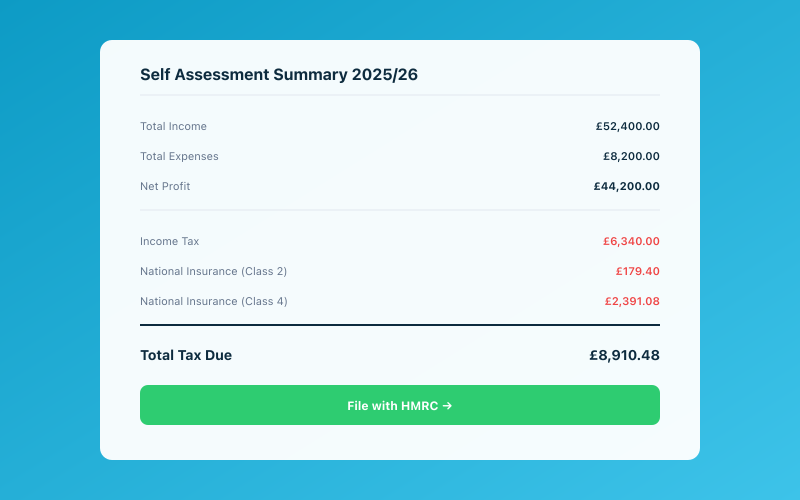 Your Accounted dashboard shows your real-time tax position
Any gains below this threshold are tax-free. Gains above it are taxed at the applicable CGT rate.
To put this in context, the annual exempt amount was £12,300 as recently as 2022/23. It was reduced to £6,000 for 2023/24 and then halved again to £3,000 for 2024/25, where it has remained for 2025/26. That is a 76% reduction in just three years — a significant change that has brought many more people into the CGT net.
Current CGT Rates for 2025/26
The rates depend on the type of asset and your overall income:
Residential Property
- 18% for basic rate taxpayers
- 24% for higher and additional rate taxpayers
These rates apply to gains on residential property that is not your main home (your principal private residence is exempt from CGT).
Other Assets (Shares, Business Assets, etc.)
- 18% for basic rate taxpayers
- 24% for higher and additional rate taxpayers
Note that from 30 October 2024, the rates for non-residential assets were increased to align with the residential property rates. Previously, non-residential assets attracted lower rates of 10% and 20%.
Business Asset Disposal Relief (BADR)
Qualifying gains under BADR are taxed at 10% on the first £1 million of lifetime qualifying gains. This is a significant benefit for those selling a qualifying business or business assets.
For more on BADR, see our guide on selling a business and asset disposal relief.
How the Annual Exempt Amount Works in Practice
The annual exempt amount applies to your total net gains for the year. Here is how it works:
- Calculate your gains and losses — Add up all chargeable gains from disposals during the tax year and deduct any allowable losses from the same year.
- Deduct the annual exempt amount — Subtract £3,000 from your net gains. If your net gains are below £3,000, there is no CGT to pay.
- Apply the appropriate tax rate — The remaining gains are taxed at your applicable rate.
Example
You sell shares during 2025/26, making a gain of £15,000. You also sell another investment at a loss of £2,000.
- Net gains: £15,000 - £2,000 = £13,000
- Less annual exempt amount: £13,000 - £3,000 = £10,000 taxable
- If you are a higher rate taxpayer: £10,000 × 24% = £2,400 CGT
Without the annual exempt amount, the tax would be £3,120 (£13,000 × 24%). The exemption saves you £720. Useful, but modest compared to the £2,952 it would have saved at the old £12,300 level.
Who Gets the Annual Exempt Amount?
Most individuals who are UK resident are entitled to the annual exempt amount. This includes:
- UK residents (full or split year)
- Personal representatives of deceased persons (for the tax year of death and the following two years)
- Trustees of certain trusts (at half the individual rate — £1,500 for 2025/26, potentially divided between multiple trusts from the same settlor)
Non-UK residents do not generally receive the annual exempt amount, except in limited circumstances (such as disposals of UK residential property).
Strategies for Making the Most of the Exemption
With the annual exempt amount at just £3,000, planning is more important than ever. Here are some practical strategies:
1. Use Both Spouses' Exemptions
If you are married or in a civil partnership, transfers between spouses are exempt from CGT. This means you can transfer assets to your spouse before selling, allowing both of you to use your £3,000 annual exempt amount — a combined £6,000 of tax-free gains.
Be aware that the rules were tightened from April 2023. Transfers between spouses for CGT purposes must now generally be completed within three years of separation (previously, it was only until the end of the tax year of separation).
2. Spread Disposals Across Tax Years
If you are planning to sell a large asset, consider whether it can be split across two tax years. For example, if you hold a portfolio of shares, you could sell some before 5 April and the remainder after, using two years' worth of annual exempt amounts.
This does not work for a single indivisible asset (like a property), but it can be effective for portfolios of shares or multiple assets.
3. Harvest Losses
If you have investments that are showing a loss, consider selling them to crystallise the loss. Capital losses can be set against gains in the same year (reducing the amount that uses up your annual exempt amount) or carried forward indefinitely to offset future gains.
However, be cautious of the "bed and breakfasting" rules. If you sell shares and buy them back within 30 days, the loss is not recognised for CGT purposes. You need to wait at least 30 days or buy back a similar (but not identical) investment.
4. Use Tax-Free Wrappers
Gains within ISAs and pensions are completely free of CGT. Maximising your ISA contributions (£20,000 per year for 2025/26) and pension contributions shelters future growth from CGT entirely.
If you hold investments outside an ISA that are likely to grow, consider selling them (using your annual exempt amount) and reinvesting within an ISA. This is sometimes called "Bed and ISA."
5. Claim All Available Reliefs
Several reliefs can reduce or defer CGT:
- Principal Private Residence Relief — Your main home is exempt from CGT.
- Business Asset Disposal Relief — 10% rate on qualifying business disposals (up to £1 million lifetime).
- Investors' Relief — 10% rate on qualifying shares in unlisted trading companies (up to £10 million lifetime).
- Holdover Relief — Available for gifts of business assets and certain trust transfers.
- Rollover Relief — Defer CGT when replacing qualifying business assets.
- EIS Deferral Relief — Defer CGT by investing in qualifying Enterprise Investment Scheme shares.
For broader tax-saving strategies, read our guide on how to pay less tax legally in the UK.
Reporting and Payment
You must report and pay CGT on UK residential property disposals within 60 days of completion, using the HMRC "report and pay Capital Gains Tax on UK property" service. For other assets, gains are reported through your Self Assessment tax return.
If you are not already registered for Self Assessment and you have a CGT liability, you will need to register. The deadline for filing and paying is 31 January following the end of the tax year (so 31 January 2027 for 2025/26 disposals of non-property assets).
Keeping accurate records of your acquisition costs, disposal proceeds, and any improvement expenditure is essential. Without these records, you may end up overpaying CGT because you cannot demonstrate your base cost. Accounted helps you keep your financial records organised, and Penny can flag transactions that might have CGT implications.
The Shrinking Exemption in Context
The reduction of the annual exempt amount from £12,300 to £3,000 is part of a broader trend of fiscal tightening through frozen or reduced allowances. Combined with the increase in CGT rates for non-residential assets, more people are paying more CGT than ever before.
This makes planning essential. Even small steps — like using both spouses' exemptions, timing disposals, and maximising tax-free wrappers — can save meaningful amounts of tax.
| Tax Year | Annual Exempt Amount | |---|---| | 2022/23 | £12,300 | | 2023/24 | £6,000 | | 2024/25 | £3,000 | | 2025/26 | £3,000 |
The trend is clear. Planning ahead is no longer optional — it is necessary.
Related Reading
Track Your Gains and Losses
Good record-keeping is the foundation of effective CGT planning. Make sure you are tracking acquisition costs, disposal proceeds, and any allowable expenses throughout the year.
Start your free trial and let Penny handle your bookkeeping automatically.
Accounted helps UK sole traders stay on top of their bookkeeping and tax. Start your free 30-day trial at getaccounted.co.uk.
Penny, your AI bookkeeper, tracks your tax position in real time and flags opportunities to reduce your bill. Meet Penny →
Tax & Compliance Specialists
Our tax specialists have decades of combined experience in UK sole trader and small business taxation, MTD compliance, and HMRC submissions. All content is reviewed against current HMRC guidance before publication and updated quarterly to reflect legislative changes.
Ready to try Accounted?
Join UK sole traders who are simplifying their bookkeeping and tax.
Start your 14-day free trial