Tax-Efficient Childcare Options for Self-Employed Parents
Childcare is one of the biggest expenses facing working parents in the UK. The average cost of a full-time nursery place for a child under two is now well over £1,000 per month in many parts of the country — and that's before you add breakfast clubs, after-school care, and holiday clubs for older children. For self-employed parents, who don't have the safety net of employer-sponsored childcare schemes, finding tax-efficient ways to manage these costs is essential.
The good news is that self-employed parents have access to several government schemes that can significantly reduce the burden. The less good news is that the rules can be confusing, and not all schemes are well-publicised. Let's go through your options.
Tax-Free Childcare
Tax-Free Childcare (TFC) is the headline scheme for self-employed parents, and it's the one most people should consider first. Here's how it works:
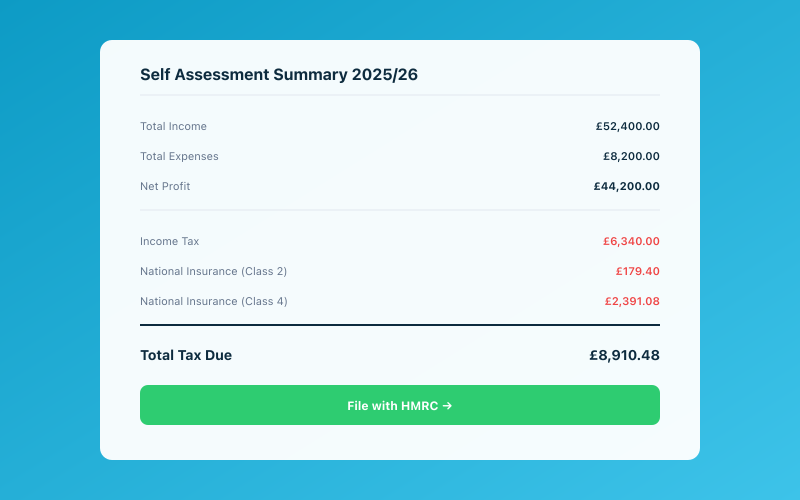 Your Accounted dashboard shows your real-time tax position
The government tops up your childcare payments by 25%. For every £8 you pay into your Tax-Free Childcare account, the government adds £2. The maximum government contribution is £2,000 per child per year (or £4,000 for a disabled child). That means for every £8,000 you spend on childcare, you effectively pay £8,000 and the government pays £2,000 — bringing your actual cost down to £8,000 for what would otherwise cost £10,000.
To use the scheme, you open a Tax-Free Childcare account through the Childcare Choices website. You pay money in, the government tops it up, and you use the account to pay your childcare provider directly. The provider must be registered with Ofsted (or the equivalent in Scotland, Wales, or Northern Ireland).
Eligibility for self-employed parents:
- You (and your partner, if you have one) must each expect to earn at least the equivalent of 16 hours per week at the National Minimum Wage over the coming quarter. For 2025/26, that's approximately £2,379 per quarter or £9,516 per year.
- Neither parent can earn more than £100,000 per year.
- You must be in the UK and not receiving Universal Credit, tax credits, or childcare vouchers from an employer.
The minimum earnings requirement catches some self-employed parents off guard, particularly in the early stages of a business or during a quiet period. If your self-employed income dips below the threshold, you'll lose eligibility — though there's a grace period if your income drops temporarily.
If you're newly self-employed, you're given a "start-up period" of up to 12 months during which the minimum income requirement doesn't apply. This is specifically designed to help parents who are starting a business.
Free Childcare Hours
The UK government offers funded childcare hours that are available to self-employed parents on the same basis as employed parents:
15 hours free for all 3-4 year olds. Every child in England is entitled to 15 hours of free early education per week from the term after they turn three until they start school. This is universal — there's no income test, and it applies regardless of whether you're employed, self-employed, or not working.
30 hours free for working parents of 3-4 year olds. If you're working (including self-employed) and meet the income criteria, your 3-4 year old is entitled to 30 hours of free childcare per week during term time. The income criteria are the same as for Tax-Free Childcare: you must earn at least the equivalent of 16 hours at the National Minimum Wage, and neither parent can earn more than £100,000.
15 hours free for 2 year olds. This was expanded significantly in recent years. Working parents (including self-employed) who meet the income criteria can now access 15 hours of funded childcare from when their child turns two.
15 hours free from 9 months. The government has been rolling out funded childcare for children aged 9 months and over for working parents. Check the current availability, as the full rollout has been implemented in phases.
These funded hours can save you thousands of pounds per year. A 30-hour place for a 3-year-old, valued at approximately £7,000-£9,000 per year depending on your area, is essentially free childcare. Even the 15-hour universal entitlement is worth £3,500-£4,500 annually.
You can use funded hours alongside Tax-Free Childcare for any additional hours you need, maximising your savings across both schemes.
Can You Claim Childcare as a Business Expense?
This is one of the most frequently asked questions from self-employed parents, and unfortunately, the answer is generally no. HMRC does not allow childcare costs to be deducted as a business expense, because childcare is considered a personal, domestic expense — even if you need childcare specifically to be able to work.
The logic (such as it is) goes like this: everyone with children needs childcare, whether they're employed, self-employed, or doing something else. The cost of looking after your children is a personal cost, not a cost incurred "wholly and exclusively" for the purposes of your trade.
This can feel deeply unfair, especially when you're paying for childcare specifically so you can run your business. But the tax rules are clear on this point, and claiming childcare as a business expense would likely be challenged by HMRC.
There are, however, some narrow exceptions:
If you employ a nanny or childminder as a business employee — for instance, if you run a childcare business yourself — the cost is a business expense. But this doesn't apply to employing someone to look after your own children while you work.
If childcare is provided as part of a business event — such as a crèche at a conference you're running — the cost may be claimable as a business expense, as it's part of delivering the event.
For most self-employed parents, the government schemes (Tax-Free Childcare and funded hours) are the main ways to reduce childcare costs, rather than tax deductions through your business. For a full overview of what you can and can't claim as a business expense, our complete list of sole trader expenses is a useful reference.
Childcare Vouchers — Are They Still Available?
The old Childcare Voucher scheme closed to new entrants in October 2018 and was replaced by Tax-Free Childcare. However, if you were already enrolled in an employer's childcare voucher scheme before that date and haven't left it, you can continue to use it.
Since childcare vouchers are an employer scheme, they're not directly available to self-employed parents. If you're both employed and self-employed (for instance, you have a part-time job alongside your business), you might still be able to use vouchers through your employer — but you'd need to choose between vouchers and Tax-Free Childcare, as you can't use both.
For most self-employed parents in 2026, Tax-Free Childcare is the relevant scheme.
Employing Your Partner or Family Members
Some self-employed parents consider employing their partner or a family member in the business, partly to make use of their tax-free personal allowance and partly to manage childcare arrangements informally. While employing family members is perfectly legal (and we have no issue with it as a concept), HMRC will scrutinise the arrangement to ensure it's genuine.
The work done must be real, the pay must be reasonable for the work performed, and you must operate proper PAYE if the earnings exceed the relevant thresholds. You can't simply pay your partner a salary for "looking after the children while you work" — that's not a business expense.
However, if your partner genuinely does work for your business — answering emails, managing social media, doing admin, handling bookkeeping — a reasonable salary for that work is deductible. The fact that your partner also happens to look after the children around this work is a domestic arrangement, not a business expense.
Using Accounted makes it easy to keep your business finances transparent and well-documented, which is important if HMRC ever questions any employment arrangements. Penny keeps track of all your income and expenses, so you've always got a clear picture of what's going through your business.
Universal Credit and Childcare Costs
If you're receiving Universal Credit, you can claim back up to 85% of your childcare costs through your UC payment. The maximum amounts are £1,014.63 per month for one child and £1,739.37 per month for two or more children.
This is a significant benefit, but it comes with a catch: you need to pay the childcare costs upfront and then claim them back through UC. For self-employed parents with irregular income, this cash-flow challenge can be difficult. You also can't use Tax-Free Childcare at the same time as claiming childcare costs through UC — you need to choose one or the other.
Generally, Tax-Free Childcare is more beneficial if your childcare costs are high and your income is above the UC threshold. UC childcare support is more beneficial if you're on a low income and are already receiving UC. It's worth running the numbers for your specific situation.
Practical Tips for Managing Childcare Costs
Beyond the formal schemes, there are practical strategies self-employed parents use to manage childcare costs:
Flexible working hours. One of the advantages of self-employment is choosing when you work. Some parents work early mornings, evenings, and nap times to reduce the number of childcare hours they need. This isn't sustainable long-term for intensive work, but it can bridge gaps.
Childcare swaps. Informal arrangements with other parents — where you look after their children one day and they look after yours another — can reduce costs without any tax implications, as no money changes hands.
Working from home during school hours. If your children are school-age, you may only need wraparound care (breakfast and after-school clubs) rather than full-day childcare, which is significantly cheaper.
Combining funded hours with paid hours strategically. Use your funded hours on the days you work the most, and save money by not using paid childcare on your lighter days.
Grandparent and family help. Many self-employed parents rely on family for some childcare. If grandparents provide regular childcare, they may be able to claim National Insurance credits through the Specified Adult Childcare Credit scheme, which helps protect their State Pension entitlement. For more on NI credits and their impact, see our guide on National Insurance for sole traders.
Planning Ahead
Childcare costs are one of the biggest financial pressures on self-employed parents, but they're also temporary. Children grow up, start school, and eventually become more independent. The intense childcare years — roughly from birth to the end of primary school — are a defined period, and planning for them can make the financial impact much more manageable.
Build childcare costs into your business planning from the start. If you know you'll need to spend £800 per month on nursery fees, factor that into your pricing, your savings targets, and your tax planning. Understanding how Tax-Free Childcare and funded hours reduce that cost helps you see the true picture.
And don't forget: keeping good financial records throughout makes everything easier. When you're applying for Tax-Free Childcare, proving your income to qualify for funded hours, or simply working out whether you can afford an extra day of nursery, having your numbers at your fingertips is invaluable. It's exactly the kind of thing Penny is designed to help with — clear, up-to-date financial information whenever you need it.
Accounted helps UK sole traders stay on top of their bookkeeping and tax. Start your free 30-day trial at getaccounted.co.uk
Related reading:
- Sole Trader Expenses — The Complete List
- National Insurance for Sole Traders
- Your First Year of Self-Employment — A Complete Guide
Related Reading
- NFTs and Digital Art — The Tax Position in 2026
- National Insurance Changes in 2026 — What's Different
Start your free trial and let Penny handle your bookkeeping automatically.
Penny, your AI bookkeeper, tracks your tax position in real time and flags opportunities to reduce your bill. Meet Penny →
Tax & Compliance Specialists
Our tax specialists have decades of combined experience in UK sole trader and small business taxation, MTD compliance, and HMRC submissions. All content is reviewed against current HMRC guidance before publication and updated quarterly to reflect legislative changes.
Ready to try Accounted?
Join UK sole traders who are simplifying their bookkeeping and tax.
Start your 14-day free trial