Tax Implications of Bartering and Contra Deals
Bartering — swapping goods or services without money changing hands — is one of the oldest forms of commerce. And in the world of small businesses and sole traders, it's alive and well. A web designer builds a site for a photographer in exchange for headshots. A plumber fixes a leaky pipe for a decorator in return for having a room painted. A consultant provides strategy advice to a café owner and gets free lunches for a month.
It all feels very informal, and because no money actually changes hands, many people assume there are no tax implications. That assumption is wrong. HMRC is very clear on this: if you receive goods or services in exchange for your own goods or services, the value of what you receive is taxable income.
Let's look at how this works in practice, what you need to report, and how to keep your records straight.
Why Bartering Is Taxable
The principle is simple. If you're in business and you provide your goods or services to someone, you've generated income. The fact that you were paid in kind rather than in cash doesn't change the fundamental nature of the transaction.
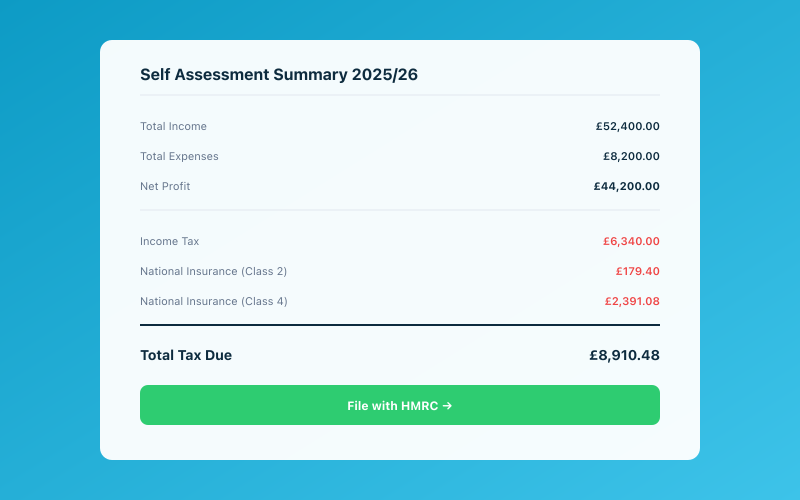 Your Accounted dashboard shows your real-time tax position
Under UK tax law, trading income includes the value of all benefits received in connection with your trade. That includes cash, cheques, bank transfers, and — yes — goods and services received through barter arrangements.
HMRC's Business Income Manual is explicit about this. If a builder constructs an extension for an accountant in return for the accountant doing the builder's tax return, both have received something of value. Both need to include that value in their trading income.
The same applies to "contra deals," which is essentially the business term for bartering. Two businesses agree to provide services to each other at an agreed value, with no money changing hands. Both businesses should record the transaction as both income and an expense.
How to Value a Barter Transaction
The key question is: what value do you put on the exchange? In most cases, you should use the market value of the goods or services you received. That means the price you'd normally pay if you bought them on the open market.
If both parties are providing services that have a clear market rate, this is straightforward. If you normally charge £500 for web design and you receive photography services that the photographer normally charges £500 for, both sides record £500 of income and £500 of expense.
Things get murkier when the values are unequal or when there's no obvious market rate. In those cases, HMRC expects you to use a reasonable estimate. If you and your barter partner have agreed a value in advance, that's usually acceptable — provided it reflects genuine market rates and isn't artificially deflated to reduce the tax bill.
If you receive something that's clearly worth more than what you provided, the income you record should reflect the value of what you received, not the value of what you gave. HMRC looks at the benefit to the recipient.
Recording Barter Transactions in Your Books
This is where things can feel a bit odd, because you're recording a transaction that doesn't involve any cash. But the bookkeeping is actually quite logical:
-
Record the income. Treat the barter as if the other party paid you in cash for your goods or services. If you'd normally charge £300 for what you provided, record £300 of income.
-
Record the expense. Treat the goods or services you received as if you'd bought them. If they'd normally cost £300, record a £300 expense (assuming it's a legitimate business expense).
-
The two entries offset each other. Your profit doesn't change, because the income and the expense are the same amount. But both need to appear in your records.
Why bother, if they cancel each other out? Because HMRC expects to see the full picture of your trading activity. Failing to record barter income is technically under-reporting your income, even if it wouldn't change your profit figure. And if the expense side isn't a legitimate business expense (say you bartered for something personal), you'd have income without a corresponding deduction — meaning you do owe tax.
Using Accounted, you can record these as manual transactions with notes explaining the barter arrangement. Penny will pick them up and include them in your income and expense totals, keeping everything accurate and transparent for HMRC.
What About VAT on Barter Deals?
If you're VAT-registered, barter transactions add another layer of complexity. Each side of the barter is treated as a separate supply for VAT purposes. You need to charge VAT on the goods or services you provide (at the appropriate rate) and you can reclaim VAT on the goods or services you receive (assuming they're for business use and you have a valid VAT invoice).
In practice, this means you and your barter partner should each issue a VAT invoice to the other, showing the value of the supply and the VAT charged. The VAT amounts should be settled in cash — barter doesn't extend to the VAT element.
For example, if you provide £1,000 of services (plus £200 VAT) and receive £1,000 of services (plus £200 VAT), you'd each issue a £1,200 invoice. The services themselves are exchanged without cash, but the £200 VAT on each side needs to be paid in money. In practice, many businesses net off the VAT (since both owe the same amount), but it's important to have proper invoices in place.
If only one party is VAT-registered and the other isn't, it gets messier. The VAT-registered party still needs to account for VAT on their supply, but they can't reclaim input VAT from the non-registered party (because no VAT was charged). This can make barter deals less attractive for VAT-registered businesses dealing with non-registered ones.
For more on what HMRC considers trading income and how to report it, see our guide on what counts as trading income.
Common Barter Scenarios and Their Tax Treatment
Let's walk through a few real-world examples:
Scenario 1: Web designer swaps with a copywriter Sarah designs a website for Tom, who writes blog content for Sarah's business in return. Sarah normally charges £2,000 for a website. Tom normally charges £2,000 for the content package. Both record £2,000 of income and £2,000 of business expense. Net effect on profit: nil. Both need to include the income on their tax returns.
Scenario 2: Plumber does a job for a restaurant owner Dave fixes the plumbing at a restaurant. In return, the restaurant owner gives Dave a tab worth £500 for meals. Dave records £500 of income. If the meals are personal (eating out with family), he can't claim them as a business expense. So Dave has £500 of additional taxable income with no offsetting deduction.
Scenario 3: Yoga instructor teaches at a gym Emma teaches a weekly class at a local gym. Instead of paying her, the gym gives her free membership. The value of the membership is £80 per month. Emma should record £960 per year of income (£80 x 12). She can claim the membership as a business expense if she uses the gym facilities for her own professional development or class preparation, but if it's purely personal use, no deduction is available.
Scenario 4: Unequal barter A graphic designer creates a logo worth £800 for a photographer. The photographer provides £400 worth of product photography in return. The graphic designer records £400 of income (the value of what they received). The photographer records £800 of income (the value of what they received). The difference might be settled in cash, or it might simply reflect an unequal exchange — either way, each party records the value of what they received.
HMRC's Approach to Barter
HMRC is well aware that bartering goes on, particularly among sole traders and small businesses. They don't have a specific crackdown on barter, but they do expect the income to be declared. If HMRC opens an enquiry into your tax affairs and discovers a pattern of barter transactions that haven't been reported, it's not going to look good.
The risk increases if you barter frequently or if the values are significant. The occasional small exchange is unlikely to raise eyebrows, but if you're running a substantial part of your business on barter — particularly if it looks like an attempt to avoid reporting income — HMRC may take a dim view.
Our article on what triggers an HMRC enquiry covers the kinds of things that can attract HMRC's attention.
Tips for Getting Barter Right
-
Always record barter transactions. Even if the income and expense cancel each other out, both should appear in your books.
-
Agree the value upfront. Before you enter a barter arrangement, agree with the other party what the value of each side is. Put it in writing — even an email exchange is better than nothing.
-
Issue invoices. Treat the barter like a normal commercial transaction. Issue an invoice for the goods or services you provide, and ask for one in return. This creates a proper paper trail.
-
Consider VAT implications. If either party is VAT-registered, the VAT element needs to be handled properly.
-
Don't barter to avoid tax. If HMRC suspects that a barter arrangement is designed to suppress income or avoid VAT, they'll challenge it. Keep things transparent and above board.
-
Use your accounting software. Record barter transactions in Accounted just as you would any other business transaction. Penny can help you categorise them correctly and ensure they're reflected in your tax calculations.
Related Reading
Start your free trial and let Penny handle your bookkeeping automatically.
Accounted helps UK sole traders stay on top of their bookkeeping and tax. Start your free 30-day trial at getaccounted.co.uk.
Penny, your AI bookkeeper, tracks your tax position in real time and flags opportunities to reduce your bill. Meet Penny →
Tax & Compliance Specialists
Our tax specialists have decades of combined experience in UK sole trader and small business taxation, MTD compliance, and HMRC submissions. All content is reviewed against current HMRC guidance before publication and updated quarterly to reflect legislative changes.
Ready to try Accounted?
Join UK sole traders who are simplifying their bookkeeping and tax.
Start your 14-day free trial