Tax When You're Both Employed and Self-Employed
Employed and Self-Employed at the Same Time? Here Is How Your Tax Works
Having a regular job and running a business on the side is increasingly common. Whether you are employed full-time and freelance in the evenings, work part-time while building your own venture, or have multiple income streams, you need to understand how the two tax systems interact.
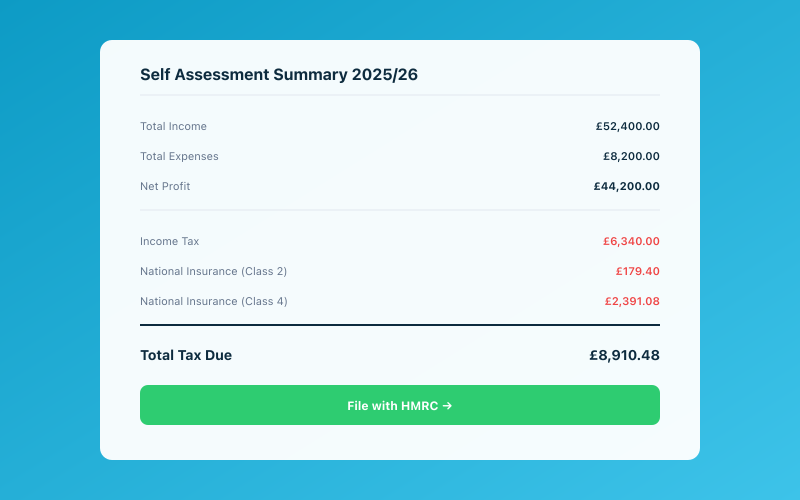 Your Accounted dashboard shows your real-time tax position
It is less complicated than most people fear, but there are details that catch people out. This guide explains how it all works for the 2025/26 tax year.
Two Systems, One Tax Bill
The UK has two main systems for collecting Income Tax:
- PAYE (Pay As You Earn) handles your employment income. Your employer deducts Income Tax and National Insurance from your salary before paying you.
- Self Assessment handles your self-employment income. You calculate your own tax and pay it directly to HMRC.
When you have both types of income, PAYE handles the employment side and Self Assessment handles the self-employment side. But they are not independent — your total income determines your tax rate, and HMRC combines everything to produce one final tax calculation.
How Your Personal Allowance Works
Everyone gets a £12,570 Personal Allowance for 2025/26 — the amount you can earn tax-free. When you have both employment and self-employment income, HMRC typically allocates your full Personal Allowance to your employment income through your tax code.
Your standard tax code is 1257L, which tells your employer to give you £12,570 of tax-free pay spread across the year. Your self-employment income then sits on top of your employment income, and is taxed at whatever marginal rate applies.
Example
Sarah earns £30,000 from her job and £8,000 profit from her freelance work.
Employment (handled by PAYE):
- £12,570 tax-free (Personal Allowance)
- £17,430 taxed at 20% = £3,486
Self-employment (handled by Self Assessment):
- £8,000 taxed at 20% = £1,600
Sarah's total income is £38,000. She is a basic-rate taxpayer, so her self-employment profit is taxed at 20%.
When Self-Employment Pushes You Into Higher Rate
If your combined income exceeds £50,270, part of it is taxed at 40%.
James earns £45,000 from his job and £12,000 profit from his business.
Employment (PAYE):
- £12,570 tax-free
- £32,430 at 20% = £6,486
Self-employment (Self Assessment):
- The basic-rate band runs from £12,571 to £50,270. James has used £45,000 of his income, so he has £5,270 of basic-rate band remaining.
- £5,270 at 20% = £1,054
- £6,730 at 40% = £2,692
- Total self-employment tax: £3,746
James pays more tax on his self-employment income because part of it falls into the higher-rate band.
National Insurance: You Pay Both Types
This is where dual income creates a double hit that catches people off guard.
Employment NI (Class 1)
Your employer deducts Class 1 NI from your salary:
- 8% on earnings between £12,570 and £50,270
- 2% above £50,270
Your employer also pays employer's NI on top (13.8%), but that is their cost, not yours.
Self-Employment NI (Class 2 and Class 4)
On your self-employment profits, you pay:
- Class 2: £3.45 per week (if profits exceed £6,725)
- Class 4: 6% on profits between £12,570 and £50,270, 2% above
The Annual Maximum
There is a maximum annual NI limit to prevent you from paying excessive contributions when you have both types of income. If your combined Class 1 and Class 4 contributions exceed the annual maximum, HMRC calculates a refund or adjustment after you file your Self Assessment return. This happens automatically — you do not need to apply for it.
However, the annual maximum only applies to the main rate of NI. The 2% rate above the upper earnings limit has no cap.
Example
If Sarah (from above) pays Class 1 NI on her £30,000 salary and Class 4 NI on her £8,000 self-employment profit, she pays NI on both. Since her total income is below £50,270, the annual maximum does not come into play.
Filing Self Assessment
When you have both employed and self-employed income, you must file a Self Assessment tax return. On this return, you declare:
- Your employment income (from your P60, which your employer gives you after the tax year)
- Your self-employment income and expenses
- Any other income (savings interest, dividends, rental income)
HMRC calculates your total tax liability, credits the tax already paid through PAYE, and tells you how much remains to pay (or if you are due a refund).
Key Deadlines
- Register for Self Assessment: within three months of starting self-employment
- File your return: by 31 January following the end of the tax year (31 January 2027 for the 2025/26 tax year)
- Pay your tax: by 31 January (same deadline as filing)
Coding Notice Adjustments
HMRC sometimes adjusts your PAYE tax code to collect self-employment tax through your salary. This is called coding out.
If your self-employment tax bill is relatively small (under £3,000 and you file your return by 30 December), HMRC can adjust your employer's tax code so that slightly more tax is deducted from your salary each month. This means you do not have to make a lump-sum payment in January.
You will receive a coding notice (P2) from HMRC showing the adjusted code. For example, instead of 1257L, your code might be reduced to 1057L, which means your employer applies a lower Personal Allowance, deducting more tax from your salary.
Should You Use Coding Out?
It can be convenient because it spreads the payment over the year. But it also reduces your monthly take-home pay from your job. If you prefer to manage your own cash flow and pay a lump sum in January, you can ask HMRC not to adjust your code.
Payments on Account
If your Self Assessment tax bill exceeds £1,000, HMRC usually requires payments on account — two advance payments towards next year's bill:
- 31 January (during the tax year): 50% of the previous year's self-employment tax
- 31 July (after the tax year ends): another 50%
These are in addition to the current year's balancing payment. In your first year, you could face a large bill: the full current year's tax plus the first payment on account for next year. Budget for this from day one.
If you expect your income to be lower next year, you can apply to reduce your payments on account. But if you reduce them and your income does not fall, HMRC charges interest on the shortfall.
Expenses
Your self-employment expenses work exactly the same whether or not you also have a job. Deduct all allowable business costs from your self-employment income to arrive at your taxable profit. Common expenses include:
- Equipment and tools
- Software and subscriptions
- Travel costs (mileage, train fares)
- Home office costs
- Phone and internet (business proportion)
- Professional subscriptions
- Marketing and advertising
The more expenses you claim, the lower your self-employment profit and the less tax you pay. This is true regardless of your employment income.
Student Loan Repayments
If you have a student loan, repayments are due on both your employment and self-employment income. Your employer deducts student loan repayments from your salary through PAYE. On your self-employment income, you make additional repayments through Self Assessment.
The repayment thresholds and rates depend on your plan type:
- Plan 1: 9% on income above £24,990
- Plan 2: 9% on income above £27,295
- Plan 4 (Scotland): 9% on income above £27,660
- Plan 5: 9% on income above £25,000
- Postgraduate: 6% on income above £21,000
Your employer handles the employment portion. Self Assessment handles the self-employment portion. The threshold applies to your total income, not each source separately.
Common Mistakes
- Not registering for Self Assessment. If you are self-employed, you must register — even if your profits are small.
- Forgetting to declare employment income. Your Self Assessment return asks for all income, including PAYE employment. Do not assume HMRC already knows. Enter your P60 figures.
- Not understanding payments on account. The January bill can be much larger than expected when it includes advance payments for next year.
- Ignoring your tax code. If HMRC adjusts your code and you do not understand why, check your Personal Tax Account online or call HMRC.
- Not setting aside money for tax. A good rule is to put 25-30% of your self-employment profit into a separate savings account for tax.
Stay on Top of Both Incomes
Managing two income streams is manageable if you keep good records throughout the year. Accounted connects to your bank, tracks your self-employment income and expenses in real time, and Penny categorises everything automatically. When it comes time to file, your numbers are already prepared. Start your free trial with Accounted today and make dual-income tax straightforward.
Related Reading
Start your free trial and let Penny handle your bookkeeping automatically.
Penny, your AI bookkeeper, tracks your tax position in real time and flags opportunities to reduce your bill. Meet Penny →
Tax & Compliance Specialists
Our tax specialists have decades of combined experience in UK sole trader and small business taxation, MTD compliance, and HMRC submissions. All content is reviewed against current HMRC guidance before publication and updated quarterly to reflect legislative changes.
Ready to try Accounted?
Join UK sole traders who are simplifying their bookkeeping and tax.
Start your 14-day free trial