Tax on Compensation Payments — Are They Taxable?
If you've received a compensation payment — whether from an employer, an insurance claim, or a legal settlement — the first question that probably crosses your mind is: do I need to pay tax on this? The answer, as with most things in UK tax, is "it depends."
Some compensation payments are completely tax-free. Others are taxable in full. And a few sit in an awkward grey area that can catch people out if they're not careful. In this guide, we'll walk through the main types of compensation payments, explain how HMRC treats each one, and help you work out what you might owe.
What Counts as a Compensation Payment?
In broad terms, a compensation payment is any sum of money you receive to make up for a loss, injury, or wrong. That could include:
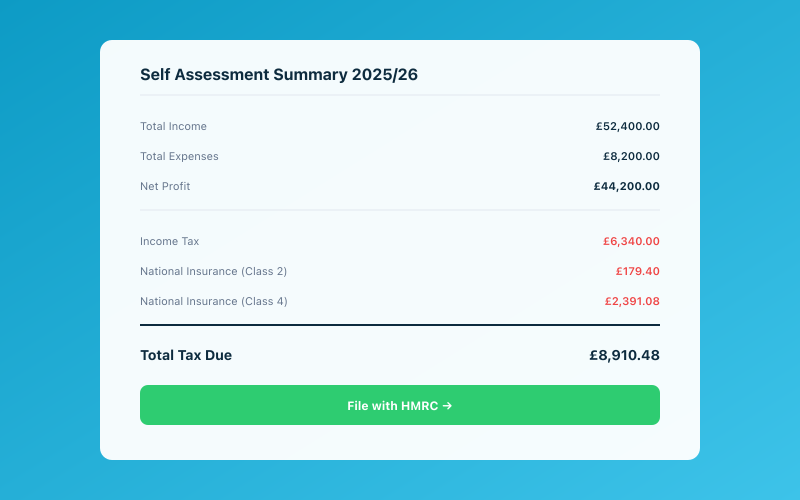 Your Accounted dashboard shows your real-time tax position
- Redundancy payments — money paid when your job is terminated
- Compensation for personal injury — from an accident, medical negligence, or workplace incident
- Settlement agreements — negotiated payouts when leaving a job
- Insurance payouts — for damage to property, loss of earnings, or other insured events
- Court-awarded damages — from a legal dispute or tribunal
- Compensation for mis-sold financial products — such as PPI refunds
Each of these is treated differently for tax purposes, so it's worth looking at them individually rather than making assumptions.
The £30,000 Tax-Free Threshold for Employment-Related Payments
One of the most commonly cited rules around compensation and tax is the £30,000 exemption. Under current legislation, the first £30,000 of a termination payment that isn't otherwise taxable (such as regular salary or holiday pay) can be received tax-free.
This applies to genuine redundancy payments, compensation for loss of office, and certain elements of settlement agreements. However, there are important caveats.
Any part of a termination payment that represents salary, bonuses, or holiday pay you were contractually entitled to is taxed as normal earnings — it doesn't qualify for the £30,000 exemption. HMRC looks at the substance of the payment, not just what it's labelled. So if your employer bundles several things together and calls the whole lot "compensation," HMRC may still carve out the elements that are really just deferred pay.
It's also worth noting that since April 2020, employer National Insurance contributions are due on any termination payment above £30,000. So whilst you personally might not pay NI on the first £30,000, your employer will be liable on amounts exceeding that threshold.
If you're self-employed and also receive a redundancy payment from a former employer, the interaction between your business income and this payment can be tricky. We've covered that scenario in more detail in our guide on tax on redundancy if you also run a business.
Personal Injury Compensation — Usually Tax-Free
Compensation for personal injury or illness is generally exempt from income tax. This includes:
- Lump-sum damages for physical or psychological injury
- Structured settlements paid over time
- Payments from the Criminal Injuries Compensation Authority
The key condition is that the payment must genuinely relate to personal injury or illness. If a settlement agreement includes a personal injury element alongside other compensation (such as loss of office), the personal injury portion needs to be clearly identified and supported by medical evidence. HMRC has been known to challenge claims where the personal injury component looks inflated to reduce the tax bill.
Interest earned on compensation held in a bank account is taxable, even if the original compensation was tax-free. So if you receive a large lump sum and it sits in a savings account generating interest, you'll need to declare that interest on your Self Assessment return.
Insurance Payouts and Business Compensation
Insurance payouts can be tax-free or taxable depending on the nature of the claim.
Generally tax-free:
- Payouts for damage to personal possessions (home contents, car, etc.)
- Life insurance proceeds
- Personal accident or sickness insurance payouts
Generally taxable:
- Business interruption insurance — because it replaces trading income that would have been taxable
- Loss of profits insurance — again, replacing what would have been taxable income
- Keyman insurance payouts received by a business
If you're a sole trader and receive a business interruption payout, that amount should be included in your trading income for the year. It's essentially standing in for the revenue you would have earned, so HMRC treats it the same way. This is something worth tracking carefully in your bookkeeping — tools like Penny in Accounted can help you categorise these payments correctly so nothing gets missed at year-end.
For more on what HMRC considers trading income, have a look at our article on what counts as trading income.
Compensation for Mis-Sold Financial Products
PPI refunds were the big one for years, though that ship has largely sailed. However, compensation for mis-sold financial products still comes up — whether it's packaged bank accounts, investment products, or pension transfers.
The compensation itself is not taxable. It's treated as a return of money you shouldn't have paid in the first place, so there's no income tax or capital gains tax to worry about.
However, the statutory interest element of the compensation is taxable. When the Financial Ombudsman or a financial institution pays you compensation plus 8% statutory interest, that interest portion is treated as savings income. It needs to be declared on your tax return, and depending on your other income, it may be covered by your Personal Savings Allowance (£1,000 for basic rate taxpayers, £500 for higher rate).
Many people miss this, and HMRC does receive data from financial institutions about compensation payments, so it's best to get it right.
Court-Awarded Damages and Legal Settlements
Damages awarded by a court follow similar principles to other compensation:
- Damages for personal injury — tax-free
- Damages for breach of contract — depends on what the damages replace. If they replace lost income, they're taxable. If they compensate for a capital loss, they may be subject to capital gains tax instead
- Damages for discrimination — usually tax-free if related to injury to feelings, but taxable if they replace lost earnings
- Punitive or exemplary damages — the tax treatment depends on what they relate to
The distinction often comes down to: what is the compensation replacing? If it's replacing something that would have been taxable (like income), then the compensation is usually taxable too. If it's compensating for something non-taxable (like personal suffering), it's usually tax-free.
Settlement agreements are worth particular attention. These are negotiated documents, and the way they're drafted matters enormously for tax. A well-structured settlement agreement can legitimately minimise the tax payable by properly allocating amounts between different heads of compensation. A poorly drafted one might leave you paying more tax than necessary — or worse, result in HMRC challenging the allocation.
How to Report Compensation Payments
If you receive a taxable compensation payment, how you report it depends on the type:
Employment-related payments are usually dealt with through PAYE by your employer. They should deduct tax on any amount above the £30,000 threshold before paying you. If they don't, or if there's a discrepancy, you may need to declare it on your Self Assessment return.
Self-employment insurance payouts should be included in your trading income on your tax return. If you use Accounted for your bookkeeping, you can record these as income and tag them appropriately so they flow through to your return correctly.
Savings interest on compensation goes in the savings income section of your return.
Capital gains from compensation relating to assets should be reported in the capital gains section. Our capital gains tax guide covers the basics of CGT reporting.
If you're unsure about any of these, it's always worth getting professional advice. The cost of an hour with a tax adviser is usually far less than the penalties for getting it wrong.
Common Mistakes to Avoid
A few pitfalls we see regularly:
- Assuming all compensation is tax-free. It isn't. The tax treatment depends entirely on what the payment is for.
- Forgetting about interest. Even when the compensation itself is exempt, any interest earned on it is taxable.
- Not keeping records. If HMRC queries a compensation payment, you need to be able to show what it was for and why you've treated it as you have. Keep the settlement agreement, court order, insurance documentation, or whatever supports your position.
- Misallocating settlement agreement amounts. If you're negotiating a settlement, get tax advice before signing. The allocation between different heads of compensation can make a real difference.
- Double-counting. If your employer has already deducted tax through PAYE on a termination payment, make sure you don't then declare the gross amount again on your Self Assessment.
Related Reading
Start your free trial and let Penny handle your bookkeeping automatically.
Accounted helps UK sole traders stay on top of their bookkeeping and tax. Start your free 30-day trial at getaccounted.co.uk.
Penny, your AI bookkeeper, tracks your tax position in real time and flags opportunities to reduce your bill. Meet Penny →
Tax & Compliance Specialists
Our tax specialists have decades of combined experience in UK sole trader and small business taxation, MTD compliance, and HMRC submissions. All content is reviewed against current HMRC guidance before publication and updated quarterly to reflect legislative changes.
Ready to try Accounted?
Join UK sole traders who are simplifying their bookkeeping and tax.
Start your 14-day free trial