How to Write a Business Plan (That You'll Actually Use)
If you've ever searched "how to write a business plan," you've probably been hit with pages of advice about writing fifty-page documents with fancy financial projections and SWOT analyses. And if you're a sole trader or freelancer, you probably thought: "I just want to earn a living doing something I'm good at — do I really need all that?"
The short answer is no, you don't need a fifty-page document. But you do need a plan. The difference is that your plan should be something you actually look at more than once — a practical, living document that helps you make better decisions, stay focused, and grow your business with intention.
In this guide, we'll walk you through how to write a business plan that's genuinely useful, without the corporate waffle.
Why Bother With a Business Plan?
Let's get the elephant out of the room. Many sole traders skip the business plan entirely, and plenty of them do just fine. So why bother?
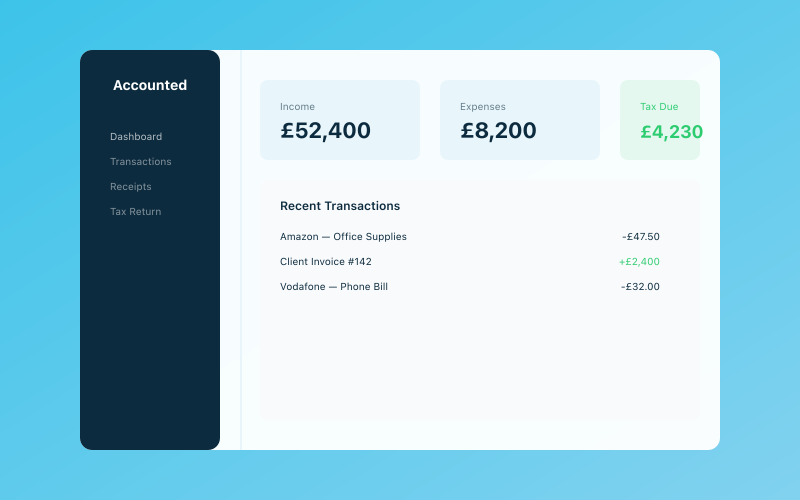 Your Accounted dashboard — income, expenses, and tax at a glance
Here's the thing: a business plan isn't just for impressing a bank manager or ticking a box. It's for you. It forces you to think through the basics — who you're selling to, how you'll make money, what you'll charge, and where you want to be in a year or two.
Without that clarity, it's easy to drift. You say yes to the wrong projects, undercharge for your time, or spend months working hard without any real progress. A plan gives you a compass.
It's also incredibly useful when things get tough. When you're knee-deep in a difficult month and wondering whether this whole self-employment thing was a mistake, a plan reminds you why you started and what you're working towards.
And if you ever do need to apply for funding, a business loan, or even a mortgage, having a plan ready makes the process far less stressful.
Start With the Basics: What Does Your Business Actually Do?
This sounds obvious, but you'd be surprised how many people struggle to explain what their business does in a couple of sentences. Start here. Write a clear, plain-English summary of:
- What you do — the service or product you offer
- Who you do it for — your ideal customer or client
- Why they should choose you — what makes you different from the competition
This is sometimes called an elevator pitch. If you can nail this in two or three sentences, everything else in your plan becomes easier.
For example: "I'm a freelance graphic designer helping small hospitality businesses across the Midlands create professional branding on a budget. I specialise in menu design, signage, and social media templates."
That's specific, clear, and immediately tells anyone reading it exactly what the business is about.
Don't worry about making it perfect straight away. You can refine it as you go. The important thing is getting something down on paper.
Know Your Market and Your Competition
You don't need to commission expensive market research, but you do need a basic understanding of the landscape you're operating in. Ask yourself:
- Who are your ideal clients? Think about their age, location, industry, budget, and what problems they need solving. The more specific you are, the easier it becomes to market your services.
- How big is the opportunity? Is there genuine demand for what you offer? Look at job boards, freelancing platforms, local business directories, and social media to get a sense of whether people are actively looking for your kind of service.
- Who else is doing what you do? Look at your competitors — not to copy them, but to understand what they charge, how they position themselves, and where there might be gaps you can fill.
You might discover, for instance, that most of your competitors target large businesses, leaving a gap in the market for someone who works specifically with startups or sole traders. That kind of insight is gold.
Keep this section simple. A page or two of notes is plenty. The goal is to show (to yourself, mainly) that you've thought about where your business fits in the real world.
Set Your Pricing and Financial Goals
This is where a lot of sole traders get stuck, but it's arguably the most important part of your plan. You need to know:
- What you'll charge — whether that's an hourly rate, a day rate, or project-based pricing. If you're not sure where to start, have a read of our guide on how to set your rates as a freelancer.
- What your costs are — including software subscriptions, insurance, equipment, travel, and anything else you need to run your business. Don't forget less obvious costs like accounting software, professional development, and marketing.
- How much you need to earn — work backwards from your personal expenses. What's the minimum you need to cover your rent or mortgage, bills, food, and a bit of savings? Add your business costs on top, and factor in tax and National Insurance. That gives you your break-even figure.
- How much you want to earn — this is your target. It should be realistic but aspirational. Give yourself something to aim for.
A simple financial forecast doesn't need to be complicated. A spreadsheet with monthly income and expenses for the next twelve months is a great start. Tools like Accounted can help you keep track of your actual income and expenses against your plan, so you can see at a glance whether you're on track.
Remember to account for quieter months. Most businesses have seasonal fluctuations, and knowing when yours are likely to come means you can plan ahead rather than panic.
Create a Simple Marketing Plan
You don't need a marketing degree to promote your business, but you do need a plan for how you'll find clients. Think about:
- Where your ideal clients hang out — is it LinkedIn, Instagram, local networking events, trade shows, or industry forums? Focus your energy on the channels that matter most.
- What content you'll create — whether it's blog posts, social media updates, case studies, or a simple portfolio website. Consistency matters more than volume. Even one good post a week can build your reputation over time.
- How you'll generate referrals — word of mouth is still one of the most powerful marketing tools for sole traders. Think about how you can encourage happy clients to recommend you. A follow-up email after a project, a referral discount, or simply doing outstanding work all help.
- What your budget is — you can do a lot with very little, but it's worth setting aside even a small amount each month for marketing. Even £50 a month on targeted social media ads can make a difference if you're strategic about it.
Keep your marketing plan realistic. If you hate social media, don't build your entire strategy around posting three times a day on five platforms. Play to your strengths and focus on what's sustainable.
Plan for the Practical Stuff
A good business plan also covers the nuts and bolts of running your business. This is the stuff that's easy to overlook when you're excited about getting started, but it'll save you headaches later.
- Legal structure — are you operating as a sole trader or considering a partnership? Each has different implications for tax, liability, and admin. Our comparison of sole trader vs limited company can help you think this through.
- Registration — have you registered with HMRC? If not, our guide on how to register as self-employed walks you through it step by step.
- Insurance — depending on your industry, you may need public liability insurance, professional indemnity insurance, or other cover. Don't skip this.
- Banking — keeping your business finances separate from your personal ones makes bookkeeping far easier and looks more professional. Even a simple separate current account will do.
- Record keeping — HMRC expects you to keep accurate records of your income and expenses. With Making Tax Digital rolling out, digital record keeping is becoming essential. This is where a tool like Penny, the AI assistant in Accounted, can save you hours by automatically categorising your transactions and keeping everything tidy.
Review and Revisit (This Is the Bit Most People Skip)
Here's the secret to writing a business plan that you'll actually use: build in regular reviews.
Set a reminder — quarterly works well for most sole traders — to sit down and look at your plan. Ask yourself:
- Am I on track with my financial goals?
- Has anything changed in my market or with my competition?
- Am I spending my time on the right things?
- What's working well, and what isn't?
- Do I need to adjust my pricing, my marketing, or my services?
Your business plan should evolve as your business does. The version you write today won't be the same one you're working from in six months, and that's exactly how it should be.
Some people like to do this review on their own with a cup of tea and a quiet afternoon. Others find it helpful to talk things through with a mentor, a business friend, or even their accountant. Whatever works for you, just make sure you do it.
Keeping It Simple Is the Whole Point
The best business plans for sole traders and freelancers are short, clear, and practical. Aim for something you can read in ten minutes and update in thirty. If your plan is so long that you never look at it, it's not serving its purpose.
Here's a quick template to get you started:
- Business summary — what you do, who for, and why you're different (half a page)
- Market and competition — who your clients are and who else serves them (one page)
- Pricing and finances — what you charge, your costs, and your income targets (one page)
- Marketing plan — how you'll find and keep clients (one page)
- Practical details — legal structure, insurance, banking, record keeping (half a page)
- Goals and milestones — what you want to achieve in the next 3, 6, and 12 months (half a page)
That's four or five pages in total. Enough to be useful, short enough to actually read.
Related Reading
Accounted helps UK sole traders stay on top of their bookkeeping and tax. Start your free 30-day trial at getaccounted.co.uk
Accounted keeps your books sorted automatically so you can focus on running your business. See Accounted →
Business & Operations Advisors
Our business advisors cover the practical side of running a UK sole trader business — from HMRC registration to managing growth. Content is written for real business owners in plain English, not accountants.
Ready to try Accounted?
Join UK sole traders who are simplifying their bookkeeping and tax.
Start your 14-day free trial