NHS Workers Going Private — Tax When Transitioning to Self-Employment
You've spent years working in the NHS — building your clinical skills, dealing with impossible workloads, and watching your real-terms pay erode year after year. Now you're seriously thinking about going private. Whether you're a physiotherapist, a nurse practitioner, a counsellor, a dentist, or any other healthcare professional, the idea of setting your own hours, choosing your own patients, and actually being paid what you're worth is incredibly appealing.
But the transition from employed NHS worker to self-employed private practitioner comes with a whole new set of financial responsibilities. Tax, National Insurance, pension decisions, registration requirements, insurance — there's a lot to get right. This guide walks you through all of it.
The Big Decision: Full Break or Gradual Transition?
Before we get into the tax details, it's worth thinking about how you want to make the move. You broadly have three options:
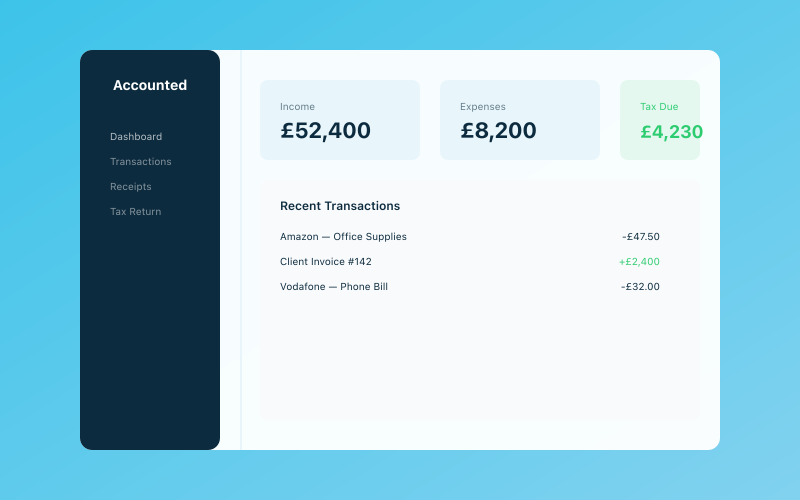 Your Accounted dashboard — income, expenses, and tax at a glance
Going all in. You resign from the NHS and launch your private practice. This gives you full focus and commitment, but it's the highest-risk approach. You'll have no income until clients start paying, and it can take months to build up a full caseload.
Reducing your NHS hours and building privately alongside. Many healthcare professionals drop to part-time NHS work while building their private practice on their days off. This gives you financial stability while you establish yourself, and it means you stay in the NHS pension scheme (more on that later). The downside is that it's exhausting, and you'll have competing demands on your time and energy.
Bank or agency work alongside private practice. This is similar to the part-time approach but with more flexibility. You pick up NHS shifts as and when you need them, while focusing primarily on building your private caseload.
Each approach has different tax implications, so let's work through them.
Registering With HMRC
If you're going to work privately — whether full-time or alongside NHS employment — you need to register as self-employed with HMRC within three months of starting your private work.
This is a straightforward online process. You'll register for Self Assessment and Class 2 National Insurance, and you'll receive a Unique Taxpayer Reference (UTR) number. You'll need this UTR every year when filing your tax return.
If you're continuing to work in the NHS alongside your private practice, you'll have two income streams: your NHS salary (taxed through PAYE) and your self-employment income (declared through Self Assessment). Your tax return will capture both, and HMRC will calculate your overall tax position.
Most healthcare professionals starting out in private practice operate as sole traders. It's simple, low-cost, and perfectly adequate for the vast majority of practitioners. Some people set up limited companies, but this generally only makes financial sense once you're earning significantly above the higher-rate threshold — and it comes with more administrative burden.
How Your NHS Pension Is Affected
Your NHS Pension is one of the most valuable benefits of working in the NHS, and it's crucial to understand how going private affects it.
If you leave the NHS entirely, you stop accruing pension benefits. Your existing pension is preserved and will be paid to you at your Normal Pension Age (which varies depending on which section of the scheme you're in). You won't lose what you've already built up, but you won't be adding to it.
If you reduce your NHS hours, you'll continue accruing pension benefits on your reduced salary. Your final pension will be lower than if you'd stayed full-time, but you're still in the scheme.
Once you're self-employed, you can't contribute to the NHS Pension Scheme. You'll need to make your own pension arrangements — typically a personal pension or SIPP. The good news is that pension contributions are tax-deductible, so they reduce your taxable profit.
Before making any decisions, it's worth getting a pension forecast from the NHS Pensions website. This will show you your projected benefits based on your current service and help you understand what you'd be giving up.
For many healthcare professionals, the pension question is actually the biggest factor in their decision. A common approach is to stay in the NHS at reduced hours until you've built up enough pension entitlement to feel comfortable, while growing your private practice on the side.
Understanding Your Tax as a Private Practitioner
Your self-employment tax works like this:
Income Tax is charged on your profits — your private practice income minus your allowable business expenses. If you're also employed by the NHS, your self-employment profits sit on top of your employed income for tax purposes.
Example: If your part-time NHS salary is £25,000 and your private practice profits are £20,000, your total taxable income is £45,000. Your personal allowance (£12,570) is already used up by your NHS salary, so your private practice profits are taxed at 20%.
If your combined income exceeds £50,270, you'll start paying 40% on the excess. This is a realistic scenario for experienced practitioners doing well in private practice.
National Insurance adds another layer. On your NHS salary, you pay employee National Insurance through PAYE. On your self-employment profits, you pay Class 2 (£3.45/week) and Class 4 (6% on profits between £12,570 and £50,270, 2% above that). If you've reached State Pension age, you won't pay NI on your self-employment income.
Payments on account apply if your Self Assessment tax bill exceeds £1,000. HMRC will ask you to make advance payments towards next year's bill — 50% in January and 50% in July. In your first year, this means you could face a bill of 150% of your annual tax liability in one go.
Setting aside 25-30% of your private practice income for tax is a sensible starting point. Penny in Accounted can track your income and expenses as they happen and give you a running estimate of your tax position — which is invaluable when you have multiple income sources.
Expenses You Can Claim
Private healthcare practitioners have a wide range of allowable expenses. Here are the main ones:
Room or clinic rental. If you rent a treatment room, consulting room, or space in a clinic, the rental cost is fully deductible. This is often the single biggest expense for private practitioners.
Professional registration and membership. Your HCPC, NMC, GDC, or other regulatory body registration fees are deductible. So are subscriptions to professional bodies like the CSP, RCN, or relevant specialist societies.
Insurance. Professional indemnity insurance is essential and fully deductible. Depending on your profession, you may also need public liability insurance and medical malpractice cover.
Equipment and supplies. Treatment tables, diagnostic equipment, consumables, and clinical supplies. If an item costs more than £1,000, it may need to be treated as a capital asset and claimed through capital allowances rather than as a straightforward expense.
CPD and training. Courses and conferences that maintain or update your existing professional skills are deductible. This includes mandatory CPD requirements for your professional registration.
Travel. Journeys between your home (or main practice location) and other work locations — such as visiting patients at home, travelling to a different clinic, or attending professional events — are deductible. Claim the simplified mileage rate or actual vehicle costs.
Technology and software. Practice management software, online booking systems, patient record systems, and general business software (accounting, email marketing, etc.).
Marketing. Website development and hosting, online advertising, printed marketing materials, and directory listings.
Home office. If you do administration, patient notes, or CPD from home, you can claim a proportion of your household costs or use the simplified flat rate.
Accountancy and bookkeeping. Fees for your accountant and accounting software subscriptions — including Accounted.
For the full list, see our sole trader expenses guide.
Practical Considerations for Healthcare Professionals
Beyond tax, there are several practical things to sort out when going private.
Insurance is non-negotiable. You need professional indemnity insurance at a minimum, and potentially public liability cover depending on your work. Some professional bodies include insurance in their membership fees; others don't. Check carefully and make sure you're properly covered before seeing your first private patient.
Regulatory requirements vary by profession. Most healthcare professionals need to maintain their registration with the relevant regulatory body (HCPC, NMC, GDC, etc.) regardless of whether they work in the NHS or privately. Some professions have additional requirements for private practice — check with your regulatory body.
CQC registration may be required if you're providing certain regulated activities. This applies mainly to doctors, dentists, and some other practitioners who provide specific types of care. CQC registration involves inspections, compliance requirements, and fees.
Data protection is critical when handling patient records. You'll need to register with the Information Commissioner's Office (ICO) and comply with UK GDPR requirements. Patient records must be stored securely, and you need clear policies on data retention and sharing.
Payment systems — you'll need a way to take payments from patients. Many practitioners use online booking and payment platforms, but you'll also need to manage invoicing for patients who pay after treatment or whose insurance companies pay on their behalf.
Building Your Private Caseload
The most common anxiety among NHS workers going private is whether they'll actually get enough patients. Here are some proven approaches:
Professional directories. Register with relevant directories for your profession — these are often the first place potential patients look.
GP and consultant referrals. Build relationships with local GPs and consultants who might refer patients to you. A well-written introductory letter explaining your services and specialisms can go a long way.
Online presence. A professional website with clear information about your services, qualifications, and fees is essential. Most patients will research you online before booking.
Insurance panel registration. If you can get on the panels of private medical insurers (BUPA, AXA, Aviva, etc.), they'll refer patients to you directly. The administrative burden is significant, and their fees are often lower than your private rates, but the volume of referrals can be substantial.
Word of mouth. Deliver excellent care, and your patients will recommend you. This is the most powerful marketing channel for any healthcare professional.
Having a clear business plan will help you think through your target market, pricing, and marketing approach before you start spending money.
Making the Transition Work
Going private after years in the NHS is a significant life change, but thousands of healthcare professionals do it successfully every year. The financial side is manageable with the right preparation — register with HMRC promptly, understand how your pension is affected, track your expenses from day one, and set money aside for tax.
The clinical skills and professional expertise you've developed in the NHS are genuinely valuable in the private sector. Patients are willing to pay for experience, skill, and dedicated attention — exactly what you offer.
Accounted helps UK sole traders stay on top of their bookkeeping and tax. Start your free 30-day trial at getaccounted.co.uk.
Related reading:
- Your First Year of Self-Employment — A Complete Guide
- How to Register as Self-Employed With HMRC
- The Complete List of Sole Trader Expenses
Related Reading
- How to Start a Cleaning Company (And Scale It)
- Retiring From Teaching and Starting a Consultancy — Tax Guide
- How to Register as Self-Employed With HMRC (Step by Step)
View our pricing and start your free 30-day trial today.
Starting out? Accounted is built for UK sole traders from day one — from £14/month. Get started →
Business & Operations Advisors
Our business advisors cover the practical side of running a UK sole trader business — from HMRC registration to managing growth. Content is written for real business owners in plain English, not accountants.
Ready to try Accounted?
Join UK sole traders who are simplifying their bookkeeping and tax.
Start your 14-day free trial