Tax When You Retire From Self-Employment
After years — perhaps decades — of running your own business, the time eventually comes to step back. Retirement from self-employment is a significant life transition, and while the prospect of no more invoices, no more chasing payments, and no more Self Assessment returns is undeniably appealing, there are some important tax matters to deal with first.
Getting the wind-down right can save you money, avoid problems with HMRC, and give you peace of mind as you move into the next phase of your life. Let's go through everything you need to think about.
Telling HMRC You're Stopping
When you stop trading as a sole trader, you need to tell HMRC. This isn't optional — if you don't notify them, they'll keep expecting tax returns and potentially issue penalties for non-filing.
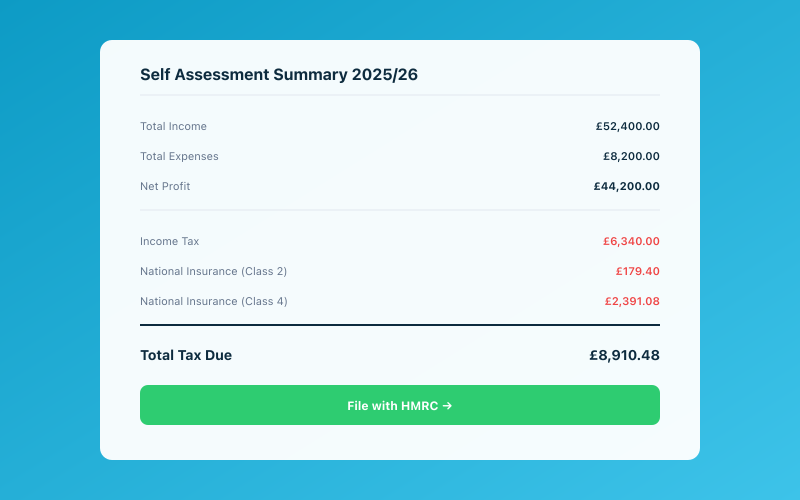 Your Accounted dashboard shows your real-time tax position
You should deregister as self-employed within the first few months of stopping trading. You can do this online through your HMRC online account or by calling HMRC directly. You'll need to tell them:
- The date you stopped self-employment
- Whether you're still receiving any self-employed income (for example, from residual contracts or ongoing royalties)
- Whether you've disposed of any business assets
If you're VAT-registered, you'll also need to deregister for VAT. You can do this at the same time, but be aware that there may be a final VAT return to file, and you might need to account for VAT on any business assets you're keeping for personal use (more on that shortly).
For a detailed walkthrough of the closure process, our guide on closing a sole trader business covers the steps in full.
Your Final Tax Return
You'll need to file one last Self Assessment tax return covering the final period of trading. This return covers from 6 April of the tax year in which you stopped trading, up to the date you ceased.
A few things to watch for on this final return:
Capital allowances. If you've been claiming capital allowances on equipment, vehicles, or other assets, you'll need to deal with the balancing charge or balancing allowance. If you sell an asset for more than its tax written-down value, you'll have a balancing charge (additional taxable income). If you sell it for less, you'll have a balancing allowance (an additional deduction). If you keep an asset for personal use, it's treated as if you sold it at market value.
Stock and work in progress. Any unsold stock or work in progress at the date you stop trading needs to be valued and dealt with. If you sell it, the proceeds are part of your final trading income. If you keep it or dispose of it for nothing, it's still technically income at market value — though in practice, if the amounts are small, this is unlikely to be an issue.
Outstanding debts. If clients still owe you money when you close the business, that income is still taxable. You'll need to include it in your final accounts, even if the cash hasn't arrived yet (assuming you're on the accruals basis). If you're on the cash basis, you only include money actually received — but you might need to consider what happens to debts that are never collected.
Overlap relief. If you've been self-employed for a long time, you may have "overlap profits" from when you first started. These are profits that were taxed twice due to the way accounting periods used to work. You're entitled to relief for these in your final tax year. Following the reforms that took effect in April 2024, many sole traders dealt with overlap profits during the 2023/24 transitional year — but if you have any remaining, your final year is the time to claim them.
Capital Gains Tax on Business Assets
When you stop trading, selling or disposing of business assets can trigger Capital Gains Tax. This applies to things like property, vehicles, equipment, and goodwill.
Each individual has a CGT Annual Exempt Amount (£3,000 for 2025/26), so smaller gains may be exempt. But if you're selling property or a business with significant goodwill, the gains could be substantial.
Business Asset Disposal Relief (formerly Entrepreneurs' Relief) can reduce the CGT rate to 10% on qualifying gains up to a lifetime limit of £1 million. To qualify, you generally need to have owned the business for at least two years before disposal. This relief can represent a significant saving compared to the standard CGT rates of 18% or 24%.
If you're married or in a civil partnership, remember that you can transfer assets to your spouse at no gain, no loss before selling. This effectively doubles the Annual Exempt Amount and may allow both of you to claim Business Asset Disposal Relief on your respective shares.
Pension Planning Before You Stop
Retirement planning and pension contributions are closely linked, and the years leading up to retirement are critical.
As a self-employed person, pension contributions reduce your taxable profit. In your final trading years, maximising your pension contributions is one of the most tax-efficient things you can do. You can contribute up to £60,000 per year (or 100% of your net relevant earnings, whichever is lower), and you may be able to carry forward unused allowances from the previous three years.
If you're approaching retirement and haven't been contributing much to a pension, the carry-forward rules could allow you to make a very large contribution in your final year of trading. This reduces your tax bill in that year and builds your retirement fund at the same time.
Once you stop trading, your ability to make tax-relieved pension contributions is limited to £3,600 per year (gross) if you have no earnings. So it's worth front-loading contributions while you still have trading income to set them against.
For more on pension planning and timing, have a look at our article on when to start paying into a pension.
State Pension Considerations
Your State Pension entitlement depends on your National Insurance record. You generally need 35 qualifying years of NI contributions to receive the full new State Pension (currently £221.20 per week for 2025/26).
As a self-employed person, you've been building up NI credits through your Class 2 and Class 4 contributions. When you stop trading, those contributions stop too. If you have gaps in your record — perhaps from years when your earnings were very low, or periods when you weren't registered — you might want to consider making voluntary contributions to fill them.
You can check your State Pension forecast on the government's website, which will tell you how many qualifying years you have and whether paying voluntary contributions would increase your pension. In many cases, the cost of filling a gap (currently £17.45 per week for Class 3 voluntary contributions) is far outweighed by the additional pension you'd receive over your retirement.
If you're retiring before State Pension age, you'll need other income to bridge the gap. This might come from your private pension (accessible from age 55, rising to 57 from April 2028), savings, investments, or other sources.
Drawing Your Private Pension
Once you retire, you'll need to decide how to draw income from your private pension. You generally have several options:
Tax-free lump sum. You can usually take up to 25% of your pension pot as a tax-free lump sum. This can be useful for paying off debts, making home improvements, or simply having a financial cushion at the start of retirement.
Drawdown. You keep your pension invested and draw income from it as needed. This gives you flexibility but requires you to manage the investment risk. Income drawn (beyond the tax-free portion) is taxed as income at your marginal rate.
Annuity. You use some or all of your pension pot to buy a guaranteed income for life. This provides certainty but less flexibility. Annuity income is taxable.
Uncrystallised funds pension lump sum (UFPLS). You take lump sums directly from your pension pot, with 25% of each lump sum being tax-free and the rest taxable.
The right choice depends on your circumstances — the size of your pension pot, your other income sources, your attitude to risk, and your personal preferences. It's worth getting financial advice on this, as the decision has long-term implications for your retirement income and tax position.
What About National Insurance After Retirement?
Once you reach State Pension age, you stop paying National Insurance. This is true regardless of whether you continue to work or earn income.
If you're retiring before State Pension age but no longer self-employed, you won't be paying NI through your business. If you take on any part-time employed work, you'll pay NI on that income until you reach State Pension age.
It's worth noting that if you're drawing a private pension before State Pension age, the pension income itself isn't subject to National Insurance — only to Income Tax. This is one of the advantages of pension income over earned income.
Planning Your Exit — A Timeline
Here's a practical timeline for winding down your self-employment:
12-24 months before: Start pension planning. Maximise contributions while you still have trading income. Review your NI record and fill any gaps. Begin planning the sale or disposal of business assets.
6-12 months before: Inform long-standing clients. Complete or hand over ongoing projects. Start reducing your workload gradually. Value any business assets for potential disposal.
3-6 months before: Finalise outstanding invoices. Chase any overdue payments. Begin closing supplier accounts and cancelling business subscriptions. Accounted can help you identify any loose ends — Penny will flag outstanding invoices and unreconciled transactions so nothing gets missed.
On cessation: Notify HMRC you've stopped trading. Deregister for VAT if applicable. Make your final pension contributions.
After cessation: File your final Self Assessment return. Pay any outstanding tax. Keep your business records for at least five years (six for VAT records).
Retiring from self-employment is the end of one chapter and the beginning of another. Getting the tax side right means you can close your business with a clear conscience and a clear desk — and enjoy the retirement you've earned.
Related reading:
- Closing a Sole Trader Business — Tax Implications
- When to Start Paying Into a Pension
- How Married Couples Can Save Tax
Accounted helps UK sole traders stay on top of their bookkeeping and tax. Start your free 30-day trial at getaccounted.co.uk.
Related Reading
Start your free trial and let Penny handle your bookkeeping automatically.
Penny, your AI bookkeeper, tracks your tax position in real time and flags opportunities to reduce your bill. Meet Penny →
Tax & Compliance Specialists
Our tax specialists have decades of combined experience in UK sole trader and small business taxation, MTD compliance, and HMRC submissions. All content is reviewed against current HMRC guidance before publication and updated quarterly to reflect legislative changes.
Ready to try Accounted?
Join UK sole traders who are simplifying their bookkeeping and tax.
Start your 14-day free trial