How to Start a Cleaning Company (And Scale It)
Cleaning is one of the most accessible businesses to start. The barriers to entry are low, the demand is consistent, and the potential to scale is real. Whether you're looking to build a solo cleaning operation or grow a team of cleaners serving hundreds of clients, the fundamentals are the same — you just need to get them right.
The UK cleaning industry is worth billions, spanning domestic cleaning, commercial cleaning, end-of-tenancy work, and specialist services. There's room for new businesses at every level, from a one-person operation with a mop and bucket to a fully managed company with branded vehicles and uniforms.
In this guide, we'll cover how to start a cleaning business from scratch and — just as importantly — how to scale it beyond just you.
Getting Started — The Basics
Starting a cleaning business requires relatively little upfront investment compared to many other ventures. Here's what you need to sort out first:
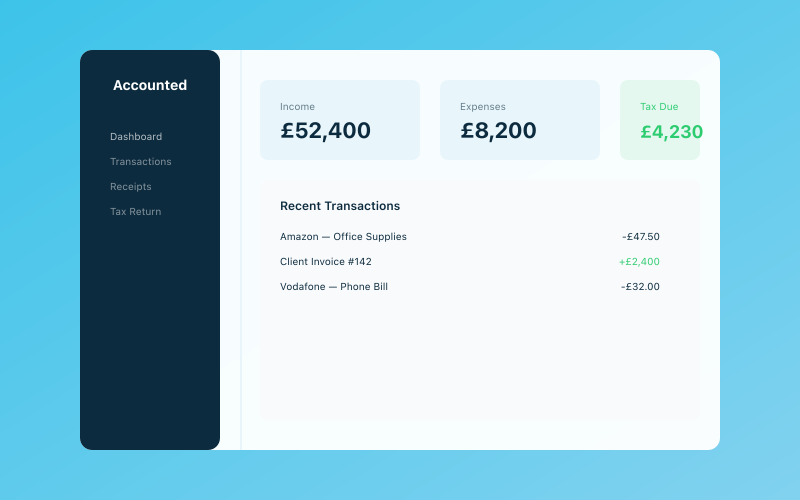 Your Accounted dashboard — income, expenses, and tax at a glance
Register as self-employed. The simplest way to start is as a sole trader. You'll need to register with HMRC — it's free, and you can do it online. You must register by 5 October following the tax year in which you start trading. As your business grows, you might later consider forming a limited company, but sole trader status is fine to begin with.
Get insured. At minimum, you need public liability insurance to cover any accidental damage to clients' property. Policies start from around £50-£100 per year for basic cover. If you're cleaning commercial properties, clients will often require a minimum of £1 million to £5 million in public liability cover. If you hire staff, employers' liability insurance is a legal requirement (minimum £5 million cover).
Invest in basic equipment. For domestic cleaning, you can start with equipment you already own — vacuum cleaner, mop, cloths, and cleaning products. As you grow, invest in commercial-grade equipment. A decent commercial vacuum costs around £150-£400, and a full professional cleaning kit can be assembled for under £500. Specialist equipment (carpet cleaners, floor polishers, pressure washers) comes later as you add services.
Set up a simple system for bookkeeping. Right from day one, track every penny coming in and going out. Accounted is built for exactly this — it lets you log income and expenses, snap photos of receipts, and keeps your tax position clear throughout the year rather than leaving it all to January.
Pricing Your Cleaning Services
Getting your pricing right is one of the most important early decisions. Too low and you'll burn out for minimal reward. Too high and you'll struggle to win clients against established competition.
Here are typical UK rates as a guide:
Domestic cleaning:
- £12 to £18 per hour in most areas
- £15 to £25 per hour in London and the South East
- Some cleaners charge a flat rate per property rather than hourly
Commercial cleaning:
- £12 to £20 per hour depending on the type of premises
- Contracts are often priced monthly based on agreed hours and frequency
Specialist services:
- End-of-tenancy cleaning: £150 to £400+ depending on property size
- Oven cleaning: £40 to £80
- Carpet cleaning: £25 to £50 per room
- Deep cleaning: £200 to £500+ for a full property
When setting your rates, consider:
- Your local market and what competitors are charging
- Travel time between clients (unpaid time that eats into your hourly rate)
- The cost of supplies and equipment
- Tax and National Insurance (remember, your take-home is less than your gross rate)
A common mistake is underpricing to win clients and then being unable to raise rates later. Start at a fair market rate and compete on reliability and quality rather than being the cheapest option. Our guide to setting rates as a freelancer has more detailed advice on pricing strategy.
Finding Your First Clients
The good news is that demand for cleaning services is strong. The challenge is getting your name out there when you're just starting.
Word of mouth. Tell everyone you know that you're starting a cleaning business. Friends, family, neighbours, and local community groups are often your first source of clients. Ask satisfied clients for referrals — offer a discount on their next clean for every new client they send your way.
Online platforms. Sites like Bark, Checkatrade, TrustATrader, and Yell connect service providers with local customers. Some charge per lead, others charge a monthly subscription. Test a couple and track which ones actually convert into paying clients.
Social media. Create a Facebook business page and join local community groups. Many people post looking for cleaners in local Facebook groups. Instagram can work well for showcasing before-and-after transformations.
Leaflets and door drops. Old-fashioned but effective, particularly for domestic cleaning in residential areas. A well-designed leaflet with a clear call to action and your contact details can generate steady enquiries. Target areas where you want to build a client cluster to minimise travel time.
Google Business Profile. Set up a free Google Business listing so you appear in local search results. Encourage clients to leave reviews — a strong rating on Google is one of the most powerful trust signals for local service businesses.
Build a simple website. It doesn't need to be fancy — just clear information about your services, your area, pricing (or "from" prices), and how to get in touch. Make sure it's mobile-friendly.
The Tax Side of Things
As a sole trader, you'll pay income tax on your profits — that's your total income minus your allowable business expenses. For the 2025/26 tax year:
- Personal Allowance: £12,570 (tax-free)
- Basic rate: 20% on profits between £12,571 and £50,270
- Higher rate: 40% on profits between £50,271 and £125,140
- Additional rate: 45% on profits over £125,140
You'll also pay National Insurance:
- Class 2: £3.45 per week
- Class 4: 6% on profits between £12,570 and £50,270, plus 2% above £50,270
Allowable expenses for a cleaning business typically include:
- Cleaning products and supplies
- Equipment and tools
- Vehicle costs (fuel, insurance, maintenance) or mileage at 45p per mile for the first 10,000 miles, 25p thereafter
- Insurance premiums
- Marketing and advertising costs
- Phone and internet (business proportion)
- Professional subscriptions and training
- Accountancy and bookkeeping software costs
Keep receipts for everything. Penny inside Accounted can help you categorise expenses correctly so you're claiming everything you're entitled to without overclaiming.
If your turnover exceeds £90,000, you'll need to register for VAT. For cleaning businesses, this can be a tipping point — adding 20% VAT to domestic cleaning prices may make you less competitive against non-VAT-registered cleaners. Some businesses manage growth strategically around this threshold, though it's important not to artificially suppress turnover to avoid registration, as HMRC takes a dim view of this.
Scaling Beyond a One-Person Operation
This is where a cleaning business gets really interesting. The jump from solo cleaner to cleaning company owner is significant, but it's where the real financial potential lies.
Hiring your first cleaner. When you have more demand than you can handle alone, it's time to hire. You can take on employees or work with self-employed subcontractors, but be careful — HMRC scrutinises the employment status of cleaners closely. If you control when, where, and how someone works, they're likely an employee, not a subcontractor. Misclassifying workers can result in penalties.
When you hire employees, you'll need to:
- Register as an employer with HMRC
- Set up PAYE (Pay As You Earn) payroll
- Pay employers' National Insurance (13.8% on earnings above £96 per week from April 2025)
- Provide employers' liability insurance
- Comply with employment law (contracts, holiday pay, minimum wage, pension auto-enrolment)
The National Minimum Wage for 2025/26 is £12.21 per hour for workers aged 21 and over. Make sure your pricing allows for this plus employers' NI and other employment costs on top.
Systems and processes. As you scale, you need systems. Create checklists for different types of cleans, standard operating procedures for staff, and a reliable scheduling system. The more consistent and repeatable your service, the easier it is to maintain quality as you grow.
Client management. Moving from a few clients to dozens (or hundreds) requires proper client management. Track bookings, preferences, access arrangements, and payment status. Accounted helps with the financial side of this — tracking invoices, chasing late payments, and keeping your cash flow visible.
Specialisation. As you grow, consider specialising in higher-value services. Commercial cleaning contracts, Airbnb and holiday let turnovers, post-construction cleaning, or specialist services like carpet and upholstery cleaning can all command higher rates and offer more predictable income than domestic cleaning alone.
Building a Sustainable Business
The cleaning businesses that thrive long-term share some common traits:
Reliability above everything. In cleaning, your reputation is built on showing up when you say you will and doing a consistently good job. One missed appointment can lose a client permanently.
Professional presentation. Branded uniforms, ID badges, branded vehicle signage — these small touches build trust and make your business look established, even if you've only been going a few months.
Clear communication. Respond to enquiries quickly, confirm bookings, and follow up after the first clean. Good communication sets you apart from competitors who are hard to reach.
Financial discipline. Track your income and expenses from day one. Set aside money for tax. Know your profit margins. A cleaning business with strong revenue but poor financial management is a business heading for trouble. Having Accounted in your corner from the start means you always know where you stand.
A good business plan will help you think through your growth strategy and set realistic targets for the first year and beyond.
Related Reading
View our pricing and start your free 30-day trial today.
Accounted helps UK sole traders stay on top of their bookkeeping and tax. Start your free 30-day trial at getaccounted.co.uk.
Starting out? Accounted is built for UK sole traders from day one — from £14/month. Get started →
Business & Operations Advisors
Our business advisors cover the practical side of running a UK sole trader business — from HMRC registration to managing growth. Content is written for real business owners in plain English, not accountants.
Ready to try Accounted?
Join UK sole traders who are simplifying their bookkeeping and tax.
Start your 14-day free trial