How to Start a Bookkeeping Business
Starting a bookkeeping business is one of the most accessible and rewarding paths into self-employment. The demand is consistent, the overheads are low, and once you build a decent client base, recurring revenue practically runs itself. If you've got an eye for detail and a knack for numbers, this could be the perfect move.
In this guide, we'll walk through everything you need to know — from qualifications and registration to finding your first clients and keeping your own books in order. Whether you're leaving a finance role or switching careers entirely, here's how to start a bookkeeping business in the UK.
Qualifications, Registration and Setup
Technically, there's no legal requirement in the UK to hold a qualification before you start offering bookkeeping services. That said, having one makes a massive difference when it comes to winning clients and building trust.
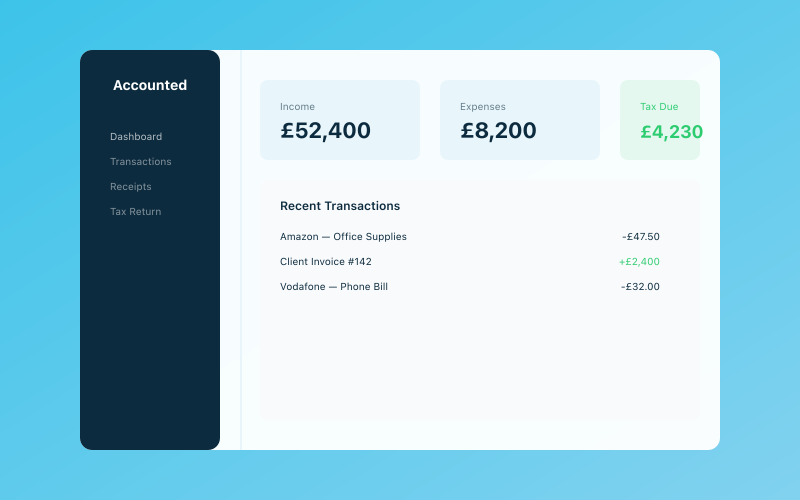 Your Accounted dashboard — income, expenses, and tax at a glance
The most common route is through the Association of Accounting Technicians (AAT). Their Foundation Certificate in Bookkeeping is a great starting point, and many bookkeepers go on to complete the AAT Advanced Diploma. Once qualified, you can apply for an AAT licence, which lets you use the AAT designation and shows clients you meet professional standards.
Another option is the Institute of Certified Bookkeepers (ICB). Their qualifications are specifically designed for practising bookkeepers and cover everything from manual bookkeeping to computerised accounting and self-assessment.
Whichever route you choose, a qualification gives you credibility. It also means you can register with a professional body, which is increasingly important for anti-money laundering (AML) supervision — more on that shortly.
If you want a deeper look at the practice side of things, have a read of our starting a bookkeeping practice guide for more detail on the operational bits.
Before you take on a single client, you need to get the admin sorted. Here's the checklist:
Register as self-employed with HMRC. If you're operating as a sole trader — which most new bookkeepers do — you'll need to register for Self Assessment. You can do this online, and HMRC will send you a Unique Taxpayer Reference (UTR). Our guide on how to register as self-employed with HMRC walks you through the whole process.
Anti-money laundering (AML) supervision. This is a legal requirement for anyone providing bookkeeping services. You need to register with a supervisory body — the AAT, ICB, or HMRC itself can all act as your supervisor. Don't skip this; the penalties for operating without AML supervision are serious.
Professional indemnity insurance. Not legally required for sole traders, but highly recommended. If a client suffers a financial loss because of an error in your work, professional indemnity insurance covers you. Most professional bodies require it as a condition of membership anyway. You can learn more about coverage options in our sole trader insurance guide.
Data protection. You'll be handling sensitive financial data, so you need to register with the Information Commissioner's Office (ICO). The fee for most sole traders is just £40 per year.
Business bank account. Technically optional for sole traders, but practically essential. Keeping business and personal finances separate makes your own bookkeeping far simpler — and it looks more professional to clients.
One of the best things about a bookkeeping business is that you can run it from home. You don't need fancy premises or expensive equipment. A reliable computer, accounting software, a decent internet connection, a quiet workspace, a scanner or scanning app, and cloud storage for backups — that's your toolkit. Many bookkeepers also invest in a second monitor, as the extra screen real estate is a genuine productivity boost when reconciling bank statements.
If you're working from home, remember that you can claim a proportion of your household costs as a business expense. HMRC's simplified expenses method lets you claim a flat rate based on the hours you work from home each month.
Choosing Your Services and Pricing
You don't have to offer everything from day one. Most new bookkeeping businesses start with a core set of services and expand as they grow. Common offerings include:
- Bank reconciliation — matching transactions to bank statements
- Invoicing and accounts receivable — sending invoices and chasing payments
- Accounts payable — managing supplier bills and payments
- VAT returns — preparing and submitting quarterly returns
- Payroll — running monthly or weekly payroll for small teams
- Management accounts — monthly profit and loss reports
- Self Assessment preparation — getting figures ready for tax returns
When it comes to pricing, most bookkeepers use one of three models:
Hourly rate. Common for ad-hoc work. Rates for new bookkeepers typically start around £20–£30 per hour, rising to £40–£50+ as you gain experience and qualifications.
Fixed monthly fee. Popular for ongoing clients. You agree a set fee based on the volume of transactions and services provided. This gives clients predictability and gives you recurring revenue.
Per-transaction pricing. Less common, but some bookkeepers charge per invoice processed or per transaction reconciled.
Fixed monthly fees tend to work best for building a sustainable business. They smooth out your income, make cash flow easier to manage, and clients appreciate knowing exactly what they'll pay.
Finding Your First Clients
This is where most people get nervous, but it's genuinely easier than you think. Here are the approaches that work:
Start with your network. Tell everyone you know that you're starting a bookkeeping business. Friends, family, former colleagues, local business owners — word of mouth is incredibly powerful, especially in the early days.
Local business networking. Groups like BNI, local chambers of commerce, and small business meetups are goldmines for bookkeepers. Many small business owners are actively looking for someone to take the books off their hands.
Partner with accountants. This is one of the smartest moves you can make. Many accountants don't want to handle day-to-day bookkeeping — they'd rather focus on year-end accounts, tax planning, and advisory work. Approach local accountancy practices and offer to handle the bookkeeping for their clients. It's a win-win.
Online presence. Set up a simple website, create a Google Business profile, and consider a LinkedIn page. You don't need anything elaborate — just a clear explanation of what you offer, who you help, and how to get in touch.
Specialise in a niche. Focusing on a particular industry — construction, hospitality, e-commerce — makes your marketing sharper and lets you command higher fees. Clients pay a premium for someone who genuinely understands their sector.
Don't underestimate the power of being approachable and responsive. Many small business owners have had bad experiences with bookkeepers who disappeared for weeks or couldn't explain things in plain English. Simply being reliable and communicative sets you apart.
Managing Your Own Books and Finances
Here's the irony of starting a bookkeeping business — you still need to keep your own books. And it's surprisingly easy to let your own admin slip when you're busy looking after everyone else's.
Set aside time each week to stay on top of your own finances. Record your income, track your expenses, and reconcile your bank account regularly. Using a tool like Penny — the AI assistant built into Accounted — can make this a lot less painful. Penny can help categorise transactions, flag anything unusual, and keep your records HMRC-ready without you spending hours on data entry.
Key expenses you can claim as a bookkeeping business include:
- Software subscriptions
- Professional body membership fees
- CPD and training costs
- Home office costs
- Travel to client meetings
- Marketing and advertising
- Professional indemnity insurance premiums
Keep receipts for everything. HMRC can ask to see them for up to six years, so a solid digital filing system is worth setting up from the start.
Growing Your Practice and Avoiding Common Mistakes
Once you've got your first few clients and your systems are running smoothly, it's time to think about growth. Here are a few strategies:
Ask for referrals. Happy clients are your best marketing channel. Don't be shy about asking — most people are happy to recommend someone who's doing a great job.
Raise your prices annually. As you gain experience and your client list grows, your rates should reflect that. Give clients plenty of notice and frame it as an investment in continued quality service.
Add higher-value services. Management accounts, cash flow forecasting, and advisory work all command higher fees than basic bookkeeping. As your skills develop, layer these in.
Consider subcontracting. When you're at capacity, you can bring in another bookkeeper to handle overflow work rather than turning clients away. This is the first step towards building a team.
Invest in technology. The right software saves hours every week. Cloud-based tools let you collaborate with clients in real time, automate bank feeds, and generate reports at the click of a button.
Writing a proper business plan helps you stay focused as you grow. Our guide to writing a business plan can help you map out your goals and the steps to reach them.
A few pitfalls trip up new bookkeeping businesses more than they should. Undercharging is the biggest — know your worth and avoid competing purely on price. Taking on too many clients too fast leads to mistakes and burnout. Neglecting your own CPD means your knowledge goes stale as tax rules and software evolve. And always have an engagement letter — get the scope of work, fees, and responsibilities in writing before you start any new client relationship.
Starting a bookkeeping business doesn't require a huge investment or years of preparation. With the right qualifications, a clear plan, and a willingness to put yourself out there, you can build a profitable practice that fits around your life. The key is to start. Register with HMRC, get your AML supervision sorted, and start telling people what you do. The clients will come.
Related reading:
- Starting a Bookkeeping Practice — The Complete Guide
- How to Register as Self-Employed with HMRC
- How to Write a Business Plan
Accounted helps UK sole traders stay on top of their bookkeeping and tax. Start your free 30-day trial at getaccounted.co.uk.
Related Reading
- Your First 90 Days as a New Sole Trader — A Survival Guide
- How to Start a Property Maintenance Business
- Starting a Business After Redundancy — A Tax and Planning Guide
View our pricing and start your free 30-day trial today.
Starting out? Accounted is built for UK sole traders from day one — from £14/month. Get started →
Business & Operations Advisors
Our business advisors cover the practical side of running a UK sole trader business — from HMRC registration to managing growth. Content is written for real business owners in plain English, not accountants.
Ready to try Accounted?
Join UK sole traders who are simplifying their bookkeeping and tax.
Start your 14-day free trial