How to Start a Property Maintenance Business
If you're handy with tools, enjoy fixing things, and like the idea of being your own boss, a property maintenance business could be the perfect fit. It's one of those businesses where demand never dries up — buildings always need looking after, landlords always need reliable tradespeople, and there's always a dripping tap somewhere that needs sorting.
The beauty of property maintenance is that it covers such a broad range of services. You don't need to be a specialist in one trade — in fact, being a capable generalist is exactly what most clients want. Let's walk through how to set it all up properly.
What You'll Cover and Getting Registered
Property maintenance is deliberately broad. It typically includes general repairs (fixing doors, shelves, fences, gutters, locks), painting and decorating, basic plumbing (tap repairs, unblocking drains, fitting bathroom fixtures — non-gas work), basic electrical work (changing light fittings, fitting sockets within Part P limitations), carpentry, garden maintenance, flat pack assembly (a surprisingly lucrative add-on), and property turnarounds between tenants.
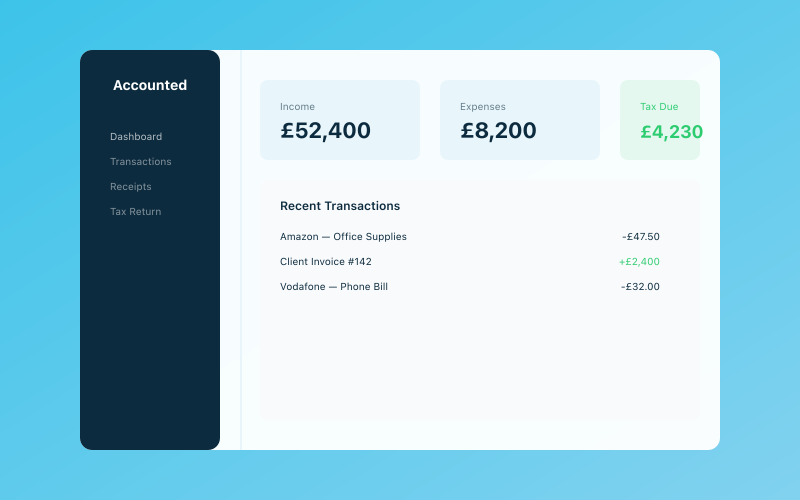 Your Accounted dashboard — income, expenses, and tax at a glance
The key thing to understand is that some work requires specific qualifications. You can't do gas work without being Gas Safe registered, and certain electrical work must be carried out by a qualified electrician. Know your limits, and subcontract specialist work to qualified professionals when needed. Many property maintenance businesses start with general handyman services and gradually expand as they gain experience, qualifications, and client trust.
Getting set up is straightforward, but there are a few important boxes to tick. Register as self-employed with HMRC — you'll need to register for Self Assessment to report your income and pay tax. Our guide to registering as self-employed with HMRC covers the whole process.
Consider your business structure — most start as sole traders, which is the simplest option. If you're concerned about personal liability on high-value properties, a limited company offers more protection but comes with more admin.
Insurance is non-negotiable in property maintenance. At an absolute minimum, you need public liability insurance (covers you if you damage a client's property or someone is injured because of your work — most clients and letting agents won't hire you without it), professional indemnity insurance, tool and equipment insurance, and vehicle insurance for business use. Our sole trader insurance guide goes into more detail on what to look for.
Check licensing requirements too — some work may require planning permission, building regulations approval, or specific certifications. If you're doing work involving waste disposal, you'll need a waste carrier licence from the Environment Agency.
You probably already own many of the tools you'll need: drill/driver, saws, multi-tool, levels and measures, spanners and pliers, pipe wrench, ladders, dust sheets, and PPE. A reliable van is practically essential — sign-writing it is also one of the cheapest and most effective forms of advertising. Invest in quality tools; cheap ones break on site, cost you time, and can be dangerous.
Pricing Your Work and Finding Clients
Pricing property maintenance work is part science, part experience. Hourly rate is the most common approach — most businesses charge between £25 and £50 per hour, depending on location, experience, and the type of work. London and the South East command higher rates. Always set a minimum call-out charge (typically one to two hours) to cover travel time and setup. Day rates of £200 to £400+ work well for larger jobs like painting, garden clearances, or multi-task property turnarounds. Fixed quotes suit defined projects, though you should build in a contingency for unexpected issues. Retainer or contract arrangements with landlords, letting agents, and property management companies provide fantastic recurring revenue.
Always be clear about what's included in your price. State whether materials are extra, whether there's a call-out fee, and what your payment terms are. Put quotes in writing — it protects both you and the client.
When it comes to finding clients, letting agents and landlords represent the single biggest opportunity. They need reliable, responsive tradespeople who can handle a range of tasks at short notice. Visit local letting agents, leave your card, and follow up. Once you've proven yourself reliable, the work tends to flow consistently. Property management companies managing commercial and residential portfolios are similar. Online platforms like Checkatrade, MyBuilder, Rated People, and Bark connect tradespeople with local customers — the leads can be competitive, but they're a good way to build reviews.
Word of mouth is your most powerful tool. Deliver great work, turn up when you say you will, and clean up after yourself. An alarming number of tradespeople fail at these fundamentals. Being reliable is your biggest competitive advantage. Local advertising through leaflet drops, community noticeboards, and local Facebook groups can also generate enquiries, and a simple website with a Google Business profile helps you appear in local search results.
Managing Your Finances
Property maintenance involves a lot of small transactions — materials from the builders' merchant, fuel costs, tool purchases, and varying invoice amounts from different clients. Staying on top of it all requires a bit of discipline.
Keep every receipt. Materials, fuel, parking, tools, PPE, insurance, van costs — they're all allowable expenses that reduce your tax bill. Snap a photo with your phone as soon as you get a receipt. Accounted's Penny feature can help by automatically categorising expenses as you go, so you're not drowning in paperwork at the end of the month.
Common allowable expenses for property maintenance businesses include materials and supplies, tools and equipment, van running costs (fuel, insurance, servicing, MOT), phone and internet, workwear and PPE, insurance premiums, marketing and advertising, accountancy and bookkeeping software, training and certifications, and waste disposal costs.
HMRC offers simplified expenses for vehicles and home office use, which can save time. For vehicles, you can claim a flat rate per mile (45p for the first 10,000 miles, 25p thereafter) instead of tracking actual costs. Set aside 25–30% of your income for your tax bill in a separate savings account — when your Self Assessment bill arrives, you'll be ready.
Invoice promptly. Don't wait until the end of the month. Bill as soon as a job is complete, and follow up on anything overdue. Cash flow problems sink more trades businesses than a lack of work does.
Growing Your Business and Avoiding Mistakes
Once you're established, there are clear paths to growth. Specialising in a particular niche — HMO maintenance, commercial property, listed buildings — lets you charge premium rates and become the go-to provider in your area. Building a team by taking on a labourer and then another tradesperson is the natural next step — just make sure you understand your obligations as an employer. Winning contracts from local authorities, housing associations, and large property management companies can be transformative for your revenue. Investing in qualifications like Part P electrical, plumbing qualifications, or asbestos awareness makes you more versatile and more valuable.
Having a plan for where you want the business to go makes these decisions easier. Our guide to writing a business plan can help you map it out.
The biggest mistakes to watch for: not getting insurance (one accident without public liability cover could end your business), underquoting (factor in travel time, materials markup, and contingency), saying yes to everything (if you're not qualified, say so and subcontract or refer), poor record-keeping (a shoebox full of receipts won't cut it when HMRC comes calling), and not chasing payments (be polite but firm — your work has value).
A property maintenance business offers freedom, variety, and solid earning potential. Every day is different, the demand is constant, and there's genuine satisfaction in fixing things and making properties better. Register with HMRC, get insured, load up the van, and start letting people know you're in business.
Related reading:
- How to Register as Self-Employed with HMRC
- How to Write a Business Plan
- The Complete Guide to Sole Trader Insurance
Accounted helps UK sole traders stay on top of their bookkeeping and tax. Start your free 30-day trial at getaccounted.co.uk.
Related Reading
- How to Start a Bookkeeping Business
- Military Veterans Starting Businesses — Grants and Tax Guide
- Starting a Business While on Maternity Leave — What You Need to Know
View our pricing and start your free 30-day trial today.
Starting out? Accounted is built for UK sole traders from day one — from £14/month. Get started →
Business & Operations Advisors
Our business advisors cover the practical side of running a UK sole trader business — from HMRC registration to managing growth. Content is written for real business owners in plain English, not accountants.
Ready to try Accounted?
Join UK sole traders who are simplifying their bookkeeping and tax.
Start your 14-day free trial