Military Veterans Starting Businesses — Grants and Tax Guide
Leaving the armed forces is one of the biggest transitions you'll ever make. After years of structure, camaraderie, and purpose, stepping into civilian life can feel disorienting — and the idea of starting your own business might seem both thrilling and terrifying in equal measure.
The good news is that military veterans are extraordinarily well-suited to running businesses. The discipline, leadership, problem-solving skills, and sheer determination you developed in service translate directly into entrepreneurship. And the UK has a growing network of grants, mentoring programmes, and support specifically designed to help ex-forces personnel start and grow businesses.
This guide covers the practical side — how to register, what you can claim, what grants are available, and how to keep HMRC happy while you build something of your own.
Why Veterans Make Excellent Business Owners
This isn't just motivational fluff. The statistics back it up. Veterans are more likely to start businesses than the general population, and their businesses tend to have higher survival rates. There are solid reasons for this.
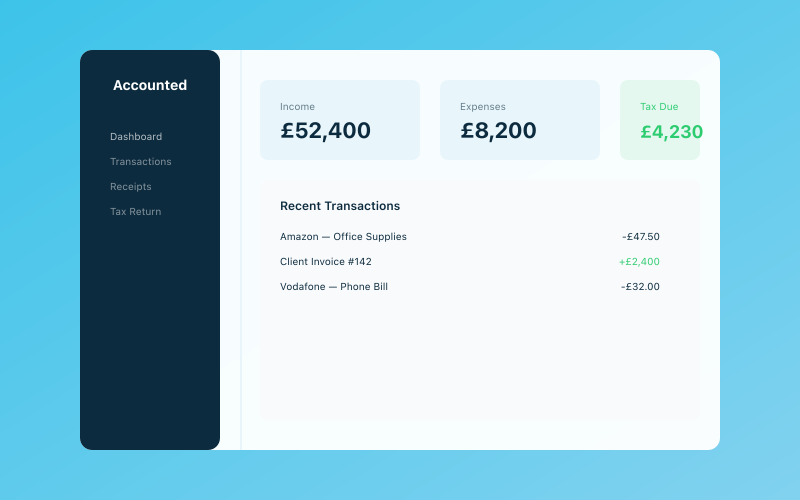 Your Accounted dashboard — income, expenses, and tax at a glance
Military training instils discipline and resilience — two qualities that are absolutely essential when you're building a business from scratch. You're used to operating under pressure, adapting to changing circumstances, and getting things done with limited resources. You understand leadership, logistics, and the importance of planning.
You also have a network. The forces community is strong, and ex-service personnel tend to support each other. That network can be invaluable when you're looking for your first clients, seeking advice, or simply needing someone who understands what you're going through.
The skills you developed in service — whether that's engineering, logistics, communications, medical training, or project management — are highly transferable. Many veterans build businesses directly related to their military expertise. Others use the transition as an opportunity to pursue something completely different. Either way, you're starting from a position of strength.
Grants and Funding for Ex-Forces Entrepreneurs
One of the most common questions veterans ask is where to find funding. Here are the main sources available in the UK.
X-Forces Enterprise (XFE) is the leading organisation supporting ex-military entrepreneurs. They offer free business start-up support, mentoring, and help with accessing Start Up Loans. Their programmes are specifically designed for the forces community, and their mentors understand the unique challenges of transitioning from military to civilian life.
Start Up Loans are government-backed personal loans of up to £25,000 with a fixed interest rate of 6%. They're available to anyone starting a business, but XFE can help veterans navigate the application process. The loans come with 12 months of free mentoring.
The Royal British Legion offers grants to veterans and their families, including financial support for business start-ups in some cases. Their grants are means-tested and typically aimed at those in financial difficulty, but it's worth enquiring.
SSAFA (Soldiers, Sailors, Airmen and Families Association) provides financial assistance and support to serving personnel, veterans, and their families. They can sometimes help with business-related costs.
The Officers' Association and Regular Forces Employment Association (RFEA) both offer career transition support, including guidance on self-employment and business start-ups.
Local enterprise partnerships across the UK run their own grant schemes, and some have specific provisions for veterans. Check what's available in your region through your local council or growth hub.
Enhanced Learning Credits (ELC) — if you're still within your eligibility window, these can be used for approved business-related training courses, which is a fantastic way to upskill before launching.
Registering Your Business and Understanding Tax
The tax system doesn't care whether you served Queen and country or spent your twenties in an office. The rules are the same for everyone, and you need to follow them from the start.
When you start your business, you must register as self-employed with HMRC within three months. This is straightforward — you can do it online, and it takes about ten minutes. You'll receive a Unique Taxpayer Reference (UTR) number, which you'll need for your tax returns.
Most veterans starting out will operate as sole traders. It's the simplest structure, there's no cost to set up, and the paperwork is minimal. You'll pay Income Tax on your profits and National Insurance contributions. If your business grows and you're earning enough to benefit from a different structure, you can always convert to a limited company later.
Your military pension is taxable income, and it's important to understand how it interacts with your business earnings. Your pension and business profits are added together to determine your total taxable income. This means that if your pension already uses up some of your personal allowance (£12,570 for 2025/26), your business profits will be taxed from a lower threshold.
For example, if your military pension is £15,000 per year and your business profits are £20,000, your total taxable income is £35,000. You've already exceeded the personal allowance through your pension, so all of your business profits are taxable at 20%.
This catches some veterans off guard, so it's worth factoring in from the beginning. Setting aside 25-30% of your business income for tax is a sensible approach, and using Accounted to track your income and expenses as you go means you'll always know where you stand.
What Expenses Can You Claim?
As a self-employed person, you can deduct allowable business expenses from your income before calculating your tax. This reduces your taxable profit and therefore your tax bill. Here are some common ones for veterans starting businesses:
- Equipment and tools — Whatever you need to do your job, from power tools to laptops to specialist equipment.
- Vehicle costs — If you use your car for business, you can claim either the simplified mileage rate (45p per mile for the first 10,000 miles, then 25p) or the actual costs of running the vehicle, proportioned for business use.
- Training and courses — Courses that update or maintain existing skills are generally deductible. Courses that teach you entirely new skills for a new trade may not be, though the rules can be nuanced.
- Insurance — Professional indemnity, public liability, and other business-related insurance premiums.
- Marketing and advertising — Website costs, business cards, online advertising, and networking event fees.
- Home office costs — If you work from home, you can claim a proportion of your household bills or use the simplified expenses flat rate.
- Software and subscriptions — Accounting software, CRM tools, industry memberships, and other digital subscriptions.
Keep records and receipts for everything. Penny, the AI assistant in Accounted, can help you categorise expenses automatically when you photograph your receipts — which saves a huge amount of time and makes sure nothing slips through the cracks.
For a comprehensive list of what you can and can't claim, check out our complete guide to sole trader expenses.
Making the Most of Your Transition Period
The transition from military to civilian life — and especially to self-employment — is a process, not an event. Give yourself time and use the resources available to you.
The Career Transition Partnership (CTP) is available to all service leavers and provides employment and business start-up support. If you haven't already engaged with them, do so. Their workshops on self-employment cover the basics of business planning, tax, and marketing.
Networking is crucial. Join veteran business networks like Veteran Owned Business (VOB) or attend events run by XFE. These connections can lead to clients, partnerships, and invaluable advice from people who've already made the journey.
Mentoring can be transformative. Many veteran support organisations offer one-to-one mentoring from experienced business owners — some of whom are veterans themselves. A good mentor can help you avoid common pitfalls and accelerate your growth.
Business planning might feel like paperwork for the sake of it, but it's genuinely useful. Even a simple one-page plan that covers what you're selling, who you're selling to, how much you'll charge, and what your costs are will give you clarity and direction. Our business plan guide can help you get started.
Don't try to do everything at once. Many successful veteran entrepreneurs started their businesses as side projects while still in employment (or during their resettlement period), testing the market before committing fully. There's no shame in taking a phased approach.
Common Pitfalls to Avoid
Having worked with many veterans through their first year of self-employment, here are the mistakes we see most often:
Not separating personal and business finances. Open a dedicated business bank account from day one. It makes bookkeeping infinitely easier and keeps things clean if HMRC ever asks to see your records.
Undercharging. Veterans are often modest about the value of their skills. Research what competitors charge and price accordingly. You're not doing anyone a favour by working for less than you're worth — least of all yourself.
Ignoring tax until January. Your Self Assessment tax return is due by 31 January each year, but if you leave everything until the last minute, you'll be stressed, rushed, and more likely to make mistakes. Keep your records up to date throughout the year, and you'll breeze through the process.
Not claiming legitimate expenses. Every allowable expense you miss is money you're effectively giving away to HMRC. Track everything from the start.
Going it alone when help is available. There's a tendency in the forces community to crack on and figure things out independently. That's admirable, but there's a lot of free support available — use it.
Your Next Steps
Starting a business after military service is a bold move, but it's one that thousands of veterans make successfully every year. You've got the skills, the discipline, and the resilience. Now it's about channelling those qualities into something that works for you.
Here's a simple checklist to get you started:
- Research your business idea and check that there's a market for it.
- Write a basic business plan.
- Register as self-employed with HMRC.
- Open a separate business bank account.
- Set up a system for tracking income and expenses.
- Look into grants and support through XFE, CTP, and other veteran organisations.
- Start building your network.
Accounted helps UK sole traders stay on top of their bookkeeping and tax. Start your free 30-day trial at getaccounted.co.uk.
Related reading:
- Your First Year of Self-Employment — A Complete Guide
- How to Register as Self-Employed With HMRC
- How to Write a Business Plan
Related Reading
- How to Start a Bookkeeping Business
- NHS Workers Going Private — Tax When Transitioning to Self-Employment
- Tax Implications of Converting a Hobby to a Business
View our pricing and start your free 30-day trial today.
Starting out? Accounted is built for UK sole traders from day one — from £14/month. Get started →
Business & Operations Advisors
Our business advisors cover the practical side of running a UK sole trader business — from HMRC registration to managing growth. Content is written for real business owners in plain English, not accountants.
Ready to try Accounted?
Join UK sole traders who are simplifying their bookkeeping and tax.
Start your 14-day free trial