Government Grants for Small Businesses — Where to Find Them
Free money. Two words that instantly get any business owner's attention. And while government grants for small businesses aren't quite as simple as someone handing you a cheque with no strings attached, they are one of the few forms of funding you don't have to pay back. That alone makes them worth exploring.
The challenge? Finding the right grants, understanding whether you're eligible, and navigating the application process — which can sometimes feel like writing a dissertation. But if you know where to look and how to present your case, grants can provide a genuine boost to your business without the burden of debt.
Let's walk through where to find them, what's available, and how to give yourself the best chance of success.
What Are Government Grants, Exactly?
A government grant is a sum of money given by a government body (national, regional, or local) to a business or individual for a specific purpose. Unlike loans, grants don't need to be repaid — but they usually come with conditions.
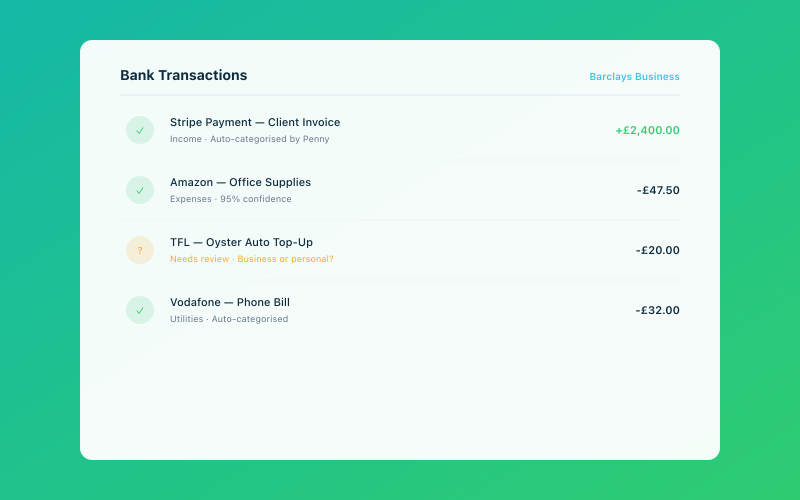 Penny auto-categorises your bank transactions with 95%+ accuracy
Common conditions include:
- The money must be used for a specific purpose — such as research and development, training, equipment, or hiring staff.
- You may need to match the funding — many grants require you to contribute a proportion of the project cost yourself (often 30% to 50%).
- You'll need to report on how the money was spent — grant providers want evidence that the funds were used as intended.
- There may be eligibility criteria — location, industry, business size, trading history, and other factors can determine whether you qualify.
It's also worth knowing that grants are competitive. There's usually a fixed pot of money, and not everyone who applies will receive funding. Strong applications with clear plans and measurable outcomes tend to win.
Where to Find Government Grants
The UK grant landscape is fragmented, with funding available at national, devolved, regional, and local levels. Here are the main places to search:
GOV.UK business finance finder
The government's own search tool at gov.uk/business-finance-support is the best starting point. You can filter by business size, location, industry, and the type of support you're looking for. It covers grants, loans, and other forms of assistance from both government and private sector partners.
Innovate UK
If your business involves innovation, research, or technology, Innovate UK (part of UK Research and Innovation) runs regular funding competitions. These range from small grants of a few thousand pounds to multi-million pound projects. Competitions are listed on the Innovate UK website and the UKRI funding finder.
Innovate UK grants typically require you to be doing something genuinely novel — not just running a standard business but developing new products, processes, or services.
Devolved governments
Scotland, Wales, and Northern Ireland each have their own grant schemes:
- Scotland: Business Gateway and Scottish Enterprise offer various grants and support programmes. The Scottish Government website lists available funding.
- Wales: Business Wales provides a single point of access for Welsh Government business grants and loans.
- Northern Ireland: Invest Northern Ireland offers grants, loans, and other support for businesses based in Northern Ireland.
- England: Funding in England is often delivered through Local Enterprise Partnerships (LEPs) and combined authorities rather than a single national body.
Local authorities and councils
Your local council may offer small grants for businesses in your area. These are often targeted at specific objectives — creating jobs, regenerating high streets, supporting the green economy, or helping businesses in deprived areas. Check your council's website or call their business support team.
Growth hubs
Growth hubs are regional business support organisations funded by the government. They offer free advice, mentoring, and signposting to funding opportunities. You can find your local growth hub through the GOV.UK website.
Industry-specific grants
Some industries have their own grant programmes. For example:
- Agriculture: The Farming Investment Fund and Countryside Stewardship offer grants for farming businesses.
- Creative industries: Arts Council England, Creative Scotland, and similar bodies provide grants for creative businesses and projects.
- Energy and environment: Grants for energy efficiency improvements, renewable energy installations, and environmental projects are available through various schemes.
Types of Grants Available
Grants come in many shapes and sizes. Here are some of the most common types for small businesses and sole traders:
Capital grants
These fund the purchase of physical assets — equipment, machinery, vehicles, or premises improvements. You'll typically need to get quotes and demonstrate that the purchase is essential for your business growth or productivity.
Revenue grants
These cover ongoing costs such as staff wages, training, marketing, or professional services. They're less common than capital grants but can be incredibly helpful for businesses looking to scale.
Match-funded grants
The most common structure. The grant covers a percentage of your project cost (often 30% to 70%), and you fund the rest yourself. For example, a 50% match-funded grant towards a £10,000 piece of equipment would give you £5,000 in grant funding, with you contributing the other £5,000.
Innovation grants
Specifically for research and development, prototyping, or bringing new products to market. Often more generous in terms of funding percentage but also more competitive.
Training and skills grants
Fund professional development, qualifications, or staff training. These can help you develop your own skills or invest in your team.
How to Apply Successfully
Grant applications take time and effort. Here's how to maximise your chances:
Read the criteria carefully
This sounds obvious, but a surprising number of applications are rejected because the applicant simply doesn't meet the eligibility criteria. Before you invest time in an application, make sure you tick every box. If you're not sure, contact the grant provider and ask.
Be specific about what you'll do with the money
"Grow my business" isn't a plan. "Purchase a CNC machine to increase production capacity by 40%, enabling us to fulfil three additional contracts worth £50,000 in annual revenue" is a plan. Grant assessors want to see clear, measurable outcomes.
Demonstrate the impact
Grants are public money, and providers need to justify their spending. Show how the grant will benefit not just your business but the wider economy — creating jobs, increasing exports, reducing carbon emissions, supporting your local community, or driving innovation.
Get your finances in order
Most grant applications require financial information — turnover, profit, cash flow forecasts, and sometimes full accounts. Having your books meticulously maintained in Accounted means you can produce these figures quickly and accurately. Penny helps keep everything organised so you're not scrambling to put numbers together at the last minute.
Write clearly and concisely
Grant assessors read dozens (sometimes hundreds) of applications. Clear, jargon-free writing that gets to the point will serve you much better than waffle. If you're not confident in your writing, consider getting someone to proofread your application. Our guide on writing a business plan covers similar skills.
Submit early
Don't wait until the deadline. Early submissions give you time to address any queries from the grant provider, and some schemes operate on a first-come, first-served basis.
Keep records of everything
If you're awarded a grant, you'll need to provide evidence of how the money was spent. Keep all receipts, invoices, and proof of payment. This is where solid bookkeeping habits really pay off.
Common Pitfalls to Avoid
Starting work before the grant is confirmed. Many grants require that you haven't already started the project before the funding is approved. If you've already bought the equipment or hired the staff, you may be ineligible.
Ignoring match funding requirements. If the grant requires you to fund 50% of the project yourself, you need to have that money available. Don't assume you'll find it later.
Treating grant money as free income. Grants are given for a specific purpose and must be spent accordingly. Using grant money for something other than what was agreed can result in clawback — being asked to return the funds.
Forgetting about tax. Grant income is generally taxable. It counts as business income and will be included in your Self Assessment. Factor this into your financial planning so the tax bill doesn't come as a surprise.
Giving up after one rejection. Grant applications are competitive, and rejection is common. Don't be discouraged. Ask for feedback, improve your application, and try again — or look for alternative grants that might be a better fit.
Grants vs. Loans — Which Is Right for You?
Grants are undeniably attractive because they don't need to be repaid. But they have significant limitations:
- They're competitive and not guaranteed.
- The application process is time-consuming.
- The money is restricted to specific purposes.
- Match funding requirements mean you still need cash of your own.
- Reporting obligations add an administrative burden.
Loans, by contrast, are more readily available, can be used more flexibly, and the application process is often faster. The trade-off is that you have to pay them back with interest.
For many small businesses, the right approach is to apply for grants where available while keeping loan options open as a backup. And some businesses use both — a grant to cover part of a project and a loan to fund the rest.
Staying Up to Date
Grant programmes change frequently. New schemes launch, existing ones close, and eligibility criteria shift. The best way to stay informed is to:
- Check GOV.UK regularly.
- Sign up for newsletters from your local growth hub or LEP.
- Follow relevant government departments and agencies on social media.
- Speak to your accountant or business adviser about opportunities they've spotted.
Finding and securing grants takes effort, but for the right business with the right project, they can provide a meaningful financial boost without adding to your debt. It's always worth looking.
Related Reading
Try Accounted free for 30 days — no credit card required.
Accounted helps UK sole traders stay on top of their bookkeeping and tax. Start your free 30-day trial at getaccounted.co.uk.
Accounted makes bookkeeping simple — Penny categorises your transactions automatically so you don't have to. See how →
Tax & Compliance Specialists
Our tax specialists have decades of combined experience in UK sole trader and small business taxation, MTD compliance, and HMRC submissions. All content is reviewed against current HMRC guidance before publication and updated quarterly to reflect legislative changes.
Ready to try Accounted?
Join UK sole traders who are simplifying their bookkeeping and tax.
Start your 14-day free trial