Business Credit Cards — Should You Get One?
If you're running a small business or working as a sole trader, the question of whether to get a business credit card has probably crossed your mind. Maybe you've seen the adverts promising cashback and rewards, or perhaps you're looking for a cleaner way to separate your personal and business spending. Either way, it's worth understanding what business credit cards actually offer — and whether the benefits outweigh the risks for someone in your position.
Let's break it down properly.
What Is a Business Credit Card, Exactly?
A business credit card works much like a personal credit card, but it's designed for business use. You get a credit limit, you make purchases, and you either pay the balance in full each month or pay it off over time (with interest, naturally).
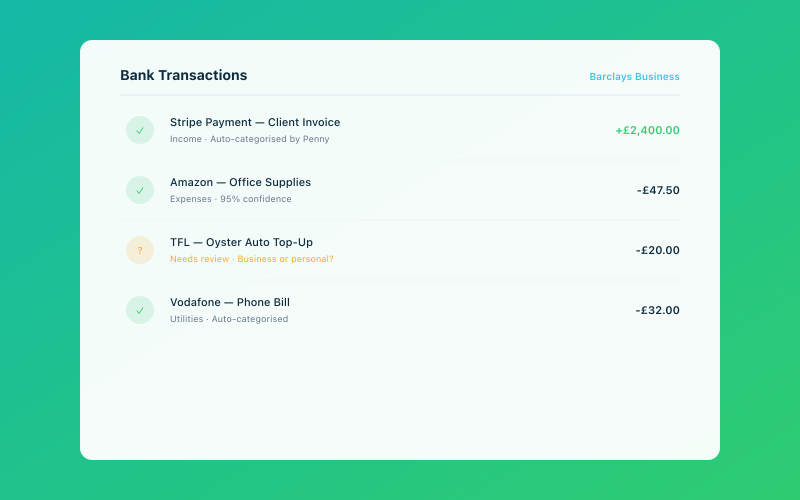 Penny auto-categorises your bank transactions with 95%+ accuracy
The key differences from a personal card are:
- It's in your business name (though as a sole trader, you're personally liable for the debt — more on that later).
- It's intended for business expenses only — supplies, travel, subscriptions, client entertaining, and so on.
- It may offer business-specific perks such as expense management tools, employee cards, and higher credit limits.
- Spending is reported separately, which helps keep your personal and business finances apart.
It's worth noting that sole traders don't have the legal separation between personal and business finances that limited companies do. So while a business credit card is a useful organisational tool, you're still personally responsible for any debt on it.
The Advantages of Having a Business Credit Card
There are some genuinely useful reasons to consider one:
Cleaner expense tracking
When all your business spending goes through one card, your bookkeeping becomes significantly easier. No more trawling through personal bank statements trying to work out which Costa receipt was a client meeting and which was a weekend treat. If you're using Accounted, having a dedicated business card means Penny can categorise your expenses more accurately, saving you time at the end of each month.
Improved cash flow
Credit cards give you a buffer between making a purchase and actually paying for it. Most cards offer an interest-free period of up to 56 days, which means you can buy supplies or pay for travel now and settle up when your client payments come in. For businesses with irregular cash flow, this flexibility can be genuinely valuable.
Building business credit history
If you ever plan to apply for a business loan, mortgage, or other finance, having a business credit card that you manage responsibly helps build your credit profile. Lenders like to see a track record of borrowing and repaying on time.
Rewards and cashback
Some business credit cards offer cashback on purchases (typically 0.5% to 1%), air miles, or other rewards. If you're spending several thousand pounds a year on business expenses anyway, you might as well get something back. Just make sure the rewards actually outweigh any annual fees.
Protection under Section 75
Purchases between £100 and £30,000 made on a credit card are protected under Section 75 of the Consumer Credit Act. If a supplier goes bust or doesn't deliver what was promised, you can claim a refund from your card provider. This doesn't apply to debit cards, so it's an added layer of protection for bigger purchases.
The Disadvantages and Risks
Of course, it's not all upside. Here are the things to watch out for:
Interest charges
If you don't pay your balance in full each month, interest rates on business credit cards can be steep — often 20% to 30% APR. That cashback reward looks a lot less attractive when you're paying 25% interest on an outstanding balance. The golden rule: if you can't commit to paying the full balance every month, a credit card might create more problems than it solves.
Annual fees
Many business credit cards charge annual fees, ranging from £30 to over £100. For a sole trader with modest spending, the fee might outweigh any rewards you earn. Always do the maths before signing up.
Personal liability
As a sole trader, there's no corporate veil protecting you. If your business can't pay the credit card bill, you're personally responsible. This is different from a limited company, where the company's debts are (usually) the company's problem. Make sure you're comfortable with this before taking on business credit.
Temptation to overspend
Easy access to credit can encourage spending that isn't strictly necessary. That shiny new piece of equipment or premium software subscription might feel justifiable when you're not paying for it today — but the bill always comes eventually.
Impact on personal credit
Since sole traders are personally liable, a business credit card will typically appear on your personal credit file. Late payments or high utilisation can affect your personal credit score, which could impact your ability to get a mortgage or personal loan.
What to Look for When Comparing Cards
If you've decided a business credit card makes sense, here's what to compare:
Interest rate (APR). Even if you plan to pay in full each month, life doesn't always go to plan. A lower APR gives you a safety net.
Interest-free period. The longer the interest-free period on purchases, the more flexibility you have. Some cards offer 0% on purchases for an introductory period (often 3 to 12 months), which can be helpful for larger investments.
Annual fee. Weigh this against the rewards on offer. A £50 annual fee is fine if you're earning £200 in cashback. It's less fine if you're earning £30.
Cashback or rewards. Look at the percentage, any caps on earnings, and whether the rewards are actually useful to you. Air miles are pointless if you never fly for business.
Credit limit. Make sure it's high enough for your needs but not so high that it tempts you into unnecessary spending.
Expense management features. Some cards come with apps or integrations that categorise spending automatically. If your card feeds into your accounting software, even better.
Employee cards. If you have staff or subcontractors who make purchases on your behalf, some cards let you issue additional cards with individual spending limits.
Popular Business Credit Cards in the UK
Without making specific recommendations (since offers change frequently), here are some of the main providers worth researching:
- American Express Business Gold — known for strong rewards, though not accepted everywhere.
- Barclaycard Business Select — competitive rates and widely accepted.
- Capital on Tap — popular with small businesses, quick approval process.
- HSBC Business Credit Card — good if you already bank with HSBC.
- NatWest Business Credit Card — straightforward option with reasonable terms.
Always check the latest rates and terms before applying. Comparison sites like MoneySuperMarket and Finder can help you see current offers side by side.
Sole Trader vs. Limited Company — Does It Matter?
Yes, it does. As mentioned earlier, sole traders are personally liable for business credit card debt. There's no legal distinction between you and your business, so the debt is yours regardless.
For limited company directors, the situation is slightly different. The card can be in the company's name, and the company is liable for the debt. However, many providers will still require a personal guarantee from the director, especially for newer or smaller businesses. So the protection isn't always as robust as it seems.
If you're weighing up whether to stay as a sole trader or incorporate, the question of liability is one of many factors to consider. But for most small-scale freelancers and sole traders, a business credit card used responsibly is perfectly manageable without the added complexity of a limited company.
Best Practices for Using a Business Credit Card
If you decide to go ahead, these habits will keep you out of trouble:
-
Pay the full balance every month. This is non-negotiable if you want to avoid interest charges. Set up a Direct Debit for the full amount so you never miss a payment.
-
Use it only for business expenses. Mixing personal and business spending defeats one of the main purposes of having the card. Keep personal purchases on your personal card.
-
Track every transaction. Don't wait until the statement arrives. Log expenses as they happen — Accounted makes this straightforward with automatic transaction feeds and Penny's smart categorisation.
-
Review your statement monthly. Check for errors, fraudulent charges, and spending patterns. Are you spending more than you expected in certain categories?
-
Keep your utilisation low. Try to use less than 30% of your credit limit at any given time. High utilisation can negatively affect your credit score.
-
Don't treat it as an emergency fund. A credit card is not a substitute for proper savings. If you don't have an emergency fund yet, building one should be a higher priority than getting a credit card. Check out our guide on the best business bank accounts as a starting point for getting your finances organised.
The Verdict
A business credit card can be a genuinely useful tool for sole traders and freelancers — but only if you use it wisely. The benefits of cleaner bookkeeping, improved cash flow, purchase protection, and rewards are real. But the risks of interest charges, overspending, and personal liability are equally real.
If you're disciplined with money, pay your bills on time, and want a cleaner separation between personal and business spending, a business credit card is well worth considering. If you're already struggling with cash flow or debt, it's probably best to focus on stabilising your finances first.
As with most financial decisions, the right answer depends on your specific situation. Take the time to compare your options, read the terms carefully, and make sure you're getting a card that genuinely works for your business — not just one with a flashy welcome offer.
Related Reading
-
Accruals and Prepayments — What They Are and Why They Matter
-
Getting a Mortgage When You're Self-Employed — The 2026 Guide
Try Accounted free for 30 days — no credit card required.
Accounted helps UK sole traders stay on top of their bookkeeping and tax. Start your free 30-day trial at getaccounted.co.uk.
Accounted makes bookkeeping simple — Penny categorises your transactions automatically so you don't have to. See how →
Tax & Compliance Specialists
Our tax specialists have decades of combined experience in UK sole trader and small business taxation, MTD compliance, and HMRC submissions. All content is reviewed against current HMRC guidance before publication and updated quarterly to reflect legislative changes.
Ready to try Accounted?
Join UK sole traders who are simplifying their bookkeeping and tax.
Start your 14-day free trial