The Best Business Bank Accounts for Sole Traders in 2026
Choosing a business bank account used to be simple — you walked into your local branch, sat down with someone in a suit, and walked out with a chequebook. In 2026, the landscape looks rather different. Between digital-first challengers, traditional high street banks modernising their offerings, and a growing number of fintech startups, sole traders have more choice than ever.
That's good news, but it can also be overwhelming. Do you go with a free account and accept fewer features? Pay a monthly fee for better tools and support? Stick with a bank you know, or try something new?
We've compared the most popular options to help you find the right fit. Whether you're just starting out or looking to switch, this guide covers what matters most: fees, features, integrations, and the overall experience of using each account day to day.
Do You Actually Need a Business Bank Account?
Legally, sole traders aren't required to have a separate business bank account. You can technically run your business through your personal account. But practically? Separating your personal and business finances is one of the best things you can do for your sanity and your bookkeeping.
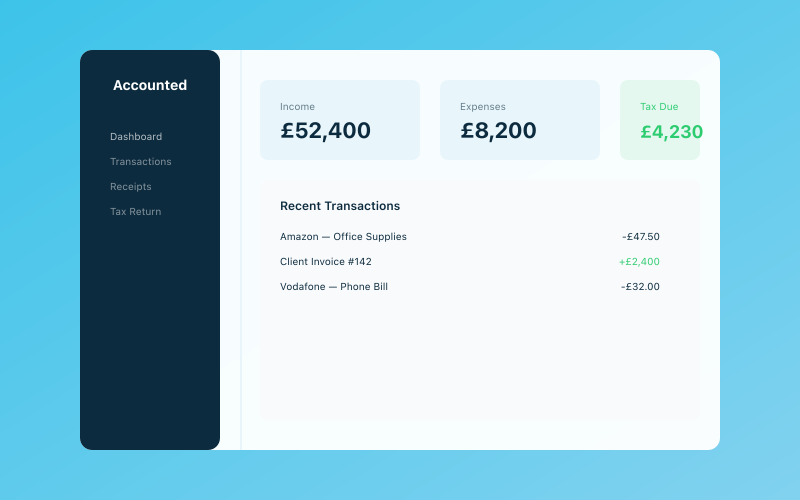 Your Accounted dashboard — income, expenses, and tax at a glance
A dedicated business account gives you:
- A clean record of all business income and expenses
- Easier bookkeeping and Self Assessment preparation
- A more professional image (clients pay into a business-named account)
- Better visibility of your cash flow and profitability
- Simpler compliance with Making Tax Digital requirements
For a deeper look at whether you need one, read our guide: Do I need a business bank account as a sole trader?
What to Look for in a Business Bank Account
Before we dive into specific accounts, here are the key factors to consider:
Fees and charges
- Monthly fee — Some accounts are free; others charge £5–£15+ per month
- Transaction fees — Charges per payment, transfer, or cash deposit
- ATM fees — Charges for cash withdrawals
- Foreign transaction fees — Important if you work with international clients
Features
- Mobile app quality — You'll use this daily, so it needs to be good
- Invoicing tools — Some accounts include basic invoicing
- Tax savings pots — Ability to set aside money for your tax bill
- Sub-accounts — Useful for organising money by purpose
- Overdraft facilities — Helpful for managing cash flow gaps
Integrations
Does the account connect with your bookkeeping software? Automatic bank feeds save enormous amounts of time. Most modern banks integrate with popular accounting tools, but it's worth checking before you sign up.
Support
When something goes wrong, can you reach someone quickly? Consider whether you want phone support, in-app chat, or the option to visit a branch in person.
The Best Business Bank Accounts for Sole Traders
Starling Bank Business
Monthly fee: Free Transaction fees: None for standard UK payments Cash deposits: £300 free per month at Post Office, then 0.7%
Starling has become a firm favourite among sole traders, and it's easy to see why. The account is genuinely free — no monthly charges, no transaction fees, and no minimum balance requirements. The mobile app is excellent, with real-time notifications, spending insights, and the ability to create separate "Spaces" for different purposes (like a tax savings pot).
Standout features:
- Automatic categorisation of spending
- Built-in savings spaces for tax
- Integration with most major accounting software (including Accounted)
- Apple Pay and Google Pay support
- Cash deposits at any Post Office
Best for: Sole traders who want a full-featured, free account with an excellent app.
Monzo Business
Monthly fee: Free (Lite) / £7 per month (Pro) Transaction fees: None for standard UK payments Cash deposits: £300 free per month at PayPoint, then 0.5%
Monzo's business account benefits from the same slick app that made their personal accounts so popular. The free Lite plan covers the basics, while the Pro plan adds features like invoicing, multi-user access, and tax tools.
Standout features:
- Intuitive, well-designed app
- Instant notifications for every transaction
- Pots for organising money (tax, expenses, savings)
- Built-in invoicing on the Pro plan
- Strong open banking integrations
Best for: Sole traders who already love Monzo's personal banking and want a seamless business account.
Tide
Monthly fee: Free (basic) / £9.99 per month (Plus) / £49.99 (Cashback) Transaction fees: 20p per bank transfer on the free plan Cash deposits: Not directly supported (via PayPoint for £1 per deposit)
Tide positions itself as more than a bank account — it's a business finance platform. The free account includes invoicing, expense management, and automatic categorisation. Higher-tier plans add features like cashback on card spending and priority support.
Standout features:
- Built-in invoicing and expense tracking
- Automatic receipt scanning
- Company formation service (useful if you later decide to incorporate)
- Integrations with accounting software
- Multi-currency accounts on paid plans
Best for: Sole traders who want invoicing and basic accounting features built into their banking.
HSBC Kinetic
Monthly fee: Free for 12 months, then £6.50 per month Transaction fees: None for electronic payments Cash deposits: Free at HSBC branches
If you prefer the reassurance of a major high street bank, HSBC Kinetic is a solid option. It combines the digital-first experience of a challenger bank with the backing and branch network of one of the world's largest banks.
Standout features:
- Branch access for cash deposits and in-person support
- Overdraft facilities available
- Cash flow forecasting tools
- Integration with popular accounting software
- 24/7 fraud protection
Best for: Sole traders who want a digital banking experience with the option of branch support.
NatWest / RBS Business
Monthly fee: Free for 12 months, then varies Transaction fees: Varies by plan Cash deposits: Free at NatWest/RBS branches
NatWest (and RBS in Scotland) offers a straightforward business account with a 12-month free banking period. Their mobile app has improved significantly, and they offer useful features like cash flow management tools and dedicated business support.
Standout features:
- Free banking for the first year
- Branch network across the UK
- Business lending and overdraft options
- Dedicated business banking support
- Free business health checks
Best for: Sole traders who value in-person banking and may need access to lending products.
Revolut Business
Monthly fee: Free (basic) / £7 per month (Grow) / £25 per month (Scale) Transaction fees: None on domestic payments (limits on free plan) Cash deposits: Not supported
Revolut's business account is particularly strong for sole traders who deal with international clients. Their multi-currency features and competitive exchange rates make it a standout choice for freelancers who regularly send or receive payments in foreign currencies.
Standout features:
- Hold and exchange 25+ currencies at competitive rates
- Multi-currency cards
- Team member access on higher plans
- API integrations
- Expense management tools
Best for: Sole traders who work internationally or deal in multiple currencies.
Comparison at a Glance
| Account | Monthly Fee | Transaction Fees | Cash Deposits | Accounting Integration | |---|---|---|---|---| | Starling | Free | None | Post Office (£300 free) | Yes | | Monzo Business | Free / £7 | None | PayPoint (£300 free) | Yes | | Tide | Free / £9.99 | 20p per transfer (free plan) | PayPoint (£1) | Yes | | HSBC Kinetic | Free (12 months) | None (electronic) | HSBC branches | Yes | | NatWest | Free (12 months) | Varies | NatWest branches | Yes | | Revolut Business | Free / £7 | None (with limits) | Not supported | Yes |
Our Recommendations
Best overall for most sole traders: Starling Bank Business. It's genuinely free, has an excellent app, integrates well with accounting software, and the savings spaces feature is perfect for setting aside tax money. It's hard to beat for everyday sole trader banking.
Best for international freelancers: Revolut Business. If you regularly deal in foreign currencies, Revolut's exchange rates and multi-currency features are a significant advantage over traditional banks.
Best for branch access: HSBC Kinetic or NatWest. If you need to deposit cash regularly or prefer the option of in-person support, these high street options still have clear advantages over digital-only banks.
Best for all-in-one features: Tide. If you want invoicing, expense tracking, and banking in a single platform, Tide offers good value — though you may prefer to use dedicated tools for each function.
Connecting Your Bank Account to Your Bookkeeping
Whichever bank you choose, connecting it to your bookkeeping software is a must. Automatic bank feeds import your transactions directly, saving you from manual data entry and reducing the chance of errors.
With Accounted, you can connect your business bank account and have transactions automatically imported and categorised. Penny, our AI assistant, even learns your spending patterns over time, making categorisation faster and more accurate the longer you use it.
This integration is particularly valuable for cash flow management — you can see exactly where your money is going without waiting for a monthly statement.
Switching Banks: Is It Worth the Hassle?
If you're already using a business bank account that isn't quite right for you, switching is easier than you might think. The Current Account Switch Service (CASS) handles most of the heavy lifting, automatically moving your direct debits and redirecting incoming payments.
Before you switch, make sure your new bank integrates with your existing bookkeeping software, and plan the transition for a quiet period in your business — you don't want payment disruptions during your busiest month.
The Bottom Line
The best business bank account is the one that fits your specific needs. If you're just starting out and want to keep costs minimal, a free account from Starling or Monzo is hard to beat. If you need branch access or lending facilities, the traditional banks still have their place.
Whatever you choose, the most important step is simply having a dedicated business account. It's the foundation of good financial management and makes everything — from bookkeeping to tax returns to understanding your profitability — significantly easier.
Accounted helps UK sole traders stay on top of their bookkeeping and tax. Start your free 30-day trial at getaccounted.co.uk.
Related reading:
- How to Separate Personal and Business Finances
- Do I Need a Business Bank Account as a Sole Trader?
- Cash Flow Management for Sole Traders
Related Reading
- Annual Accounts for Small Companies — What's Required
- Pivoting Your Business — When and How to Change Direction
Start your free trial and see how Accounted simplifies your bookkeeping.
Accounted keeps your books sorted automatically so you can focus on running your business. See Accounted →
Business & Operations Advisors
Our business advisors cover the practical side of running a UK sole trader business — from HMRC registration to managing growth. Content is written for real business owners in plain English, not accountants.
Ready to try Accounted?
Join UK sole traders who are simplifying their bookkeeping and tax.
Start your 14-day free trial