How to Separate Personal and Business Finances
When you first start out as a sole trader, mixing personal and business finances feels natural. Money comes in, money goes out, it all ends up in the same bank account. What's the harm?
Quite a lot, as it turns out. That jumbled mess of Tesco shops, client payments, petrol receipts, and Netflix subscriptions becomes a nightmare when January rolls around and you need to file your Self Assessment. Suddenly you're scrolling through twelve months of bank statements trying to remember whether that £47.50 charge was a business lunch or your mum's birthday dinner.
Separating your personal and business finances is one of the simplest, most impactful things you can do as a sole trader. It saves time, reduces stress, and gives you a clear picture of how your business is actually performing. Let's look at how to do it properly.
Why Separation Matters
Cleaner bookkeeping
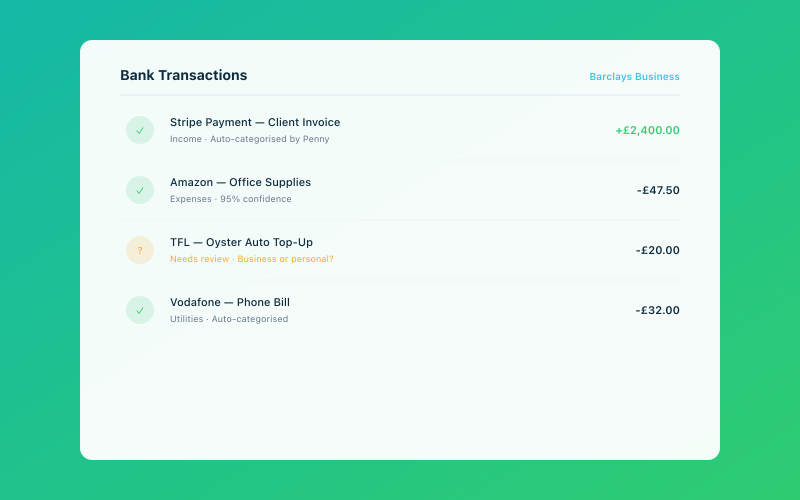 Penny auto-categorises your bank transactions with 95%+ accuracy
When all your business transactions are in one place, categorising income and expenses becomes straightforward. Instead of sifting through hundreds of mixed transactions, you're working with a clean set of business-only data. This makes bookkeeping faster, more accurate, and far less tedious.
With Making Tax Digital for Income Tax now requiring quarterly submissions for many sole traders, having tidy financial records isn't just nice to have — it's essential.
Easier Self Assessment
Come tax return time, clean records mean fewer headaches. You'll be able to see your total income and expenses at a glance, and you won't waste hours trying to separate business transactions from personal ones. If you use bookkeeping software like Accounted with automatic bank feeds, your business bank account connects directly, and most of the categorisation happens automatically.
Better financial clarity
When your business finances are separate, you can see exactly how much money your business is making — and spending. This gives you genuine insight into your profitability, cash flow patterns, and whether you're charging enough for your services.
It's hard to make good business decisions when your revenue is mixed in with your salary, savings, and personal spending. Separation gives you clarity.
HMRC compliance
While HMRC doesn't legally require sole traders to have a separate business bank account, they do require you to keep accurate records of your business income and expenses. Having everything in one dedicated account makes this dramatically easier — and far more defensible if you're ever investigated.
For more on whether you need a dedicated account, read our detailed guide: Do I need a business bank account as a sole trader?
Step 1: Open a Business Bank Account
The foundation of financial separation is a dedicated business bank account. This doesn't have to be a formal "business account" — you could use a second personal account — but a proper business account has advantages:
- Professional image — Clients pay into an account with your business name
- Business-specific features — Invoicing tools, accounting integrations, expense categorisation
- Easier to manage — Designed for business banking needs
In 2026, there are excellent options for sole traders, from fee-free digital banks like Starling and Monzo Business to more traditional options from the high street banks. Many offer free accounts for sole traders, so you don't necessarily need to pay monthly fees.
What to look for in a business bank account
- Monthly fees (or lack thereof)
- Transaction limits and charges
- Integration with your bookkeeping software
- Quality of the mobile app
- Ability to create sub-accounts or savings pots
- Customer support quality
Step 2: Set Up a System for Paying Yourself
One of the trickiest aspects of sole trader life is deciding how to pay yourself. Unlike employees who receive a regular salary, sole traders need to actively manage the flow of money between business and personal accounts.
The regular transfer method
The simplest approach is to set up a regular transfer from your business account to your personal account — a "salary" of sorts. This could be weekly, fortnightly, or monthly, depending on your income patterns.
How to decide the amount:
- Calculate your average monthly profit (income minus business expenses)
- Set aside approximately 25–30% for tax and National Insurance
- Transfer the remainder as your personal income
This method gives you a predictable personal income while ensuring your tax money stays in the business account where it belongs.
The percentage method
If your income varies significantly month to month (as it does for many freelancers), a percentage-based approach might work better. Each time you receive a payment:
- Transfer 25–30% to a dedicated tax savings pot
- Transfer an agreed percentage to your personal account
- Leave the rest in the business account for expenses and buffer
Setting aside money for tax
This is crucial and worth emphasising. As a sole trader, you'll pay Income Tax and National Insurance on your profits. For the 2025/26 tax year:
- Personal Allowance: £12,570 (no tax due)
- Basic rate: 20% on taxable income from £12,571 to £50,270
- Higher rate: 40% on taxable income from £50,271 to £125,140
- Class 2 NI: £3.45 per week
- Class 4 NI: 6% on profits between £12,570 and £50,270, then 2% above that
A common rule of thumb is to set aside 25–30% of your profit for tax and NI. If you're earning well above the basic rate threshold, bump that up to 35–40%.
Many business bank accounts let you create separate "pots" or sub-accounts specifically for tax savings. Use them. There's nothing worse than a surprise tax bill when you've already spent the money.
Step 3: Use Your Business Account Exclusively for Business
This sounds obvious, but it requires discipline. Once you've opened a business account, use it only for business transactions:
Use your business account for:
- Receiving client payments
- Paying for business supplies and equipment
- Software subscriptions used for your business
- Business travel costs
- Professional development and training
- Insurance premiums
- Marketing and advertising costs
Use your personal account for:
- Groceries and household shopping
- Personal subscriptions (Netflix, Spotify, gym)
- Social activities and dining out (unless genuinely for business)
- Personal travel
- Mortgage or rent payments
- Personal savings
What about mixed-use expenses?
Some expenses straddle both personal and business use — your phone bill, home broadband, or a car used for both personal and work journeys, for example.
For these, the simplest approach is to pay from your personal account and then claim the business portion as an expense. For example, if you use your phone 60% for business, you'd claim 60% of the bill. Record this in your bookkeeping system and keep evidence of how you calculated the split.
For more on claiming mixed-use expenses, particularly if you work from home, check out our guide on working from home expenses.
Step 4: Track Everything in Bookkeeping Software
Having a separate business account is a great start, but you'll get the most benefit by connecting it to proper bookkeeping software. This automates much of the record-keeping that HMRC requires and gives you real-time visibility of your business finances.
With Penny, Accounted's AI bookkeeping assistant, you can snap receipts, categorise expenses, and reconcile transactions through a simple chat interface. It takes the friction out of financial admin and means your records stay up to date without requiring hours of manual data entry.
What good bookkeeping software should do for you
- Automatic bank feeds — Transactions imported directly from your bank
- Receipt matching — Link photos of receipts to transactions
- Expense categorisation — Sorted into HMRC-friendly categories
- Income tracking — See all your invoices and payments in one place
- Tax estimates — Know roughly what you'll owe before the bill arrives
- Reporting — Profit and loss, cash flow, and other useful reports
Step 5: Build Good Habits
Separating your finances isn't a one-time task — it's an ongoing habit. Here are some practices that will keep things running smoothly:
Weekly check-ins
Spend 15 minutes each week reviewing your business account. Categorise any uncategorised transactions, snap any outstanding receipts, and check that everything looks correct. Little and often is far easier than a monthly marathon.
Monthly reviews
Once a month, take a proper look at your numbers. How much did you earn? What were your biggest expenses? Are you on track to meet your tax savings target? This regular review helps you spot issues early and make informed decisions about your business.
Quarterly reconciliation
If you're submitting quarterly updates under MTD, you'll need to reconcile your records every three months anyway. But even if you're not yet required to, quarterly reconciliation is a good habit. It ensures your books match your bank statements and catches any errors before they snowball.
Annual clean-up
At the end of each tax year (5 April), do a thorough review. Make sure all income is recorded, all expenses are claimed, and everything is ready for your Self Assessment return. If your records have been well maintained throughout the year, this should be a relatively painless process.
Common Mistakes to Avoid
Using your business card for personal purchases — Even "just this once" can create confusion. If it happens accidentally, record it as a personal withdrawal and move on.
Not separating from day one — The longer you wait, the messier things get. Even if you've been trading for years with mixed finances, start separating today. You don't need to unpick the past — just draw a line and go forward cleanly.
Forgetting about cash transactions — If you receive cash payments, make sure they go into your business account and are properly recorded. Cash income is still taxable, and HMRC takes unreported cash income very seriously.
Overcomplicating things — You don't need multiple business accounts, complex spreadsheets, or an elaborate system. One business account, one bookkeeping app, and a regular habit of keeping things tidy. That's it.
The Bottom Line
Separating your personal and business finances might not be the most exciting part of running a business, but it's one of the most useful. It saves you time, reduces your tax-season stress, gives you genuine financial clarity, and keeps you on the right side of HMRC.
If you haven't done it yet, start this week. Open a business account, connect it to your bookkeeping software, and commit to keeping things separate going forward. Your future self will thank you — especially in January.
Accounted helps UK sole traders stay on top of their bookkeeping and tax. Start your free 30-day trial at getaccounted.co.uk.
Related reading:
- Do I Need a Business Bank Account as a Sole Trader?
- The Best Business Bank Accounts for Sole Traders in 2026
- Cash Flow Management for Sole Traders
Related Reading
- Government Grants for Small Businesses — Where to Find Them
- What Is Working Capital and Why It Matters
Try Accounted free for 30 days — no credit card required.
Accounted makes bookkeeping simple — Penny categorises your transactions automatically so you don't have to. See how →
Tax & Compliance Specialists
Our tax specialists have decades of combined experience in UK sole trader and small business taxation, MTD compliance, and HMRC submissions. All content is reviewed against current HMRC guidance before publication and updated quarterly to reflect legislative changes.
Ready to try Accounted?
Join UK sole traders who are simplifying their bookkeeping and tax.
Start your 14-day free trial