What Is Working Capital and Why It Matters
You can be profitable on paper and still run out of cash. That's not a paradox — it's a working capital problem, and it's one of the most common reasons small businesses get into financial difficulty. Understanding working capital won't just help you sleep better at night; it'll help you make smarter decisions about when to spend, when to chase payments, and how to keep your business running smoothly.
In this guide, we'll explain what working capital is, how to calculate it, what a healthy level looks like, and — most importantly — practical steps you can take to manage it well.
What Is Working Capital?
Working capital is the money available to fund your day-to-day business operations. It's the difference between what you have coming in (or available) in the short term and what you owe in the short term.
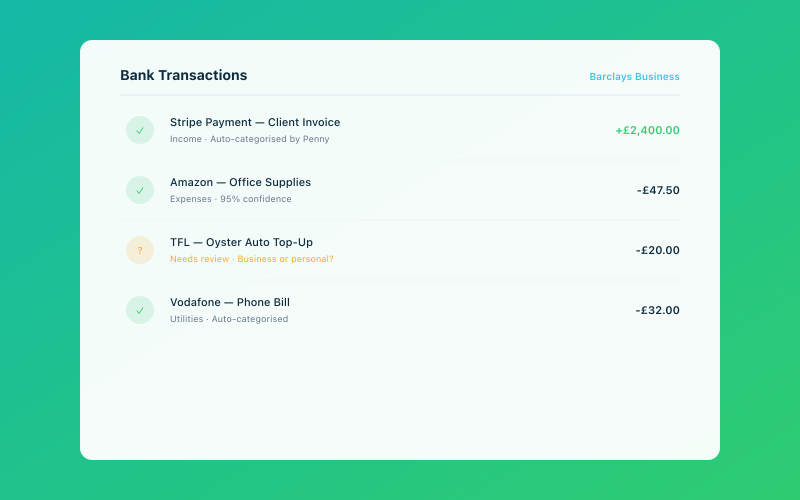 Penny auto-categorises your bank transactions with 95%+ accuracy
The formula:
Working Capital = Current Assets - Current Liabilities
Current assets are things that are either cash or can be converted to cash within the next 12 months:
- Cash in the bank
- Money owed to you by clients (trade debtors)
- Stock or inventory
- Prepayments (e.g., insurance paid in advance)
Current liabilities are obligations you need to pay within the next 12 months:
- Money you owe to suppliers (trade creditors)
- Tax owed (Income Tax, VAT, National Insurance)
- Loan repayments due within 12 months
- Credit card balances
- Accrued expenses (bills you've incurred but not yet paid)
Example:
You're a sole trader carpenter. At the end of March:
-
Cash in bank: £8,000
-
Money owed by clients: £5,000
-
Materials in stock: £2,000
-
Total current assets: £15,000
-
Owed to timber supplier: £3,000
-
VAT due next quarter: £2,500
-
Tax provision: £4,000
-
Credit card balance: £500
-
Total current liabilities: £10,000
Working capital = £15,000 - £10,000 = £5,000
That £5,000 is the cushion that keeps the business running. It's what allows you to buy materials for the next job, pay your phone bill, fill up the van, and cover any gaps between doing the work and getting paid.
Why Working Capital Matters So Much
Working capital is often described as the lifeblood of a business, and it's not an exaggeration. Here's why it's so critical:
It Bridges the Gap Between Spending and Earning
In most businesses, you spend money before you earn it. You buy materials, put in the hours, issue an invoice, and then wait 30, 60, or sometimes 90 days to get paid. During that waiting period, working capital is what keeps the lights on.
The longer this gap between spending and receiving payment, the more working capital you need. A business that gets paid upfront (like a retail shop) needs far less working capital than one that invoices on 30-day terms and waits an additional 15 days for payment.
It Protects You from Unexpected Costs
Vans break down. Tools get stolen. A client cancels a big project. Tax bills come in higher than expected. Working capital provides the buffer that lets you absorb these shocks without going into crisis mode.
Without adequate working capital, a single unexpected expense can cascade into missed payments, damaged supplier relationships, and serious stress.
It Determines What Opportunities You Can Seize
Got an enquiry for a large job that would require buying significant materials upfront? Without working capital, you might have to turn it down or negotiate unfavourable payment terms. With healthy working capital, you can take on bigger projects, bulk-buy materials for discounts, or invest in equipment that makes you more efficient.
It Affects Your Creditworthiness
Suppliers, banks, and potential partners all look at working capital when assessing your business. Low or negative working capital signals risk. Healthy working capital signals a well-managed business.
We've written in detail about the relationship between profit and cash flow in our profit vs cash flow guide — if you haven't read it, it pairs well with this piece, because working capital is really about the practical mechanics of how cash moves through your business.
How Much Working Capital Do You Need?
There's no single right answer, but there are some useful rules of thumb.
The current ratio (current assets divided by current liabilities) is the standard measure. A ratio of 1.0 means your current assets exactly match your current liabilities — you can pay your bills, but there's zero margin for error. Most financial advisers recommend a current ratio between 1.5 and 2.0 for small businesses.
In our carpenter example above: £15,000 / £10,000 = 1.5. That's at the lower end of the healthy range — workable, but not a lot of room for surprise expenses.
Months of operating expenses is another useful way to think about it. If your monthly costs are £4,000 and your working capital is £5,000, you've got about 1.25 months of runway. Ideally, you'd want at least 2-3 months' worth.
Industry norms vary. Businesses that hold stock need more working capital. Service businesses that can invoice quickly need less. Seasonal businesses need more during their off-peak periods and less during peak trading. Think about the rhythm of your specific business and plan accordingly.
The Working Capital Cycle
Understanding the working capital cycle helps you see where your cash gets "trapped" and where it's freed up.
The cycle typically works like this:
- You buy materials or supplies — cash goes out
- You hold stock — cash is tied up in inventory
- You do the work or sell the product — stock converts to a debtor
- You invoice the client — still waiting for cash
- The client pays — cash comes back in
- You pay your suppliers — cash goes out again
The length of this cycle determines how much working capital you need. A fast cycle (cash comes back quickly) means you need less. A slow cycle (long stock holding periods, slow-paying clients) means you need more.
Every day you can shave off this cycle frees up working capital. If you can reduce the time between invoicing and getting paid by 10 days, or negotiate an extra 10 days with your supplier, that's real money released back into the business.
Common Working Capital Problems
Growing Too Fast
This catches a lot of business owners off guard. Rapid growth devours working capital because each new project requires upfront spending before the revenue comes in. If you're growing quickly, the gap between outgoing and incoming cash widens — the classic "profitable but broke" scenario.
Slow-Paying Clients
If your average client takes 45 days to pay instead of the 30 days specified in your terms, that's 15 extra days of cash tied up in debtors. Multiply that across all your outstanding invoices and it adds up quickly.
Getting paid on time is one of the most impactful things you can do for your working capital. Clear payment terms, prompt invoicing, and consistent follow-up on overdue accounts all help.
Overstocking
For businesses that hold stock, excess inventory is dead working capital. Every pound sitting on a shelf in the form of materials or products is a pound that's not in the bank earning nothing. Order what you need, when you need it, and avoid the temptation to bulk-buy more than you can use in a reasonable timeframe (unless the discount genuinely justifies the cash outlay).
Tax Surprises
Tax bills that you haven't planned for can devastate your working capital overnight. Setting aside money regularly for Income Tax, National Insurance, and VAT ensures these obligations don't come as a shock. Using Penny in Accounted to track your income and expenses throughout the year means you'll have a much clearer picture of what you're likely to owe — no nasty surprises when January rolls around.
Practical Ways to Improve Your Working Capital
Invoice Promptly and Chase Firmly
The sooner you invoice, the sooner the payment clock starts. Don't wait until the end of the month to send invoices if you completed the work on the 5th. Send the invoice the same day you finish the job.
Set up reminders for overdue invoices and follow up consistently. Many small business owners feel uncomfortable chasing money, but it's a normal and necessary part of business. Your payment terms aren't a suggestion — they're part of the contract.
Negotiate Supplier Terms
If your suppliers offer 14-day terms, ask for 30. If they offer 30, ask for 45. The longer you can take to pay (without damaging the relationship or incurring penalties), the more cash you keep in the business for longer.
Some suppliers also offer early payment discounts — say, 2% off if you pay within 7 days. Whether this is worthwhile depends on your cash position and the effective annualised return, but it's worth considering.
Take Deposits and Stage Payments
For larger jobs, ask for a deposit upfront and agree stage payments throughout the project. This dramatically improves your working capital position because you're receiving cash throughout the job rather than waiting until the end.
A 30% deposit plus a 30% mid-project payment means you've received 60% of the revenue before you even invoice the final balance. That fundamentally changes the cash flow dynamic.
Manage Stock Carefully
If you hold stock, review it regularly. What's sitting there unsold? What's slow-moving? Can you return unused stock to suppliers? The goal is to hold just enough stock to meet demand without tying up excessive cash.
Build a Cash Reserve
The best protection against working capital problems is a cash buffer. Aim to build up a reserve equal to at least two to three months of operating expenses. This takes time, but even a small reserve makes an enormous difference to your resilience.
Treat the reserve like a bill — set aside a fixed amount each month, just as you would for rent or insurance.
Use Cash Flow Forecasting
A cash flow forecast is simply a projection of your expected incomings and outgoings over the coming weeks and months. It helps you see potential working capital pinch points before they arrive, giving you time to take action.
You don't need anything fancy — a spreadsheet works. But doing it regularly (monthly at minimum, weekly for businesses with tight cash positions) can be transformative. Our guide on cash flow forecasting for beginners walks you through how to set one up.
Consider Finance Options (Carefully)
If you need more working capital than the business can generate organically, there are options: business overdrafts, invoice factoring, short-term loans, or credit cards. These can be useful, but they all come at a cost. Only borrow what you need and have a clear repayment plan.
Monitoring Your Working Capital
Review your working capital monthly. Note current assets, current liabilities, and the resulting figure. Track the current ratio over time and look for trends: is working capital growing or shrinking? Are debtors increasing? Are you taking longer to pay your own bills?
If you're using Accounted, Penny keeps things categorised so pulling together a working capital snapshot each month is quick and easy. Get this right, and you'll have the financial foundation to grow, invest, and handle whatever comes your way.
Related Reading
Try Accounted free for 30 days — no credit card required.
Accounted helps UK sole traders stay on top of their bookkeeping and tax. Start your free 30-day trial at getaccounted.co.uk.
Accounted makes bookkeeping simple — Penny categorises your transactions automatically so you don't have to. See how →
Tax & Compliance Specialists
Our tax specialists have decades of combined experience in UK sole trader and small business taxation, MTD compliance, and HMRC submissions. All content is reviewed against current HMRC guidance before publication and updated quarterly to reflect legislative changes.
Ready to try Accounted?
Join UK sole traders who are simplifying their bookkeeping and tax.
Start your 14-day free trial