Bad Debts — How to Write Them Off for Tax
Every business owner dreads it, but at some point, it happens: a client doesn't pay. Maybe they've gone bust, maybe they're ignoring your emails, or maybe they're simply refusing to pay because they're disputing the work. Whatever the reason, you're left with an invoice that's never going to be settled.
The good news — if you can call it that — is that HMRC lets you write off bad debts and get tax relief on the money you're owed but will never receive. If you're VAT-registered, you can even reclaim the VAT you've already paid over. In this guide, we'll explain exactly how it works.
What Counts as a Bad Debt and When You Can Write It Off
A bad debt is money owed to you that you've given up any reasonable expectation of receiving. It's an invoice you've sent, work you've done, or goods you've delivered — but the payment isn't coming.
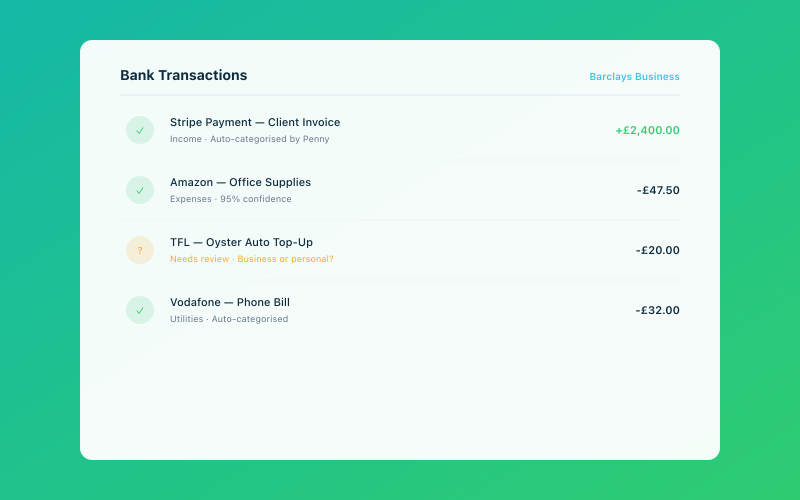 Penny auto-categorises your bank transactions with 95%+ accuracy
There's an important distinction between a bad debt and a doubtful debt. A doubtful debt is one where payment is uncertain but still possible — the client might be in financial difficulty, or they might be slow to pay. A bad debt is one where you've concluded that payment won't happen — the client has gone into liquidation, become untraceable, or you've exhausted all reasonable efforts to collect.
For tax purposes, you can only write off debts that are genuinely bad. HMRC won't accept a write-off just because a client is a few weeks late — you need to demonstrate that you've taken reasonable steps to collect the debt and that there's no realistic prospect of payment.
There's no specific time limit in law that automatically makes a debt "bad." It's a judgement call based on the circumstances. However, the following situations typically justify a write-off: the debtor has gone into administration, liquidation, or bankruptcy; the debtor has ceased trading with no prospect of recovery; you've been unable to contact the debtor despite repeated attempts; the cost of pursuing the debt would exceed the amount owed; a court has declared the debtor insolvent; or you've obtained a court judgement but been unable to enforce it.
It helps to keep a clear paper trail showing your collection efforts — emails, letters, phone records, and any correspondence with the debtor or their insolvency practitioner. If HMRC queries a bad debt write-off, this evidence supports your case.
For practical advice on chasing overdue invoices before it gets to the write-off stage, our guide on handling late-paying clients has some useful templates and strategies.
How to Write Off a Bad Debt for Income Tax
The treatment depends on which accounting basis you use.
Accrual basis. If you prepare your accounts on an accrual basis, you've already included the unpaid invoice as income (because you recorded it when the work was done, not when payment was received). Writing off the bad debt creates an expense that offsets that previously recorded income, reducing your taxable profit. In your accounts, you debit bad debts expense (profit and loss) and credit trade debtors (balance sheet). This reduces your profit by the amount of the bad debt, which in turn reduces your tax bill.
Cash basis. If you're a sole trader using the cash basis, you only record income when it's actually received. Since you never received the payment, you never recorded the income — so there's no bad debt to write off. Under the cash basis, you simply don't include the unpaid amount in your income. No adjustment is needed because the income was never recognised in the first place.
This is one of the advantages of the cash basis for small businesses — bad debts essentially take care of themselves. You can read more about the differences in our guide to cash basis vs accrual accounting.
Here's a step-by-step process for writing off a bad debt. First, exhaust your collection efforts — send reminders, make phone calls, send a formal letter before action, and consider a debt collection agency or the small claims court for amounts up to £10,000. Next, assess whether the debt is genuinely bad. Then write off the debt in your accounting records — remove the amount from your trade debtors and record it as a bad debt expense. Record the write-off details (date, amount, client name, invoice number, reason) and keep supporting evidence. Finally, include the bad debt expense in your tax computation to reduce your taxable profit.
If you use Accounted, Penny can help flag invoices that are significantly overdue, prompting you to take action before it reaches the write-off stage. Prevention is always better than cure.
Larger businesses sometimes create provisions for bad debts rather than writing off individual invoices. A specific provision identifies a particular debt that's doubtful and provisions against it — HMRC generally accepts these where there's genuine evidence of doubt. A general provision sets aside a percentage of all debts based on historical experience — HMRC does not normally allow general provisions as a tax deduction. For most sole traders and small businesses, specific write-offs of individual debts are simpler and more tax-effective than provisions.
Reclaiming VAT on Bad Debts
If you're VAT-registered and you've already accounted for VAT on an invoice that's become a bad debt, you can reclaim that VAT from HMRC. This is called bad debt relief.
The conditions for claiming bad debt relief are: the debt is at least six months old from the date payment was due or the date of supply (whichever is later); you've already paid the VAT to HMRC on your VAT return; the debt has been written off in your accounts; and the value of the supply didn't exceed the normal selling price.
To claim, you include the VAT amount as input tax (Box 4) on your VAT return. You also need to keep specific records — a copy of the original invoice, records showing the debt has been written off, the amount of VAT you're reclaiming, the VAT period in which you originally accounted for the VAT, and evidence that you haven't been paid.
There's a time limit: you must make the claim within four years and six months from the date the payment was due.
A note for the debtor's side: If you owe money to a supplier and that debt becomes more than six months old, you're required to repay the input VAT you claimed on that purchase. This catches out businesses that claim VAT on purchases but never actually pay the supplier.
Occasionally, a client pays up after you've written off the debt. When this happens, for income tax the recovered amount is treated as income in the period you receive it. For VAT, if you've claimed bad debt relief, you need to repay the VAT to HMRC in the period you receive the payment. Keep your records updated.
How to Minimise Bad Debts
Writing off bad debts is a last resort. Here are practical steps to reduce the risk:
Credit check new clients. Before taking on a large job or offering credit, check the client's financial standing. Companies House records, credit reference agencies, and even a quick Google search can reveal warning signs.
Use clear payment terms. State your payment terms on every invoice and in your contracts. Net 30 days is standard, but for new clients, you might want to require payment upfront or in instalments.
Invoice promptly. The sooner you invoice, the sooner you get paid. Delays in invoicing create delays in payment.
Chase early. Don't wait until a debt is months overdue before chasing. A friendly reminder the day after the due date sets the tone.
Take deposits. For large projects, request a deposit upfront and stage payments throughout the work. This limits your exposure if the client defaults.
Use retention of title clauses. If you're selling goods on credit, a retention of title clause means the goods legally remain yours until payment is received.
Monitor your debtors regularly. Keep an eye on who owes you money and how long the debts have been outstanding. An aged debtor report shows this at a glance.
Let's be honest — writing off a bad debt is frustrating. You did the work, delivered the goods, or provided the service, and you're not getting paid. It can feel personal, especially when you're a small business and every invoice matters. Try to view it pragmatically. The tax relief softens the blow, and the time you'd spend chasing a genuinely unrecoverable debt is better spent winning new business from clients who actually pay. Learn from it, tighten your credit control, and move on.
Bad debts are an unfortunate reality of running a business, but you don't have to absorb the full cost. If you use accrual accounting, writing off a bad debt reduces your taxable profit. If you're VAT-registered, you can reclaim the VAT after six months. And regardless of your accounting basis, the practical steps — documenting your efforts, keeping records, and claiming relief properly — ensure you get every penny of tax back that you're entitled to. The best approach, of course, is to minimise bad debts in the first place. Clear terms, prompt invoicing, and proactive chasing go a long way.
Related reading:
- How to Handle Late-Paying Clients
- Cash Basis vs Accrual Accounting
- Double-Entry Bookkeeping Explained
Accounted helps UK sole traders stay on top of their bookkeeping and tax. Start your free 30-day trial at getaccounted.co.uk.
Related Reading
- Accruals and Prepayments — What They Are and Why They Matter
- ISAs for Self-Employed People — Which Type Is Best?
Try Accounted free for 30 days — no credit card required.
Accounted makes bookkeeping simple — Penny categorises your transactions automatically so you don't have to. See how →
Tax & Compliance Specialists
Our tax specialists have decades of combined experience in UK sole trader and small business taxation, MTD compliance, and HMRC submissions. All content is reviewed against current HMRC guidance before publication and updated quarterly to reflect legislative changes.
Ready to try Accounted?
Join UK sole traders who are simplifying their bookkeeping and tax.
Start your 14-day free trial