Double-Entry Bookkeeping Explained Simply
If you've ever looked into bookkeeping and stumbled across the term "double-entry," you might have felt a wave of mild panic. It sounds like something from an advanced accounting course — all debits, credits, and T-accounts. And to be fair, it can be taught in a way that makes it feel unnecessarily complicated.
But the underlying idea is actually quite elegant and straightforward. Double-entry bookkeeping has been used for over 500 years — it was first formally described by an Italian mathematician in 1494 — and there's a good reason it's survived this long. It works.
Let's strip away the jargon and explain what double-entry bookkeeping actually is, how it works, and whether you need to worry about it as a sole trader or small business owner.
What Is Double-Entry Bookkeeping?
At its simplest, double-entry bookkeeping is a system where every financial transaction is recorded in at least two places. For every transaction, one account is debited and another is credited, by the same amount.
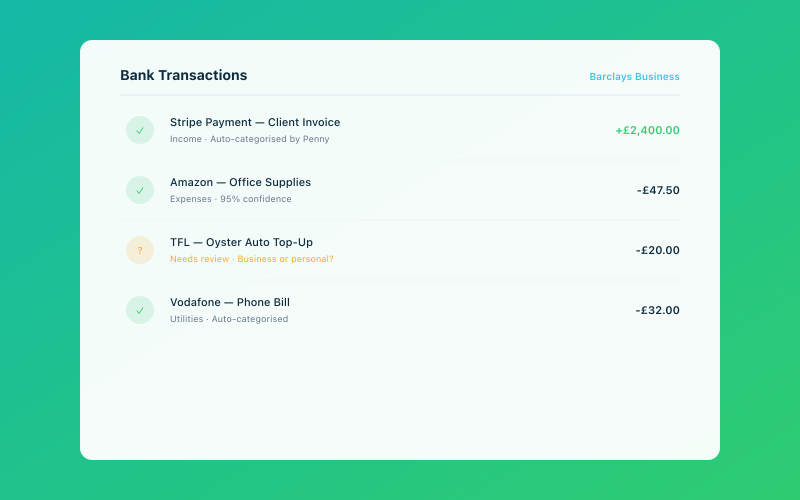 Penny auto-categorises your bank transactions with 95%+ accuracy
Think of it like this: money never just appears or disappears. If money comes into your business, it comes from somewhere. If it goes out, it goes to something. Double-entry bookkeeping captures both sides of every transaction, which means your books are always balanced and complete.
The alternative is single-entry bookkeeping, which is essentially a list of income and expenses — more like a cashbook. Single-entry is simpler but less robust. It doesn't track assets, liabilities, or equity, and it makes it harder to spot errors.
How Does It Work?
Every transaction involves two entries:
- A debit entry in one account
- A credit entry in another account
The total debits must always equal the total credits. This is the fundamental rule that keeps everything in balance.
Understanding Debits and Credits
This is where people often get confused, because "debit" and "credit" don't mean what you might intuitively think.
In everyday language, a "credit" to your bank account means money coming in, and a "debit" means money going out. But in double-entry bookkeeping, the terms have specific technical meanings that depend on the type of account:
| Account Type | Debit Means | Credit Means | |---|---|---| | Assets (bank, equipment) | Increase | Decrease | | Liabilities (loans, money owed) | Decrease | Increase | | Equity (owner's capital) | Decrease | Increase | | Income (sales, revenue) | Decrease | Increase | | Expenses (costs, overheads) | Increase | Decrease |
Don't worry if this feels counterintuitive at first. It takes a bit of practice, and most modern accounting software handles it behind the scenes anyway.
A Simple Example
Let's say you're a self-employed photographer and you receive a £1,000 payment from a client for a wedding shoot.
In double-entry bookkeeping, this transaction has two sides:
- Debit: Bank account — increased by £1,000 (money has come in)
- Credit: Sales income — increased by £1,000 (you've earned revenue)
Both entries are for £1,000. The books balance.
Now let's say you buy a new camera lens for £400:
- Debit: Equipment expense — increased by £400 (you've spent money on a business cost)
- Credit: Bank account — decreased by £400 (money has gone out)
Again, both entries are £400. The books still balance.
A Slightly More Complex Example
You send an invoice for £2,500 to a client but haven't been paid yet:
- Debit: Accounts receivable (debtors) — increased by £2,500 (money is owed to you)
- Credit: Sales income — increased by £2,500 (you've earned the revenue)
When the client pays two weeks later:
- Debit: Bank account — increased by £2,500 (cash received)
- Credit: Accounts receivable — decreased by £2,500 (the debt is now settled)
This is one of the key advantages of double-entry over single-entry. It tracks not just cash movements, but also amounts owed to you and by you — giving a much fuller picture of your financial position.
Why Does Double-Entry Matter?
It Keeps Your Books Balanced
Because every transaction has equal and opposite entries, any mistakes become apparent quickly. If your debits and credits don't add up, you know something's wrong. This built-in error detection is one of the main reasons the system has endured for centuries.
It Gives You a Complete Financial Picture
Single-entry bookkeeping tells you your income and expenses. Double-entry bookkeeping also tracks your assets, liabilities, and equity — which means you can produce a full set of financial statements, including a balance sheet and a profit and loss statement.
It Tracks What You're Owed and What You Owe
If you invoice clients and don't always get paid immediately, double-entry bookkeeping tracks those outstanding amounts. Similarly, it tracks money you owe to suppliers. This is invaluable for cash flow management and for understanding your true financial position.
It's Required for Larger Businesses
Limited companies in the UK are generally expected to use double-entry bookkeeping. If you're thinking about incorporating in the future, starting with double-entry now means less disruption later.
It Supports Accrual Accounting
If you use accrual accounting (as opposed to cash basis), double-entry bookkeeping is essentially a requirement. Accrual accounting records income when it's earned and expenses when they're incurred, regardless of when cash moves — and tracking this properly requires the two-sided recording that double-entry provides.
Do Sole Traders Need Double-Entry?
Here's the honest answer: it depends.
If you're a sole trader with straightforward finances — a few income streams, regular expenses, no stock, no debts — single-entry bookkeeping (or cash basis accounting) may be perfectly adequate. HMRC doesn't require sole traders to use double-entry bookkeeping, and many sole traders do just fine without it.
However, double-entry becomes increasingly valuable as your business grows in complexity. Consider it if:
- You carry stock or inventory
- You regularly invoice clients on credit terms (i.e., they don't pay immediately)
- You have business loans or other liabilities
- You have significant assets (vehicles, equipment, property)
- Your turnover is approaching or exceeding the VAT threshold of £90,000
- You want to produce formal financial statements
- You're considering incorporating as a limited company
Even if you don't technically need it, using accounting software that runs double-entry behind the scenes gives you the benefits without the complexity. You enter your transactions normally; the software handles the debits and credits for you.
The Chart of Accounts
In a double-entry system, every transaction is recorded against specific accounts from a chart of accounts — essentially a categorised list of all the financial accounts in your business.
A typical sole trader's chart of accounts might include:
Asset accounts:
- Business bank account
- Cash in hand
- Accounts receivable (money owed by clients)
- Equipment
- Vehicles
Liability accounts:
- Accounts payable (money owed to suppliers)
- Loans
- Tax owed
- Credit card balances
Equity accounts:
- Owner's capital
- Drawings (money taken out for personal use)
- Retained profit
Income accounts:
- Sales income
- Other income (interest, etc.)
Expense accounts:
- Materials and supplies
- Rent
- Insurance
- Travel
- Phone and internet
- Software subscriptions
- Professional fees
- Marketing
Each transaction moves money between these accounts. The chart of accounts can be as simple or as detailed as you need it to be.
Double-Entry in Practice: A Day in the Life
Let's follow a sole trader — Lisa, who runs a small bakery — through a typical day to see how double-entry captures her transactions:
Morning: Lisa buys £150 of flour and sugar from her supplier, paying by bank transfer.
- Debit: Materials expense +£150
- Credit: Bank account -£150
Lunchtime: A customer orders a wedding cake and pays a £200 deposit.
- Debit: Bank account +£200
- Credit: Deposits received (liability) +£200
Note that this is recorded as a liability, not income, because Lisa hasn't delivered the cake yet. She owes the customer either the cake or a refund.
Afternoon: Lisa sends a £450 invoice to a local café for last week's pastry delivery.
- Debit: Accounts receivable +£450
- Credit: Sales income +£450
The income is recorded now, even though Lisa hasn't received the cash yet. The accounts receivable balance shows she's owed £450.
Evening: Lisa pays her monthly insurance premium of £85 by direct debit.
- Debit: Insurance expense +£85
- Credit: Bank account -£85
At the end of the day, Lisa's books are perfectly balanced. Every pound is accounted for — both where it came from and where it went.
Common Misconceptions
"It's Too Complicated for Small Businesses"
The concept is simple. The execution used to be complex when it was done manually, but modern software like Accounted handles the double-entry mechanics automatically. You categorise a transaction; the software creates the correct debit and credit entries behind the scenes.
"Debits Are Bad and Credits Are Good"
This is a hangover from personal banking terminology. In bookkeeping, debits and credits are neither good nor bad — they're simply two sides of every transaction. A debit to your expense account (a cost) is paired with a credit to your bank account (money leaving). Neither is inherently positive or negative.
"I Need an Accounting Qualification"
You absolutely don't. Understanding the principles is helpful, but you don't need to manually create journal entries. If you can categorise a transaction as "income" or "expense," you can do double-entry bookkeeping with the right software.
"Single-Entry Is Good Enough"
For some businesses, it is. But single-entry systems can't produce a balance sheet, can't track debtors and creditors effectively, and don't have the built-in error detection of double-entry. If your business is growing or you want a fuller picture of your finances, double-entry is worth the upgrade.
Getting Started
If you're currently using a simple spreadsheet or cashbook and want to move to double-entry, here's a practical path forward:
-
Choose your software. Most modern accounting software uses double-entry by default, even if it doesn't make a fuss about it. The complexity is handled for you.
-
Set up your chart of accounts. Most software comes with a standard chart that you can customise. Don't overcomplicate it — start with the basics and add categories as needed.
-
Enter your opening balances. What's in your bank account? Do you have outstanding invoices? Any unpaid bills? These form your starting point.
-
Start recording transactions. Connect your bank feed, categorise transactions, and let the software do the heavy lifting.
-
Reconcile regularly. Match your software records to your bank statement monthly to catch any discrepancies. For more on how to do this effectively, see our guide on understanding your bank statement.
The transition is easier than most people expect, and the improved clarity and accuracy are well worth the effort.
Wrapping Up
Double-entry bookkeeping is one of those things that sounds much more intimidating than it actually is. At its core, it's just a system for recording both sides of every financial transaction — ensuring your books are always balanced and your records are complete.
You don't need to become an expert in debits and credits to benefit from it. Modern software handles the mechanics, leaving you to focus on running your business. But understanding the principle — that every transaction has two sides — will help you make sense of your financial statements and give you greater confidence in your numbers.
Accounted helps UK sole traders stay on top of their bookkeeping and tax. Start your free 30-day trial at getaccounted.co.uk
Related reading:
- What Is Bookkeeping and Why Does It Matter?
- Cash Basis vs Accrual Accounting — Which Should You Use?
- How to Read a Profit and Loss Statement
Related Reading
- Break-Even Analysis — How to Calculate Yours
- Start Up Loans — The Government-Backed Scheme Explained
Related reading: Choosing Your Accounting Year End Date.
For more on this topic, read Common Tax Scams Targeting Self-Employed People.
Related reading: Identity Theft for Sole Traders: Prevention.
Related reading: Student Loan Repayments When Self-Employed.
Try Accounted free for 30 days — no credit card required.
Accounted makes bookkeeping simple — Penny categorises your transactions automatically so you don't have to. See how →
Tax & Compliance Specialists
Our tax specialists have decades of combined experience in UK sole trader and small business taxation, MTD compliance, and HMRC submissions. All content is reviewed against current HMRC guidance before publication and updated quarterly to reflect legislative changes.
Ready to try Accounted?
Join UK sole traders who are simplifying their bookkeeping and tax.
Start your 14-day free trial