Cash Basis vs Accrual Accounting — Which Should You Use?
When you start a business in the UK, one of the first decisions you'll need to make — whether you realise it or not — is how you record your income and expenses. Do you count a sale when the money lands in your bank account, or when you send the invoice? Do you record an expense when you pay the bill, or when you receive it?
These aren't trick questions. They're the fundamental difference between the two main accounting methods: cash basis and accrual accounting. And the one you choose affects your tax bill, your financial records, and how you understand your business's performance.
The good news is that for most sole traders, the decision is more straightforward than it sounds. Let's walk through both methods in plain English so you can make the right choice for your situation.
What Is Cash Basis Accounting?
Cash basis is the simpler of the two methods. It works exactly the way you'd expect:
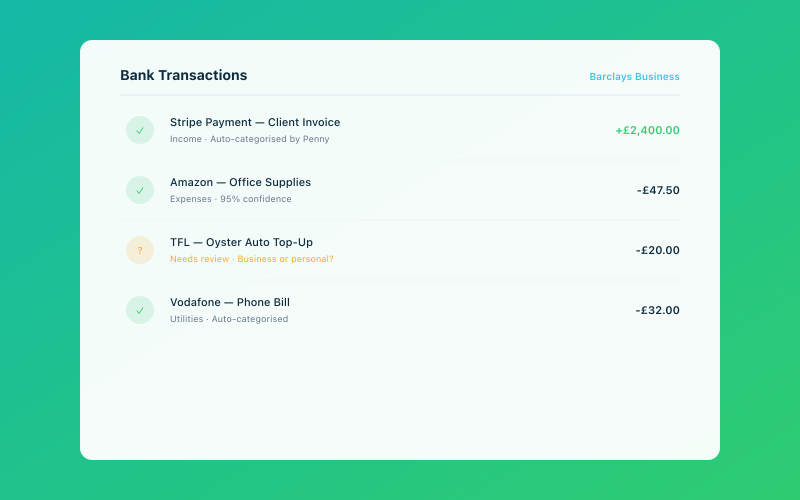 Penny auto-categorises your bank transactions with 95%+ accuracy
- Income is recorded when you receive the money — not when you invoice or do the work, but when the cash actually hits your bank account
- Expenses are recorded when you pay them — not when you receive the bill, but when the money leaves your account
In other words, cash basis tracks the actual movement of money. If no money has moved, nothing is recorded.
A Quick Example
You're a freelance web designer. In March, you complete a project and send an invoice for £3,000. The client pays in April.
Under cash basis:
- March income: £0 (you haven't received the money yet)
- April income: £3,000 (the payment arrives)
Similarly, you receive your annual insurance bill of £600 in February but don't pay it until March.
Under cash basis:
- February expenses: £0
- March expenses: £600
It's intuitive because it matches what you see on your bank statement. Money in, money out — that's your financial picture.
What Is Accrual Accounting?
Accrual accounting takes a different approach. It records income and expenses when they're earned or incurred, regardless of when the money actually moves:
- Income is recorded when you earn it — typically when you send the invoice or deliver the work
- Expenses are recorded when you incur them — when you receive the bill or when the cost relates to, not when you pay it
The Same Example, Accrual Style
Using the same web design scenario:
Under accrual accounting:
- March income: £3,000 (you completed the work and invoiced in March)
- April income: £0 (the payment is just settling an existing debt)
And the insurance bill:
- February expenses: £600 (you received the bill and incurred the liability)
- March expenses: £0 (the payment settles the existing liability)
Accrual accounting gives you a different — and in some ways more complete — picture. It shows you the economic reality of your business: what you've genuinely earned and what you genuinely owe, regardless of cash timing.
The Key Differences at a Glance
| Feature | Cash Basis | Accrual Basis | |---|---|---| | When income is recorded | When cash is received | When earned or invoiced | | When expenses are recorded | When cash is paid | When incurred or billed | | Complexity | Simpler | More complex | | Cash flow visibility | Very clear | Less direct | | True profitability picture | Can be misleading | More accurate | | Outstanding invoices tracked | No | Yes | | Outstanding bills tracked | No | Yes | | Balance sheet | Limited | Full |
Who Can Use Cash Basis in the UK?
HMRC allows most sole traders and partnerships to use cash basis accounting, provided:
- Your annual turnover is £150,000 or less
- You're not a limited company (companies must use accrual accounting)
- You're not a Lloyd's underwriter or have a profit share from a partnership that uses accrual accounting
Cash basis is actually the default method for eligible sole traders. If you don't actively choose to use accrual accounting, HMRC assumes you're using cash basis.
If your turnover exceeds £150,000, you must switch to accrual accounting. You can also voluntarily switch to accrual at any time if you prefer.
Advantages of Cash Basis
It's Simpler
Cash basis is significantly easier to manage, especially if you're doing your own bookkeeping. You don't need to track invoices you've sent but not been paid for, or bills you've received but not paid. Your bank statement is essentially your accounting record.
Your Tax Bill Matches Your Cash Position
Under cash basis, you only pay tax on money you've actually received. If a client hasn't paid you yet, that income doesn't count until they do. This is particularly helpful for businesses with slow-paying clients — you won't end up with a tax bill on money you haven't received.
No Need to Track Debtors and Creditors
Because you only record transactions when money moves, you don't need to maintain an accounts receivable ledger (money owed to you) or accounts payable ledger (money you owe). This reduces the complexity of your record-keeping.
It's Easy to Reconcile
Your accounting records should closely match your bank statements, which makes bank reconciliation straightforward. If the numbers don't match, it's usually easy to find out why.
Advantages of Accrual Accounting
It Shows True Business Performance
Accrual accounting gives you a more accurate picture of how your business is performing. It matches income to the period when you did the work, and expenses to the period when you used the goods or services. This is particularly important for businesses with uneven cash flows.
It Tracks What You're Owed
Under accrual accounting, you can see at a glance how much money is owed to you by clients. This is invaluable for chasing payments and managing your cash flow. If you regularly invoice clients on credit terms, knowing your total outstanding invoices is important.
It Produces Better Financial Statements
Accrual accounting supports full financial statements, including a proper balance sheet and a more meaningful profit and loss statement. If you need to present your accounts to a bank, investor, or potential buyer, accrual-based statements are more informative.
It's Better for Growing Businesses
As your business grows, accrual accounting scales more naturally. It handles complex transactions — deposits, milestone payments, prepaid expenses — more accurately. If you're heading towards the VAT threshold or considering incorporating as a limited company, accrual accounting is likely what you'll need anyway.
Disadvantages of Each Method
Cash Basis Drawbacks
- It can distort your profit picture. If a large payment arrives in January for work done in November, your January figures look artificially high and November looks low.
- Limited loss relief. Under cash basis, you can generally only offset losses against future trading profits from the same business, not against other income.
- No balance sheet. Cash basis doesn't naturally produce a balance sheet, which limits the financial insight you can get.
- Restricted interest deduction. Under cash basis, you can only deduct up to £500 in loan interest per year.
- Not suitable for complex businesses. If you carry stock, have significant assets, or deal with complex transactions, cash basis may not capture your finances accurately.
Accrual Basis Drawbacks
- More complex to maintain. You need to track invoices, bills, prepayments, and accruals — which requires more bookkeeping effort.
- Tax on money you haven't received. If you invoice in March but don't get paid until June, you still owe tax on that income for March. This can create cash flow challenges.
- Requires double-entry bookkeeping. To do accrual accounting properly, you really need a double-entry bookkeeping system.
How to Decide: A Practical Guide
Here's a decision framework to help you choose:
Choose Cash Basis If:
- You're a sole trader with turnover under £150,000
- Your business is relatively straightforward (services, freelancing, simple trades)
- You don't carry significant stock
- You want to keep your bookkeeping as simple as possible
- You're doing your own books and don't want to deal with debits and credits
- Your clients generally pay reasonably quickly
- You don't need detailed financial statements for borrowing or investment
Choose Accrual Accounting If:
- Your turnover is above £150,000 (it's mandatory)
- You're a limited company (it's mandatory)
- You carry stock or inventory
- You have significant outstanding invoices at any given time
- You need detailed financial statements (e.g., for a bank loan or mortgage application)
- You want a more accurate picture of your business performance
- You're planning to grow, incorporate, or take on investment
- You already use accounting software that handles accrual accounting for you
Not Sure? Start with Cash Basis
For most new sole traders, cash basis is the sensible starting point. It's simpler, it's the HMRC default, and it works well for the majority of small, service-based businesses. You can always switch to accrual later if your needs change.
Switching Between Methods
You're not locked in. You can switch from cash basis to accrual (or vice versa) at the start of a new tax year. If you do switch, you'll need to make some transitional adjustments to avoid counting income or expenses twice — or not at all.
For example, if you switch from cash basis to accrual, you'll need to bring in any outstanding invoices (money owed to you at the switch date) and outstanding bills (money you owe) as opening figures.
If you use accounting software like Accounted, Penny can help you manage this transition smoothly, ensuring nothing falls through the cracks.
What About Making Tax Digital?
Making Tax Digital (MTD) for Income Tax Self Assessment is being rolled out for sole traders and landlords, starting from April 2026 for those with income over £50,000. MTD requires quarterly digital reporting, but it doesn't mandate a specific accounting method. You can use either cash basis or accrual accounting with MTD-compatible software.
That said, MTD does require digital record-keeping, which means spreadsheets alone may no longer be sufficient. Using accounting software that supports your chosen method — and is MTD-compatible — will be essential.
A Note on the Existing Guide
We've also written a more detailed comparison of cash basis vs accrual accounting that covers the technical differences in greater depth. If you've already read this guide and want to dive deeper into the mechanics, that's a good next step.
Wrapping Up
Choosing between cash basis and accrual accounting doesn't need to be stressful. For most UK sole traders, cash basis is the natural starting point — it's simpler, it matches your bank account, and it means you only pay tax on money you've actually received.
As your business grows or becomes more complex, you might find that accrual accounting gives you a clearer, more useful picture of your finances. And that's fine — you can switch when the time is right.
The most important thing isn't which method you choose. It's that you keep consistent, accurate records using whichever method works for your business. Good bookkeeping habits matter far more than the accounting method behind them.
Accounted helps UK sole traders stay on top of their bookkeeping and tax. Start your free 30-day trial at getaccounted.co.uk
Related reading:
- Cash Basis vs Accrual Accounting — A Detailed Comparison
- What Is Bookkeeping and Why Does It Matter?
- Double-Entry Bookkeeping Explained Simply
Related Reading
Related reading: Choosing Your Accounting Year End Date.
For more on this topic, read Common Tax Scams Targeting Self-Employed People.
Related reading: Identity Theft for Sole Traders: Prevention.
Related reading: Student Loan Repayments When Self-Employed.
Related reading: What to Do If Your Business Is a Victim of Fraud.
Related reading: Invoice Fraud: How Scammers Target Small Businesses.
Related reading: Understanding Your Balance Sheet: Small Business.
Try Accounted free for 30 days — no credit card required.
Accounted makes bookkeeping simple — Penny categorises your transactions automatically so you don't have to. See how →
Tax & Compliance Specialists
Our tax specialists have decades of combined experience in UK sole trader and small business taxation, MTD compliance, and HMRC submissions. All content is reviewed against current HMRC guidance before publication and updated quarterly to reflect legislative changes.
Ready to try Accounted?
Join UK sole traders who are simplifying their bookkeeping and tax.
Start your 14-day free trial