What Is a Balance Sheet and Why Should You Care?
If you've ever glanced at a set of business accounts and felt your eyes glaze over, you're not alone. Financial statements can look intimidating — columns of numbers, jargon-heavy labels, and totals that don't always seem to make sense at first blush. But here's the thing: understanding your balance sheet is one of the most useful skills you can pick up as a business owner.
Think of your balance sheet as a snapshot of your business's financial health at a single point in time. It tells you what you own, what you owe, and what's left over. Once you know how to read one, you'll be far better placed to make smart decisions about spending, borrowing, and growing your business.
Let's break it down in plain English.
What Exactly Is a Balance Sheet?
A balance sheet is one of three core financial statements — alongside the profit and loss statement and the cash flow statement. While the P&L tells you how your business performed over a period (say, a tax year), the balance sheet tells you where things stand right now.
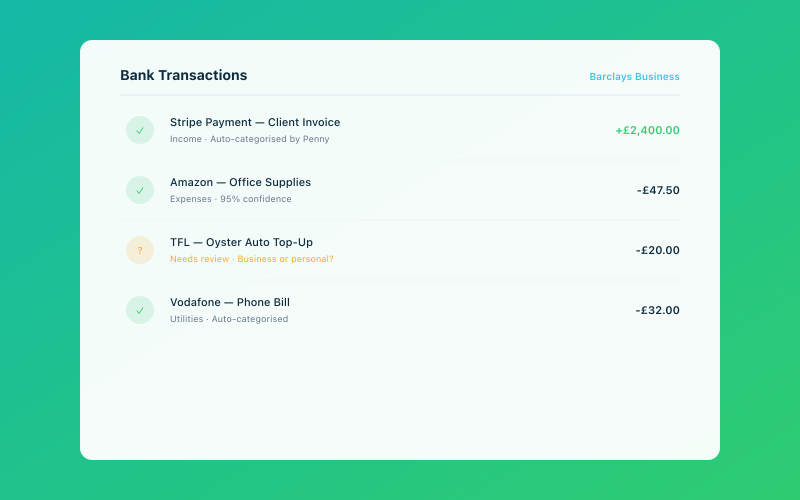 Penny auto-categorises your bank transactions with 95%+ accuracy
It's built around a beautifully simple equation:
Assets = Liabilities + Equity
That's it. Everything your business owns (assets) is funded either by money you owe to others (liabilities) or by the owner's own stake in the business (equity). The two sides must always balance — hence the name.
If you're a sole trader, you might wonder whether balance sheets are just for limited companies. They're certainly more formally required for companies, but understanding the concept is valuable regardless of your business structure. It helps you see beyond the day-to-day and get a proper grip on your financial position.
The Three Building Blocks
Assets — What You Own
Assets are everything your business owns or is owed. They're typically split into two categories:
Current assets are things you expect to turn into cash within the next twelve months. These include:
- Cash in your business bank account
- Money owed to you by customers (trade debtors or accounts receivable)
- Stock or inventory you plan to sell
- Prepaid expenses (such as insurance you've already paid for the coming year)
Non-current assets (sometimes called fixed assets) are longer-term items that help your business operate but aren't intended for quick sale:
- Equipment, machinery, or tools
- Vehicles
- Property
- Computers and office furniture
- Intangible assets like patents or trademarks
For many sole traders and small business owners, current assets — particularly cash and outstanding invoices — make up the bulk of the balance sheet. If you're a freelance graphic designer, for instance, your main assets might be cash in the bank, a laptop, and a few unpaid client invoices.
Liabilities — What You Owe
Liabilities are the flip side. They represent money your business owes to others. Again, these are split into current and non-current:
Current liabilities are debts due within twelve months:
- Unpaid supplier invoices (trade creditors)
- Tax you owe but haven't yet paid (such as your Self Assessment bill)
- Short-term loans or overdrafts
- Accrued expenses (costs you've incurred but not yet been invoiced for)
Non-current liabilities are longer-term obligations:
- Business loans with repayment terms beyond a year
- Hire purchase agreements
- Long-term lease obligations
Understanding your liabilities is crucial for cash flow planning. If you know a large VAT bill or Self Assessment payment is coming, you can plan ahead rather than getting caught short. For more on this, have a look at our guide to cash flow management for sole traders.
Equity — What's Left Over
Equity is sometimes called net assets or owner's equity. It represents the residual interest in the business after all liabilities have been deducted from all assets. In simple terms, if you sold everything your business owns and paid off every debt, equity is what you'd be left with.
For a sole trader, equity typically includes:
- Capital you've put into the business
- Retained profits (earnings you've kept in the business rather than drawing out)
- Minus any drawings you've taken for personal use
For limited companies, equity includes share capital, retained earnings, and any reserves.
Why Should You Actually Care?
You might be thinking, "I'm a sole trader, not a FTSE 100 finance director — do I really need this?" Fair question. Here's why the answer is yes.
It Shows Your True Financial Position
Your bank balance alone doesn't tell the full story. You might have £15,000 in the bank but owe £12,000 in supplier invoices and tax. That's a very different picture from having £15,000 with no debts. The balance sheet lays this out clearly.
It Helps You Make Better Decisions
Thinking about investing in new equipment? Taking on a loan? Hiring your first employee? Your balance sheet helps you assess whether you can afford it. If your liabilities are already high relative to your assets, taking on more debt might not be wise.
It's Essential for Borrowing
If you ever apply for a business loan, overdraft, or mortgage as a self-employed person, lenders will want to see your balance sheet. A healthy one — with assets comfortably exceeding liabilities — makes you a far more attractive prospect.
It Catches Problems Early
A balance sheet that's deteriorating over time (liabilities growing faster than assets, for instance) is an early warning sign. Spotting this early gives you time to course-correct before things become serious.
A Simple Balance Sheet Example
Let's say you're a self-employed plumber called Sarah. On 5 April 2026, her balance sheet might look something like this:
Assets
| Item | Amount | |---|---| | Business bank account | £8,200 | | Outstanding invoices from customers | £3,400 | | Van | £12,000 | | Tools and equipment | £2,500 | | Total Assets | £26,100 |
Liabilities
| Item | Amount | |---|---| | Unpaid supplier invoices | £1,200 | | Van finance remaining | £6,000 | | Tax owed (Self Assessment) | £2,800 | | Total Liabilities | £10,000 |
Equity
| Item | Amount | |---|---| | Capital introduced | £5,000 | | Retained profits | £14,100 | | Drawings | -£3,000 | | Total Equity | £16,100 |
Notice that Total Assets (£26,100) equals Total Liabilities (£10,000) plus Total Equity (£16,100). The balance sheet balances.
Sarah's in a reasonably healthy position. Her assets comfortably exceed her liabilities, and she has a decent amount of equity built up in the business.
How Often Should You Review Your Balance Sheet?
For sole traders, there's no legal requirement to produce a formal balance sheet unless you're using accrual accounting and need one for your records. But reviewing your financial position regularly — even informally — is a smart habit.
Here are some sensible checkpoints:
- End of each tax year (5 April) — Take stock of where things stand before filing your Self Assessment. Remember, if your income is above the personal allowance of £12,570, you'll be paying at least the basic rate of 20% on earnings between £12,571 and £50,270.
- Quarterly — A quick review every three months helps you spot trends and stay on top of things.
- Before major decisions — Thinking about a big purchase or a change in direction? Check your balance sheet first.
If you're using accounting software like Accounted, generating a balance sheet view is straightforward — Penny can help you understand your assets and liabilities without needing to wrestle with spreadsheets.
Common Balance Sheet Mistakes to Avoid
Even experienced business owners sometimes trip up. Watch out for these:
- Forgetting to include all liabilities. It's easy to overlook tax you owe but haven't paid yet, or expenses you've incurred but not been billed for.
- Overvaluing assets. That van you bought three years ago isn't worth what you paid for it. Assets like vehicles, equipment, and computers depreciate over time.
- Mixing personal and business finances. If you're using one bank account for everything, it's much harder to get an accurate picture. Our guide on separating personal and business finances explains why this matters and how to do it.
- Ignoring it entirely. The biggest mistake of all. Even a rough balance sheet is better than flying completely blind.
How the Balance Sheet Connects to Other Statements
Your balance sheet doesn't exist in isolation. It's closely linked to your other financial statements:
- The profit and loss statement feeds into the balance sheet. Profits increase your equity; losses reduce it. If you're not sure how to read a P&L, our step-by-step guide walks you through it.
- The cash flow statement explains changes in your cash position, which appears as an asset on the balance sheet. Understanding the difference between profit and cash flow is essential for avoiding nasty surprises.
Together, these three statements give you a complete picture of your business's financial health. The P&L tells you how you performed, the cash flow statement shows where the money went, and the balance sheet tells you where you stand right now.
Wrapping Up
A balance sheet might seem like just another piece of financial paperwork, but it's genuinely one of the most powerful tools in your business toolkit. It tells you what you own, what you owe, and what your business is actually worth — and that knowledge puts you in control.
You don't need an accounting degree to make sense of it. Once you understand the basic equation — assets equal liabilities plus equity — the rest falls into place. Start reviewing yours regularly, and you'll make better, more confident decisions about your business.
Accounted helps UK sole traders stay on top of their bookkeeping and tax. Start your free 30-day trial at getaccounted.co.uk
Related reading:
- How to Read a Profit and Loss Statement
- Profit vs Cash Flow — Why Profitable Businesses Go Bust
- How to Keep Business Records for HMRC
Related Reading
Try Accounted free for 30 days — no credit card required.
Accounted makes bookkeeping simple — Penny categorises your transactions automatically so you don't have to. See how →
Tax & Compliance Specialists
Our tax specialists have decades of combined experience in UK sole trader and small business taxation, MTD compliance, and HMRC submissions. All content is reviewed against current HMRC guidance before publication and updated quarterly to reflect legislative changes.
Ready to try Accounted?
Join UK sole traders who are simplifying their bookkeeping and tax.
Start your 14-day free trial