How to Value Your Business — Basic Methods
At some point, almost every business owner asks the question: what is my business actually worth? Maybe you're thinking about selling up. Maybe you want to bring in a partner or investor. Maybe you're going through a divorce and the business is a marital asset. Or perhaps you're just curious — after years of hard work, you'd like to know what you've built in financial terms.
The trouble is, valuing a business isn't like valuing a house. There's no Rightmove for businesses that gives you a neat price tag. Business valuation is part science, part art, and part negotiation. But while the precise number can be debated, the basic methods are well established and surprisingly accessible once you understand them.
In this guide, we'll walk through the most common approaches to valuing a small business, explain when each method works best, and help you think about what your business might actually be worth.
Why Business Valuation Matters
Before we get into the methods, it's worth understanding why valuation matters even if you're not planning to sell anytime soon.
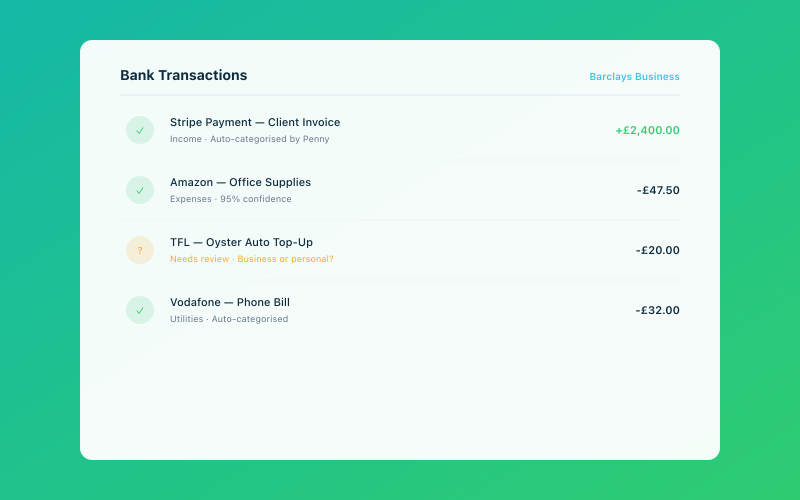 Penny auto-categorises your bank transactions with 95%+ accuracy
Planning your exit. Even if retirement or sale is years away, having a rough idea of your business's value helps you plan. If your goal is to sell for a certain amount, you can work backwards to understand what the business needs to achieve to get there.
Bringing in a partner. If someone wants to buy into your business, you need to agree on what the business is worth to determine a fair price for their share.
Insurance. Business interruption insurance and keyman insurance often require an estimate of business value.
Tax planning. Business valuation is relevant for inheritance tax, capital gains tax on disposal, and various reliefs like Business Asset Disposal Relief. HMRC will have their own views on what your business is worth, so it helps to understand the methodology.
Benchmarking. Tracking your business value over time can be a powerful motivator and a useful way to measure whether strategic decisions are building long-term value.
Method 1: Asset-Based Valuation
The simplest way to value a business is to add up everything it owns and subtract everything it owes. This gives you the net asset value.
Formula: Total Assets - Total Liabilities = Net Asset Value
Assets include tangible things like equipment, vehicles, stock, property, and cash in the bank, as well as intangible assets like intellectual property or trademarks.
Liabilities include debts, loans, outstanding supplier invoices, tax owed, and any other obligations.
When it works well:
- Businesses with significant physical assets (property, machinery, vehicles)
- Businesses that are being wound down rather than sold as going concerns
- Businesses where the assets are the main source of value
When it doesn't work well:
- Service businesses with few tangible assets
- Businesses where the value is in the people, the brand, or the customer relationships
- Growing businesses whose future earning potential far exceeds their current assets
For most small service-based businesses — which includes the majority of sole traders and freelancers — an asset-based valuation dramatically understates the true value. A freelance web developer might have a laptop, a desk, and a few hundred pounds in the bank, but their business might generate £80,000 a year in profit. Clearly, the assets alone don't capture what the business is worth.
That said, asset-based valuation provides a useful "floor" — the minimum the business should be worth. If none of the other methods produce a figure above the net asset value, something might be off.
Method 2: Earnings Multiples (Price-to-Earnings)
This is the most commonly used method for small businesses that generate consistent profits. It values the business as a multiple of its annual earnings.
Formula: Business Value = Annual Profit x Multiple
The key decisions here are which profit figure to use and what multiple to apply.
Which profit figure?
For sole traders and small businesses, the most common figure used is "adjusted net profit" or "seller's discretionary earnings" (SDE). This starts with your net profit and then adds back:
- Your own salary or drawings (since a buyer would replace you)
- Any personal expenses that have been run through the business
- One-off or non-recurring costs
- Depreciation (sometimes)
The idea is to arrive at the true economic profit the business generates, independent of how the current owner has structured their finances.
If your business reported a net profit of £40,000 last year, and you paid yourself £35,000 in salary/drawings on top of that, your SDE is approximately £75,000.
What multiple?
This is where it gets subjective. Multiples for small UK businesses typically range from 1x to 4x annual earnings, depending on factors like:
- Industry: Some sectors command higher multiples than others. Professional services and technology businesses tend to attract higher multiples than, say, retail or food.
- Growth rate: A business growing at 20% per year is worth more than one that's flat.
- Dependency on the owner: If the business can run without you, it's worth more. If everything depends on your personal skills and relationships, buyers see that as risky.
- Recurring revenue: Businesses with subscription-based or contract-based revenue are more valuable because the income is more predictable.
- Customer concentration: If 50% of your revenue comes from one client, that's a risk. A diversified client base commands a higher multiple.
For a typical small sole trader business, a multiple of 1x to 2x SDE is common. For a well-established business with diversified clients, recurring revenue, and the ability to operate without the owner, 3x to 4x is achievable.
Example:
Your SDE is £75,000 and a reasonable multiple for your type of business is 2x.
Business value = £75,000 x 2 = £150,000
It's common to use an average of the last three years' profits rather than just the most recent year, which smooths out any unusual peaks or troughs.
Method 3: Revenue-Based Valuation
Sometimes businesses are valued as a multiple of their revenue (turnover) rather than profit. This is less common for small businesses, but it's used in certain situations.
Formula: Business Value = Annual Revenue x Multiple
Revenue multiples are typically much lower than earnings multiples — often 0.5x to 1x for small businesses — because revenue doesn't account for the costs of generating that income.
When it's used:
- Businesses that aren't yet profitable but have strong revenue growth
- Industries where revenue multiples are the standard benchmark
- Businesses where profitability is temporarily suppressed (perhaps due to investment in growth)
When it's misleading:
- A business with £200,000 in revenue but only £10,000 in profit is a very different proposition from one with £200,000 in revenue and £80,000 in profit, even though a revenue-based valuation would give them the same number
For most small business owners, earnings-based valuation is more meaningful and more commonly used.
Understanding the distinction between revenue and profit is fundamental to interpreting any valuation. Our guide on turnover vs profit vs income covers this in detail.
Method 4: Discounted Cash Flow (DCF)
The discounted cash flow method values a business based on the cash it's expected to generate in the future, discounted back to today's value. It's based on the principle that a pound received in the future is worth less than a pound received today.
How it works (simplified):
- Estimate the business's annual free cash flow for the next 3-5 years
- Choose a discount rate (typically 15-25% for small businesses, reflecting the risk)
- Calculate the present value of each year's cash flow
- Add up the present values
Example (simplified):
Expected cash flows: £50,000 per year for 5 years Discount rate: 20%
Year 1: £50,000 / 1.20 = £41,667 Year 2: £50,000 / 1.44 = £34,722 Year 3: £50,000 / 1.728 = £28,935 Year 4: £50,000 / 2.074 = £24,113 Year 5: £50,000 / 2.488 = £20,094
Total present value = £149,531
DCF is the most theoretically "correct" method, but it relies heavily on assumptions about future performance and the appropriate discount rate. Small changes in these assumptions can produce wildly different valuations. For small businesses, it's often more useful as a cross-check than as the primary valuation method.
For more on why cash flow matters so much, see our guide on cash flow forecasting for beginners.
Which Method Should You Use?
In practice, most small business valuations use a combination of methods:
- Start with an asset-based valuation to establish the floor — the minimum the business is worth.
- Use earnings multiples as the primary valuation method for a profitable business.
- Cross-check with a revenue multiple to see if the numbers are in the right ballpark.
- Consider DCF if the business has significant growth potential that isn't reflected in current earnings.
If the different methods produce broadly similar figures, that gives you confidence in the valuation. If they produce very different numbers, that tells you something about the nature of the business's value — is it in the assets, the earnings, or the growth potential?
Factors That Increase Your Business Value
If you're thinking about selling in the future, here are the things that make a business more valuable:
Reduce owner dependency. Document processes, build systems, and if possible, hire or train others to handle key functions. A business that runs without you is worth significantly more than one that falls apart when you step away.
Diversify your client base. No buyer wants to acquire a business where one or two clients represent the majority of revenue.
Build recurring revenue. Retainers, subscriptions, and long-term contracts are more valuable than one-off project work.
Keep clean financial records. Nothing kills a deal or lowers a valuation faster than messy books. If a buyer can't trust the numbers, they'll either walk away or heavily discount the price. Using Accounted to keep your records organised throughout the year means you'll have credible, transparent financials when the time comes. Penny's categorisation keeps everything tidy and audit-ready.
Show consistent growth. A business that's grown steadily over the past three to five years is worth more than one that's been flat.
Protect your intellectual property. Trademarks, copyrights, proprietary processes, and trade secrets all add value.
Getting a Professional Valuation
For an informal estimate — perhaps for planning purposes — the methods above will serve you well. But if you're actually going to sell, bring in a partner, or deal with a tax event, it's worth getting a professional valuation from a chartered accountant or business valuation specialist.
A professional valuation typically costs between £1,000 and £5,000 for a small business, depending on complexity. They'll have access to industry benchmarks and comparable transactions that will make the valuation more robust and credible.
If HMRC is involved — for example, in a capital gains tax calculation — a professional valuation carries far more weight than a DIY estimate.
Related Reading
Try Accounted free for 30 days — no credit card required.
Accounted helps UK sole traders stay on top of their bookkeeping and tax. Start your free 30-day trial at getaccounted.co.uk.
Accounted makes bookkeeping simple — Penny categorises your transactions automatically so you don't have to. See how →
Tax & Compliance Specialists
Our tax specialists have decades of combined experience in UK sole trader and small business taxation, MTD compliance, and HMRC submissions. All content is reviewed against current HMRC guidance before publication and updated quarterly to reflect legislative changes.
Ready to try Accounted?
Join UK sole traders who are simplifying their bookkeeping and tax.
Start your 14-day free trial