What Is an Invoice and How to Create One Properly
You've done the work, the client is happy, and now you need to get paid. That's where invoices come in. An invoice is simply a formal request for payment — a document you send to your customer that says "here's what I did, here's what it costs, and here's how to pay me."
It sounds straightforward enough, and it is. But getting your invoices right matters more than you might think. A well-structured invoice helps you get paid faster, keeps your records clean, and ensures you're meeting your legal obligations. A sloppy or incomplete one can lead to delays, disputes, and headaches at tax time.
Whether you've never sent an invoice before or you've been doing it for years but want to make sure you're doing it properly, this guide covers everything you need to know.
What Exactly Is an Invoice?
An invoice is a commercial document issued by a seller to a buyer. It itemises the products or services provided, states the amount owed, and specifies how and when payment should be made.
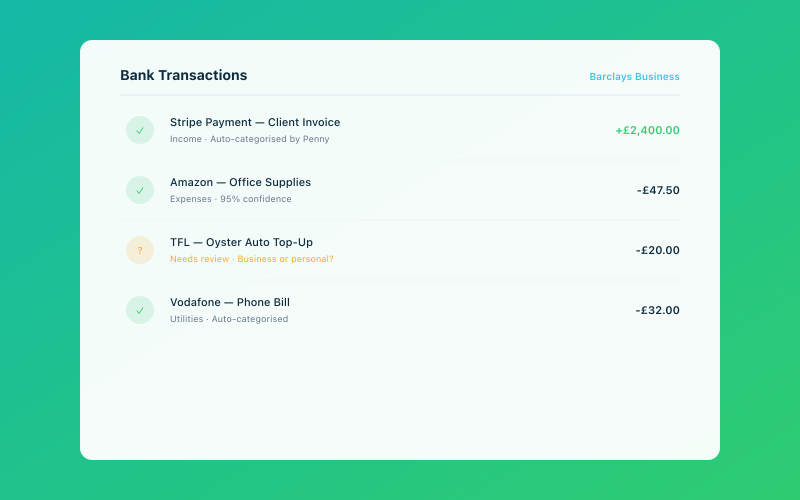 Penny auto-categorises your bank transactions with 95%+ accuracy
For sole traders and freelancers, an invoice is typically sent after you've completed work for a client (though you can also invoice in advance or in stages for larger projects). It serves several purposes:
- It's a request for payment — it tells your client exactly what they owe and when
- It's a legal record — it documents the transaction for both parties
- It's a tax record — HMRC requires you to keep copies of all invoices you issue
- It's a professional touch — a clear, well-formatted invoice reflects well on your business
An invoice is not the same as a receipt (which confirms payment has been received) or a quote (which estimates costs before work begins). It's the document that bridges the gap between completing work and getting paid.
What Must an Invoice Include?
There's no single mandatory format for invoices in the UK, but there is essential information that every invoice should contain. If you're VAT registered, there are additional requirements, but we'll focus on the basics first.
Essential Information
Every invoice you issue should include:
-
The word "Invoice" — it should be clearly labelled so there's no confusion about what the document is
-
A unique invoice number — each invoice needs a sequential identifier (e.g., INV-001, INV-002). This helps both you and your client track and reference payments. The numbering system is up to you, but it must be sequential with no gaps.
-
Your business name and contact details — your name (or trading name), address, email, and phone number
-
Your client's name and address — the person or business you're billing
-
The date the invoice is issued — this establishes when the payment clock starts ticking
-
A clear description of what you're charging for — itemise the products delivered or services provided. Be specific enough that the client knows exactly what they're paying for.
-
The amount owed — show the quantity, unit price, and total for each line item, plus the overall total. In the UK, amounts should be in pounds sterling (£).
-
Payment terms — when payment is due (e.g., "Payment due within 30 days of invoice date" or a specific date)
-
Payment details — how you'd like to be paid. For bank transfers, include your account name, sort code, and account number. You might also accept PayPal, card payments, or other methods.
If You're Not VAT Registered
If your turnover is below the VAT registration threshold of £90,000, you don't charge VAT on your invoices. You should not include a VAT number or show VAT as a separate line item. Your invoice totals are simply the net amounts you're charging.
If You Are VAT Registered
VAT-registered businesses must issue VAT invoices that include additional details:
- Your VAT registration number
- The VAT rate charged on each item
- The total amount excluding VAT
- The total VAT charged
- The total amount including VAT
There are also simplified VAT invoices (for sales under £250) and modified invoices, but the full VAT invoice is the standard.
How to Create an Invoice
Option 1: Use Invoicing Software
The easiest and most professional approach. Tools like Accounted let you create, send, and track invoices directly from the app. Penny can help you set up templates, automatically number your invoices, and chase overdue payments. The details are pre-filled, formatting is consistent, and everything is saved for your records.
Option 2: Use a Template
If you prefer a manual approach, create a template in Word, Google Docs, or a spreadsheet. Fill in the details for each new invoice, export as a PDF, and email it to your client. The key is making sure all the essential information is included every time.
Option 3: Start from Scratch
You can absolutely create invoices from scratch each time, but this is slower and more error-prone. You're more likely to forget a detail, make a numbering mistake, or create inconsistently formatted documents. A template or software is almost always the better choice.
Writing Clear Invoice Descriptions
One of the most overlooked aspects of invoicing is the description. Vague descriptions like "work completed" or "services rendered" are unhelpful for your client and for your own records. They also make it harder for the person approving payment to match the invoice to the work.
Good descriptions are specific but concise:
| Poor description | Better description | |---|---| | Design work | Logo design and brand guidelines package — March 2026 | | Consulting | Business strategy consultation — 4 hours @ £75/hr, 12 March 2026 | | Building work | Kitchen tiling — labour and materials, 28 Elm Street, completed 15 March 2026 | | Writing | Blog content — 4 articles of 1,500 words each, delivered 20 March 2026 |
Clear descriptions reduce the chance of queries and speed up payment. They also help you months or years later when you're reviewing your records or answering questions from HMRC.
Setting Payment Terms
Payment terms tell your client when you expect to be paid. Common options include:
- Due on receipt — payment is expected immediately upon receiving the invoice
- Net 7 — due within 7 days
- Net 14 — due within 14 days
- Net 30 — due within 30 days (this is the most common)
- Net 60 — due within 60 days (usually reserved for larger organisations)
You're free to set whatever terms you like, but shorter terms improve your cash flow. If a client pushes for 60-day terms, consider whether you can afford to wait that long to be paid. For more on how payment timing affects your finances, see our guide on profit vs cash flow.
You might also want to include your policy on late payments. Under the Late Payment of Commercial Debts (Interest) Act 1998, you have the right to charge interest on overdue invoices and claim a fixed sum as compensation — though many sole traders choose not to enforce this to maintain client relationships.
Deposits and Milestone Payments
For larger projects, consider asking for payment in stages:
- An upfront deposit — typically 25-50% before work begins
- Milestone payments — tied to specific deliverables during the project
- Final payment — the remaining balance on completion
This approach reduces your financial risk and improves cash flow throughout the project. Issue a separate invoice for each payment stage.
Invoice Numbering Best Practices
Your invoice numbering system should be:
- Sequential — each new invoice gets the next number in the sequence
- Unique — no two invoices should share a number
- Gap-free — missing numbers can raise questions during an audit
You can keep it simple (1, 2, 3...) or use a more structured format:
- INV-001, INV-002, INV-003 — simple and clear
- 2026-001, 2026-002 — includes the year for easy reference
- JB-0001 — includes your initials
The format doesn't matter much — consistency does. Pick a system and stick with it.
Getting Paid Faster: Practical Tips
Even the most perfectly formatted invoice won't help if your client doesn't pay on time. Here are some practical tips for improving your payment rate:
Invoice Immediately
Don't wait days or weeks after completing work. Send your invoice the same day you finish, or the next morning at the latest. The longer you delay, the longer you wait to be paid.
Make Payment Easy
Include all the information your client needs to pay you — bank details, payment links, or whatever method you accept. The fewer barriers to payment, the faster you'll receive it.
Send Reminders
A friendly reminder a few days before the due date, and a polite follow-up the day after, is perfectly reasonable. Many late payments are simply the result of busy people forgetting, not deliberate avoidance.
Build Relationships
Clients who know you, like you, and value your work are more likely to pay promptly. Building good relationships isn't just good for business — it's good for your cash flow.
Follow Up Firmly
If a payment is significantly overdue, follow up firmly but professionally. A phone call is often more effective than an email. Be clear about the amount owed, the original due date, and when you expect payment. For detailed advice on the invoicing process, see our guide on how to invoice as a sole trader.
Record Keeping
HMRC requires you to keep copies of all invoices you issue for at least five years after the 31 January submission deadline for the relevant tax year. This means invoices from the 2025/26 tax year should be kept until at least 31 January 2032.
Store your invoices in an organised system — whether that's folders on your computer, cloud storage, or within your accounting software. Being able to quickly find a specific invoice saves time and stress, particularly if HMRC asks questions.
Common Invoicing Mistakes
- Forgetting to include payment details. If your client doesn't know how to pay you, they can't pay you.
- Using vague descriptions. Be specific about what you're billing for.
- Not following up on overdue invoices. Silence is not a strategy. Chase politely but consistently.
- Inconsistent numbering. Gaps or duplicates in your invoice sequence can cause problems.
- Not issuing invoices promptly. Invoice as soon as the work is done.
- Sending invoices to the wrong person. Make sure your invoice goes to whoever handles payments, not just your day-to-day contact.
Wrapping Up
An invoice is more than just a bill — it's a professional document that represents your business, supports your financial records, and drives your cash flow. Getting it right doesn't take long, but it makes a genuine difference.
Create a template or use invoicing software, include all the essential information, be clear about what you're charging for and when payment is due, and follow up promptly when payments are late. Do these things consistently, and you'll spend less time chasing money and more time doing the work you love.
Accounted helps UK sole traders stay on top of their bookkeeping and tax. Start your free 30-day trial at getaccounted.co.uk
Related reading:
- How to Invoice Correctly in the UK
- How to Invoice as a Sole Trader
- Profit vs Cash Flow — Why Profitable Businesses Go Bust
Related Reading
- How to Improve Your Credit Score as a Sole Trader
- Understanding Financial Ratios — A Sole Trader's Guide
Try Accounted free for 30 days — no credit card required.
Accounted makes bookkeeping simple — Penny categorises your transactions automatically so you don't have to. See how →
Tax & Compliance Specialists
Our tax specialists have decades of combined experience in UK sole trader and small business taxation, MTD compliance, and HMRC submissions. All content is reviewed against current HMRC guidance before publication and updated quarterly to reflect legislative changes.
Ready to try Accounted?
Join UK sole traders who are simplifying their bookkeeping and tax.
Start your 14-day free trial