How to Improve Your Credit Score as a Sole Trader
When you're a sole trader, your personal credit score and your business finances are essentially the same thing. There's no legal separation between you and your business, which means your personal credit history plays a direct role in whether you can get a mortgage, a business loan, a credit card, or even a mobile phone contract.
The tricky part? Being self-employed can make it harder to maintain a strong credit score — not because you're less creditworthy, but because the systems weren't really designed with you in mind. Irregular income, complex tax affairs, and the absence of a regular payslip can all work against you.
The good news is that improving your credit score is entirely within your control. It just takes a bit of understanding, some practical steps, and — crucially — patience. Let's get into it.
What Actually Makes Up Your Credit Score?
Before you can improve your score, it helps to understand what goes into it. In the UK, the three main credit reference agencies are Experian, Equifax, and TransUnion. Each calculates your score slightly differently, but they all look at broadly the same factors:
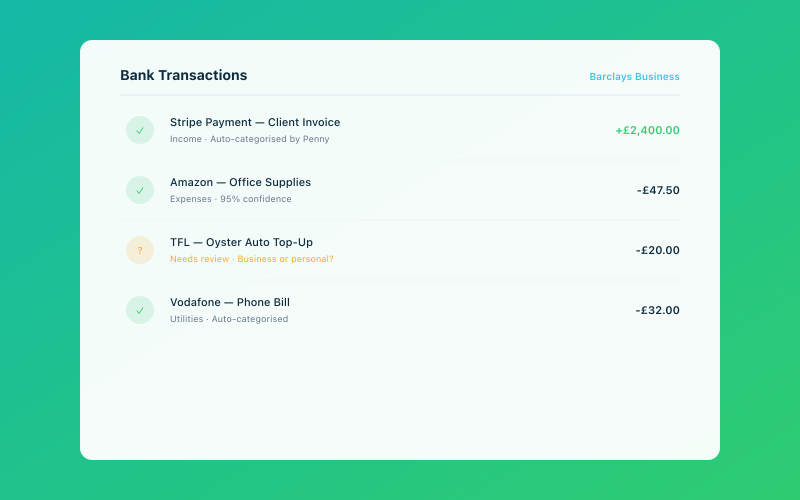 Penny auto-categorises your bank transactions with 95%+ accuracy
Payment history (most important). Do you pay your bills on time? This includes credit cards, loans, mortgages, and even utility bills. Late or missed payments are the single biggest drag on your score.
Credit utilisation. How much of your available credit are you using? If your credit card limit is £5,000 and your balance is £4,500, that's 90% utilisation — and it sends a signal that you're stretched. Aim to keep utilisation below 30%.
Length of credit history. Longer credit histories are generally better. If you've had a credit card for 10 years and always paid on time, that's a strong positive signal.
Types of credit. Having a mix of credit types (credit card, mortgage, personal loan) can help, though this is a minor factor. Don't take on debt just for the sake of diversity.
Hard searches. Every time you apply for credit, a hard search is recorded on your file. Too many in a short period can suggest you're desperately seeking credit, which puts lenders off. Space out your applications.
Electoral roll registration. Being on the electoral roll at your current address confirms your identity and address, which is a basic requirement for most lenders.
Step 1: Check Your Credit Reports
You can't fix what you can't see. Start by checking your credit reports with all three agencies:
- Experian — free via their app or MoneySavingExpert's Credit Club.
- Equifax — free via ClearScore.
- TransUnion — free via Credit Karma.
Look for errors: wrong addresses, accounts you don't recognise, incorrect payment statuses, or outdated information. Mistakes are more common than you'd think, and disputing them can give your score an immediate lift.
Also check for any financial associations — if you've ever had a joint account or joint mortgage with someone who has poor credit, their history could be dragging yours down. You can request a "notice of disassociation" if the financial link is no longer active.
Step 2: Get the Basics Right
Some credit score improvements are straightforward:
Register on the electoral roll. If you're not registered, do it now at gov.uk/register-to-vote. This is one of the simplest things you can do, and the impact is immediate.
Set up Direct Debits for everything. Missed payments are the biggest score killer. Set up Direct Debits for at least the minimum payments on all credit accounts, plus your utility bills. Automating payments removes the risk of forgetting.
Keep old accounts open. That credit card you got 15 years ago and never use? Keep it open. The length of your credit history matters, and closing old accounts shortens it. Just make sure there's no annual fee eating away at you.
Use a credit card (responsibly). If you don't have any active credit, lenders can't see how you manage debt — and "no history" isn't much better than "bad history." Get a credit card, use it for small regular purchases, and pay it off in full every month.
Step 3: Manage Your Finances Like a Lender Is Watching
Because, in a sense, they are. Lenders look at patterns of behaviour, and self-employed applicants often face extra scrutiny. Here's how to make your finances look as strong as possible:
Keep your business and personal finances separate. This comes up time and again, but it genuinely matters. Having a dedicated business bank account shows lenders that you're running your business professionally. It also makes your personal spending patterns clearer and more predictable.
Avoid unnecessary credit applications. Each application creates a hard search on your file. If you're planning to apply for a mortgage in the next 6 to 12 months, avoid applying for new credit cards, store cards, or loans in the meantime. Use eligibility checkers (which use soft searches) to gauge your chances before formally applying.
Pay more than the minimum. If you have outstanding balances, paying more than the minimum each month demonstrates to lenders that you're in control of your finances. It also reduces your utilisation ratio faster.
Don't max out your credit. Even if you pay your balance in full each month, if your statement balance is consistently close to your limit, it can look like you're over-reliant on credit. Try to keep your statement balance below 30% of your limit — or even lower if possible.
Step 4: Address Self-Employment-Specific Challenges
As a sole trader, you face some unique challenges that employed people don't:
Income proof is harder
Lenders typically want to see two to three years of accounts or Self Assessment tax returns. If you're newly self-employed, your options may be more limited. Focus on building a track record by filing your tax returns on time and keeping meticulous records. Accounted can help you maintain clean, organised books that are ready to share with lenders when needed.
Irregular income raises flags
If your income varies significantly from month to month, lenders may view you as higher risk. You can't eliminate this variability, but you can mitigate its impact by maintaining a healthy savings buffer and demonstrating consistent cash flow management.
Tax bill surprises affect affordability
If a large tax bill catches you off guard and you need to borrow to pay it, that's a red flag. Saving for your tax bill systematically throughout the year prevents this scenario and keeps your credit profile clean.
Your SA302 is your payslip
When employed people apply for a mortgage, they show payslips. When you're self-employed, lenders want your SA302 (tax calculation) from HMRC. Make sure your tax returns are filed on time and that the figures accurately reflect your income. Understating income to reduce your tax bill will come back to bite you when you need to prove your earnings to a lender.
Step 5: Be Patient and Consistent
Credit scores don't improve overnight. Most changes take three to six months to show up, and building a genuinely strong credit history takes years. The key is consistency:
- Pay everything on time, every time.
- Keep utilisation low.
- Avoid unnecessary credit applications.
- Check your reports regularly for errors.
- Maintain stable financial behaviour.
Think of your credit score like a reputation — it takes time to build, but it's easy to damage. One missed payment can take up to six years to fall off your record, so prevention is always better than cure.
Common Myths About Credit Scores
Let's clear up a few misconceptions:
"Checking my own score hurts it." No. Checking your own credit report is a soft search and has zero impact on your score. Check it as often as you like.
"I need to carry a balance to build credit." No. Paying your balance in full every month is the best approach. You don't need to pay interest to build a good credit history.
"There's one universal credit score." No. Each agency calculates its own score using its own methodology. A lender might check one, two, or all three, and they also apply their own criteria on top.
"Earning more money means a better score." Not directly. Your income doesn't appear on your credit report. What matters is how you manage the money you have — paying bills on time, keeping debt manageable, and maintaining stable financial behaviour.
"Being self-employed automatically hurts your score." Not true. Your employment status doesn't directly affect your credit score. However, the financial behaviours that sometimes come with self-employment (irregular income, late tax payments, etc.) can have an indirect impact.
Using Penny to Stay on Track
One of the most practical things you can do for your credit score is simply stay on top of your finances. When your books are up to date, your tax savings are on track, and your cash flow is healthy, you're far less likely to miss payments or need emergency credit.
Penny, the AI bookkeeping assistant in Accounted, helps by keeping your records organised in real time. When you know exactly where your money is going, you can spot problems before they become crises — and that calm, controlled approach to money management is exactly what a strong credit score reflects.
Related Reading
Try Accounted free for 30 days — no credit card required.
Accounted helps UK sole traders stay on top of their bookkeeping and tax. Start your free 30-day trial at getaccounted.co.uk.
Accounted makes bookkeeping simple — Penny categorises your transactions automatically so you don't have to. See how →
Tax & Compliance Specialists
Our tax specialists have decades of combined experience in UK sole trader and small business taxation, MTD compliance, and HMRC submissions. All content is reviewed against current HMRC guidance before publication and updated quarterly to reflect legislative changes.
Ready to try Accounted?
Join UK sole traders who are simplifying their bookkeeping and tax.
Start your 14-day free trial