Understanding Financial Ratios — A Sole Trader's Guide
Financial ratios might sound like something only large corporations and MBA students need to worry about. But here's the thing — they're just as useful for a one-person plumbing business or a freelance designer as they are for a FTSE 100 company. In fact, because sole traders have fewer people looking at the numbers and fewer safety nets, understanding your key ratios can be even more important.
You don't need a finance degree to use financial ratios. You just need your basic business figures — turnover, costs, profit, what you're owed, and what you owe — and a willingness to look at them honestly. In this guide, we'll walk through the ratios that actually matter for sole traders and show you how to calculate and use them.
What Are Financial Ratios and Why Should You Care?
A financial ratio is simply one number divided by another to give you a meaningful comparison. On their own, raw figures like "I made £45,000 this year" don't tell you much. But when you express that as a percentage of turnover, or compare it to last year, or look at how it relates to your costs, patterns start to emerge.
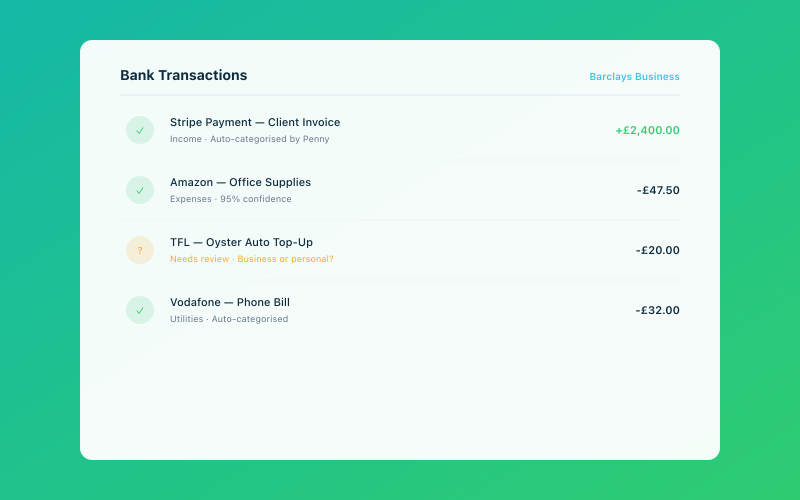 Penny auto-categorises your bank transactions with 95%+ accuracy
Financial ratios help you answer questions like:
- Am I actually making enough profit relative to my turnover?
- Am I spending too much on materials or supplies?
- How quickly are my clients paying me?
- Do I have enough cash to cover my short-term obligations?
- Is my business getting more or less efficient over time?
The beauty of ratios is that they let you compare performance across different time periods, even if your turnover has changed significantly. They also let you benchmark yourself against others in your industry — if the average net profit margin for your type of work is 20% and yours is 8%, that's a signal worth investigating.
If you're already tracking your income and expenses with Accounted, you'll have the raw numbers you need right at your fingertips. Penny can help keep your categories clean so that calculating these ratios is straightforward.
Profitability Ratios — Are You Making Enough?
These are the ratios most sole traders should look at first, because profitability is the heartbeat of any business.
Gross Profit Margin
Formula: (Turnover - Cost of Sales) / Turnover x 100
Your gross profit margin tells you what percentage of your turnover is left after you've covered the direct costs of delivering your service or product. For a sole trader, "cost of sales" might include materials, subcontractor costs, or any direct expenses tied to specific jobs.
If your turnover is £80,000 and your cost of sales is £30,000, your gross profit margin is:
(£80,000 - £30,000) / £80,000 x 100 = 62.5%
What's a "good" gross margin? It varies enormously by industry. A consultant with no material costs might have a gross margin above 90%. A builder who buys a lot of materials might be around 30-40%. The important thing is to track yours over time and understand what drives changes.
For a deeper dive into the difference between gross and net margins, check out our piece on gross margin vs net margin.
Net Profit Margin
Formula: Net Profit / Turnover x 100
Your net profit margin is what's left after all expenses — not just cost of sales, but also overheads like rent, insurance, phone bills, software subscriptions, and everything else. This is the figure that matters most for your take-home income as a sole trader.
Using the same example: if your turnover is £80,000 and your total expenses (including cost of sales) are £55,000, your net profit is £25,000 and your net profit margin is:
£25,000 / £80,000 x 100 = 31.25%
If your net profit margin is shrinking over time, it means your costs are growing faster than your income. That's a trend you want to catch early.
Revenue Per Hour (or Per Day)
This isn't a traditional financial ratio, but for sole traders who sell their time, it's one of the most useful metrics you can track.
Formula: Turnover / Billable Hours (or Days)
If you earned £80,000 from 1,400 billable hours, your effective rate is £57.14 per hour. Compare this to your headline rate — if you charge £75 per hour, it means you're spending a fair chunk of time on non-billable work (admin, marketing, travel, etc.).
Tracking this ratio helps you understand your true earning power and can inform decisions about pricing, efficiency, and whether to outsource non-billable tasks.
Efficiency Ratios — How Well Is Your Business Running?
Debtor Days (Average Collection Period)
Formula: (Trade Debtors / Turnover) x 365
Debtor days tells you, on average, how long it takes your clients to pay you. If your trade debtors (money owed to you) at a given point are £12,000 and your annual turnover is £80,000:
(£12,000 / £80,000) x 365 = 54.75 days
That means, on average, you're waiting nearly 55 days to get paid. If your standard payment terms are 30 days, that's a problem — your clients are consistently paying late.
High debtor days can put serious pressure on your cash flow, especially as a sole trader. Understanding this number can motivate you to tighten up your invoicing and credit control. If you're not already reading our guide on cash flow versus profit, it's worth a look — because you can be profitable on paper while still running out of cash.
Expense Ratio
Formula: Total Operating Expenses / Turnover x 100
This tells you what percentage of your turnover is eaten up by business expenses. A rising expense ratio means your overheads are growing faster than your income.
If you're spending £55,000 to generate £80,000 in turnover, your expense ratio is 68.75%. Track this quarterly and you'll quickly spot if costs are creeping up.
Liquidity Ratios — Can You Pay Your Bills?
Current Ratio
Formula: Current Assets / Current Liabilities
Current assets include cash in the bank, money owed to you by clients, and any stock. Current liabilities include money you owe to suppliers, tax due, and any other short-term obligations.
If your current assets total £15,000 and your current liabilities total £8,000, your current ratio is 1.875. That means you have £1.88 of assets for every £1 of short-term debt, which is comfortable.
A current ratio below 1.0 means you owe more in the short term than you can cover with your current assets — a warning sign that you might struggle to pay your bills. For sole traders, a ratio between 1.5 and 2.0 is generally considered healthy, though it depends on your industry and the predictability of your income.
Cash Ratio
Formula: Cash and Cash Equivalents / Current Liabilities
This is a stricter version of the current ratio — it only looks at actual cash (not money owed to you or stock). If you have £10,000 in the bank and £8,000 in current liabilities, your cash ratio is 1.25.
For sole traders, the cash ratio is arguably more relevant than the current ratio, because it reflects your ability to pay your bills right now, without relying on clients paying their invoices on time.
For more on why cash management matters, have a read of our cash flow forecasting for beginners guide.
How to Use These Ratios in Practice
Calculating ratios once is interesting. Calculating them regularly is powerful. Here's how to make ratios a practical part of running your business:
Track monthly or quarterly. Set aside a few minutes at the end of each month or quarter to calculate your key ratios. You don't need all of them — pick the three or four that matter most to your business and focus on those.
Compare to previous periods. The trend matters more than any single number. A net profit margin of 25% is great — unless it was 35% last year and 30% the year before. Declining trends deserve investigation.
Set benchmarks. Find out what typical ratios look like for your industry. Trade associations, accountancy firms, and industry reports often publish benchmarks. Use these as a reference point, not a target — every business is different.
Act on what you find. Ratios are diagnostic tools. If your debtor days are too high, tighten your credit control. If your expense ratio is climbing, review your costs. If your net margin is shrinking, work out whether it's a pricing problem, a cost problem, or a bit of both.
Use them for planning. Ratios can help you set targets and make decisions. For example, if you want to maintain a 30% net profit margin while growing your turnover to £100,000, you know your total expenses need to stay below £70,000.
Which Ratios Matter Most for Your Business?
Not every ratio is equally important for every sole trader. Here's a rough guide:
Service-based businesses (consultants, freelancers, trades): Focus on net profit margin, revenue per hour/day, and debtor days. These tell you whether you're pricing right, working efficiently, and getting paid on time.
Product-based businesses (retailers, makers, online sellers): Focus on gross profit margin, stock turnover, and the current ratio. You need to know your margins on products are healthy and that you're not tying up too much cash in stock.
Businesses with significant overheads (premises, employees, equipment): Pay extra attention to the expense ratio and the current ratio. High overheads mean you need to keep a closer eye on whether your revenue is covering your costs and leaving enough to live on.
Whatever type of sole trader you are, tracking even a handful of ratios consistently will give you a much clearer picture of your business health than just looking at your bank balance.
Related Reading
Accounted helps UK sole traders stay on top of their bookkeeping and tax. Start your free 30-day trial at getaccounted.co.uk.
Further Reading
- Check the current income tax rates on GOV.UK.
- HMRC outlines record-keeping requirements for businesses.
Try Accounted free for 30 days — no credit card required.
Accounted makes bookkeeping simple — Penny categorises your transactions automatically so you don't have to. See how →
Tax & Compliance Specialists
Our tax specialists have decades of combined experience in UK sole trader and small business taxation, MTD compliance, and HMRC submissions. All content is reviewed against current HMRC guidance before publication and updated quarterly to reflect legislative changes.
Ready to try Accounted?
Join UK sole traders who are simplifying their bookkeeping and tax.
Start your 14-day free trial