Gross Margin vs Net Margin — What's the Difference?
When someone asks "what's your margin?", the answer depends entirely on which margin they're talking about. Gross margin and net margin are both measures of profitability, but they tell you very different things about your business. Mixing them up — or only looking at one — can give you a dangerously incomplete picture of how well your business is actually doing.
In this guide, we'll explain exactly what each margin measures, how to calculate them, and why paying attention to both is essential for any business owner who wants to make informed decisions.
What Is Gross Margin?
Gross margin (also called gross profit margin) measures the percentage of your revenue that's left after subtracting the direct costs of producing your goods or delivering your services. These direct costs are known as "cost of sales" or "cost of goods sold" (COGS).
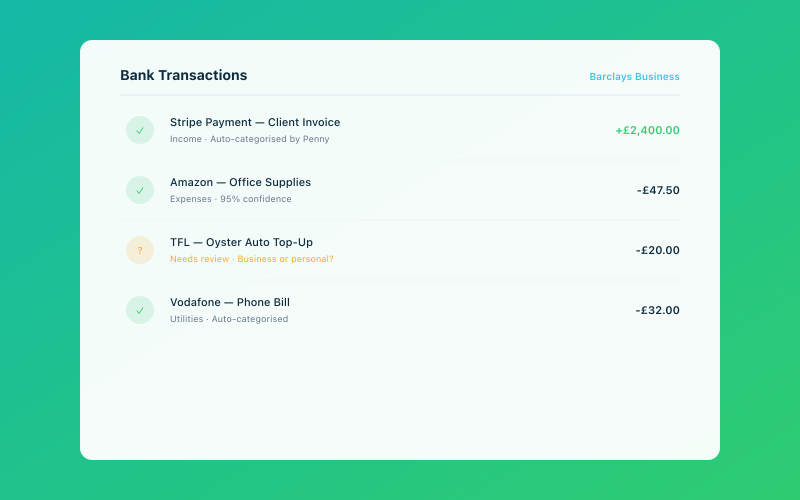 Penny auto-categorises your bank transactions with 95%+ accuracy
The formula:
Gross Margin (%) = (Revenue - Cost of Sales) / Revenue x 100
What counts as cost of sales?
Cost of sales includes only the costs directly tied to producing what you sell. For different types of businesses, this might include:
- A product-based business: Raw materials, manufacturing costs, packaging, shipping to customers
- A trades business: Materials purchased for specific jobs, subcontractor costs
- A service business: Direct labour costs if you hire people to deliver the service, software licences tied to specific client work
- A food business: Ingredients, food packaging
Cost of sales does not include your general overheads — things like rent, insurance, marketing, office supplies, and administrative costs. Those get captured in the net margin calculation.
Example:
You run a small bakery business. In a month:
- Revenue: £8,000
- Ingredients: £2,400
- Packaging: £300
- Market stall fees (per-event): £500
- Total cost of sales: £3,200
Gross profit = £8,000 - £3,200 = £4,800 Gross margin = £4,800 / £8,000 x 100 = 60%
This tells you that for every pound of revenue, 60p is available to cover your overheads and generate profit. The remaining 40p goes directly to the costs of making and selling your products.
What Is Net Margin?
Net margin (also called net profit margin) measures the percentage of your revenue that remains as actual profit after all costs have been deducted — not just cost of sales, but all business expenses including overheads, administrative costs, and everything else.
The formula:
Net Margin (%) = Net Profit / Revenue x 100
Where net profit = Revenue - Cost of Sales - All Other Business Expenses
What's included beyond cost of sales?
Everything. All the overheads and running costs that keep your business operating:
- Rent or mortgage interest on business premises
- Insurance
- Software subscriptions and tools
- Marketing and advertising
- Phone and internet
- Vehicle costs
- Professional fees (accountant, legal)
- Office supplies
- Bank charges
- Training and development
- Depreciation on equipment
Example (continuing the bakery):
In the same month:
- Gross profit: £4,800 (from above)
- Kitchen rent: £600
- Insurance: £80
- Van costs: £350
- Marketing: £150
- Phone and internet: £60
- Software: £40
- Accountancy fees: £100
- Miscellaneous: £120
- Total overheads: £1,500
Net profit = £4,800 - £1,500 = £3,300 Net margin = £3,300 / £8,000 x 100 = 41.25%
So while 60% of each pound covers the cost of production (gross margin), only 41.25% actually makes it through to profit after all expenses (net margin). That 18.75 percentage point gap represents your overheads as a proportion of revenue.
Why Both Margins Matter
It's tempting to focus only on net margin — after all, that's the "real" profit figure. But gross margin tells you something equally important, and the two margins together give you a much richer understanding of your business.
Gross Margin Tells You About Your Core Business Model
Your gross margin reflects the fundamental economics of what you sell. It answers the question: are you charging enough for your products or services relative to what they cost to produce?
A declining gross margin might mean:
- Your material costs are rising, but you haven't raised prices
- You're discounting too heavily
- You've taken on lower-margin work
- Your suppliers have increased their prices
If your gross margin is unhealthy, no amount of overhead control will save the business. You need to address the core pricing and cost-of-sales equation.
Net Margin Tells You About Your Overall Efficiency
Your net margin reflects how well you're managing the entire business. A healthy gross margin combined with a poor net margin means your overheads are too high relative to your revenue. This could indicate:
- You're paying for office space you don't fully need
- Subscriptions and tools have crept up without adding proportionate value
- Marketing spend isn't generating sufficient returns
- Administrative costs are eating into profits
The Gap Between Them Tells You About Your Overheads
The difference between gross margin and net margin is effectively your overhead burden as a percentage of revenue. In our bakery example, the gap is 18.75 percentage points. If that gap is widening over time, it means your overheads are growing faster than your revenue — a warning sign that needs attention.
Tracking both margins in Accounted is straightforward when your expenses are properly categorised. Penny helps keep cost-of-sales items separate from overheads, so you can see both margins clearly without having to do manual sorting at the end of each period.
What's a "Good" Margin?
This is the question everyone asks, and the honest answer is: it depends entirely on your industry and business model.
High gross margin industries (70-90%+):
- Consulting and professional services
- Software and digital products
- Creative and design services
These businesses have low direct costs because they're primarily selling expertise or intellectual property.
Medium gross margin industries (40-60%):
- Trades and construction (with materials)
- Food and beverage
- Retail (higher end)
These businesses have significant material or stock costs but also healthy markups.
Lower gross margin industries (10-30%):
- Retail (commodity products)
- Manufacturing
- Wholesale distribution
These businesses operate on thinner margins but typically aim for higher volumes.
For net margin, most small businesses in the UK operate somewhere between 10% and 30%. Service businesses with low overheads can achieve higher net margins, while businesses with premises, staff, and significant infrastructure will be lower.
The key isn't hitting a specific number — it's understanding your margins, tracking them over time, and making sure they're heading in the right direction.
How to Improve Your Gross Margin
If your gross margin is lower than you'd like, here are the main levers you can pull:
Raise your prices. This is often the most effective and least disruptive option. Even a small price increase goes directly to your gross margin. If you're unsure about raising prices, test it with new clients first and see the impact.
Reduce your cost of sales. Negotiate better rates with suppliers, buy in bulk for discounts, find alternative materials, or streamline your production process.
Change your product or service mix. If some of your offerings have higher margins than others, focus your marketing and sales efforts on the high-margin items.
Reduce waste and rework. In product-based businesses, waste directly hits your cost of sales. In service businesses, unbillable rework has the same effect.
How to Improve Your Net Margin
If your gross margin is healthy but your net margin is disappointing, the issue is your overheads:
Audit your subscriptions and tools. It's remarkably easy for software costs to creep up. Review every monthly subscription and ask whether it's earning its keep.
Review your premises costs. Can you work from home more often? Share a space? Negotiate your rent?
Assess your marketing spend. Are you getting a measurable return? If not, consider redirecting that budget to channels that work.
Automate where possible. Admin time is an overhead cost even if you don't pay yourself a salary — because time spent on admin is time not spent on billable work. Tools that automate bookkeeping, invoicing, and expense tracking free up your time for revenue-generating activity.
Outsource strategically. Sometimes paying someone else to handle a task (bookkeeping, social media, admin) is cheaper than doing it yourself when you factor in your opportunity cost.
Tracking Your Margins Over Time
Calculating your margins once gives you a snapshot. Calculating them every month gives you a trend — and trends are far more powerful than snapshots.
Here's a simple approach:
- At the end of each month, note your revenue, cost of sales, and total expenses
- Calculate both your gross margin and net margin percentages
- Record them in a simple spreadsheet or table
- Review the trend quarterly
Look for patterns. Do your margins dip in certain months? (Seasonality.) Are they gradually declining? (Rising costs or pricing pressure.) Did they jump after you raised prices or cut a cost? (Evidence that your decision worked.)
If you're using Accounted, your income and expense data is already organised. You just need to pull the numbers and do the two calculations. It takes five minutes and can save you from unpleasant surprises.
For more on understanding your business finances, our guide to reading a profit and loss statement walks you through the full picture. And if you're finding that profit and cash don't seem to match up, our piece on profit vs cash flow explains why that happens.
Margin Mistakes to Avoid
Confusing markup with margin. Markup is the percentage added to cost to get the selling price. Margin is the percentage of the selling price that's profit. A 50% markup produces a 33.3% margin, not 50%. They're different calculations and mixing them up leads to pricing errors.
Ignoring your own time in cost of sales. If you're a sole trader delivering services, your time is a cost — even if you don't "pay" yourself a wage. Ignoring this flatters your margins and can lead to underpricing.
Comparing your margins to the wrong benchmarks. A service business shouldn't compare its margins to a retailer's, and vice versa. Compare like with like.
Looking at margins in isolation. A high margin on low revenue isn't necessarily better than a lower margin on much higher revenue. Margin percentages need to be considered alongside absolute profit figures.
Related Reading
Try Accounted free for 30 days — no credit card required.
Accounted helps UK sole traders stay on top of their bookkeeping and tax. Start your free 30-day trial at getaccounted.co.uk.
Accounted makes bookkeeping simple — Penny categorises your transactions automatically so you don't have to. See how →
Tax & Compliance Specialists
Our tax specialists have decades of combined experience in UK sole trader and small business taxation, MTD compliance, and HMRC submissions. All content is reviewed against current HMRC guidance before publication and updated quarterly to reflect legislative changes.
Ready to try Accounted?
Join UK sole traders who are simplifying their bookkeeping and tax.
Start your 14-day free trial