Stock Valuation for Tax Purposes
If your business buys and sells physical goods — whether you're a retailer, an online seller, a manufacturer, or a tradesperson who stocks materials — then stock valuation affects your tax bill. How you value the stock sitting in your warehouse, shop, or van at the end of your accounting year directly impacts your taxable profit.
It's one of those topics that sounds dry until you realise it could be costing you money. In this guide, we'll explain the rules, walk through the main valuation methods, and show you how to get it right for HMRC.
Why Stock Valuation Matters and HMRC's Basic Rule
Your taxable profit is calculated as:
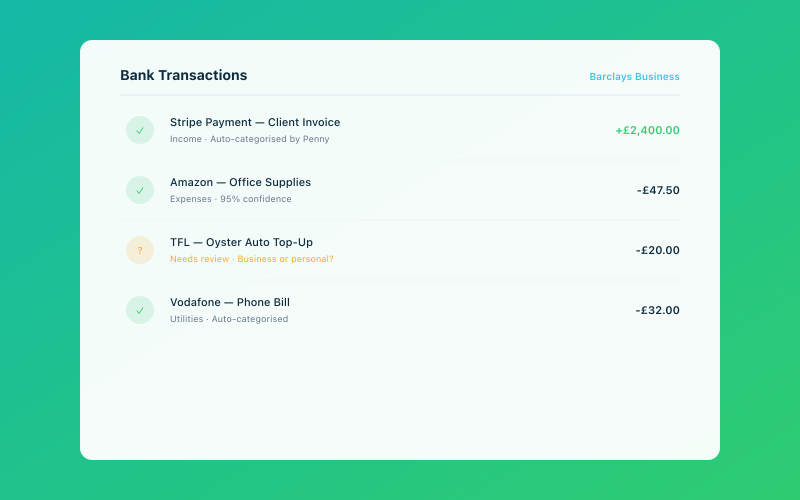 Penny auto-categorises your bank transactions with 95%+ accuracy
Income - Cost of Goods Sold (COGS) = Gross Profit
The cost of goods sold isn't simply what you spent on stock during the year. It's calculated as:
Opening stock + Purchases - Closing stock = Cost of Goods Sold
This means your closing stock figure directly affects your COGS and, therefore, your profit. A higher closing stock value means lower COGS and higher profit (more tax). A lower closing stock value means higher COGS and lower profit (less tax).
Let's illustrate with a simple example. You start the year with £5,000 of stock. During the year, you purchase £30,000 of new stock. At year end, you count your stock and need to value it.
If your closing stock is valued at £8,000: COGS = £5,000 + £30,000 - £8,000 = £27,000
If your closing stock is valued at £6,000: COGS = £5,000 + £30,000 - £6,000 = £29,000
That £2,000 difference in stock valuation translates directly into a £2,000 difference in profit — and potentially £400–£900 more or less in tax, depending on your tax rate.
HMRC's fundamental rule is straightforward: stock should be valued at the lower of cost or net realisable value (NRV). Cost is what you paid for the stock, including any costs to bring it to its current location and condition (purchase price, import duties, delivery charges). Net realisable value is the amount you'd expect to receive if you sold the stock, minus any costs of selling.
For most stock, cost will be lower than NRV — you sell things for more than you paid for them. In those cases, you value stock at cost. But if stock has become damaged, obsolete, or slow-moving, its NRV might be lower than cost. In those cases, you write the stock down to NRV — and this is where you're most likely to reduce your tax bill through stock valuation.
Stock Valuation Methods and What Counts as "Cost"
When you've bought the same type of stock at different prices over the year, you need a consistent method to determine which cost applies to each unit. The three main methods are:
FIFO (First In, First Out) assumes that the oldest stock is sold first. Your closing stock is valued at the most recent purchase prices.
Example: You're a candle maker. During the year, you bought wax at three different prices: January — 100 kg at £5/kg; April — 100 kg at £6/kg; September — 100 kg at £7/kg. At year end, you have 80 kg remaining. Under FIFO, you'd assume you sold the oldest stock first, so your closing stock is from the most recent purchases: 80 kg valued at £7/kg = £560.
AVCO (Average Cost) calculates a weighted average cost across all purchases. Using the same example, total cost is (100 x £5) + (100 x £6) + (100 x £7) = £1,800 for 300 kg. Average cost = £6/kg. Closing stock: 80 kg x £6 = £480.
LIFO (Last In, First Out) assumes the newest stock is sold first, so closing stock is valued at the oldest prices. Using our example, 80 kg would be valued at £5/kg = £400. LIFO is less common in the UK and generally not recommended, as it tends not to reflect the physical flow of most businesses' stock.
HMRC doesn't mandate a specific method, but they do require that you use one that gives a fair and consistent result. FIFO and AVCO are both widely accepted. The key word is consistent — once you've chosen a method, stick with it from year to year.
The cost of stock isn't just the price on the purchase invoice. HMRC expects you to include all costs necessarily incurred in bringing the stock to its present location and condition: purchase price (net of trade discounts), import duties and taxes that can't be recovered, transport and delivery costs to your premises, and handling costs directly related to acquiring the stock.
For manufacturers, cost also includes direct materials, direct labour, and a fair proportion of production overheads. What you don't include: storage costs (unless necessary for production), selling and distribution costs, administrative overheads unrelated to production, and abnormal waste or spoilage.
Stock Counts, Record-Keeping and Special Situations
HMRC expects you to carry out a physical stock count at or near your year end. This means actually counting what you've got — not just estimating or relying on your software.
Plan ahead and schedule your count close to your year end. If you can't count on the exact date, count a few days before or after and adjust for any movements between the count date and the year end. Work through your storage area methodically, counting each item and recording quantities. Include all stock — finished goods, work in progress, raw materials, packaging. Don't forget stock held at other locations, on consignment, or in transit. During the count, flag anything that's damaged, expired, or unlikely to sell at full price — these items need to be valued at NRV rather than cost. Keep your stock count records for at least six years, as HMRC can ask for them in an enquiry.
If you're using Accounted to manage your books, keeping track of purchases and sales throughout the year makes the stock valuation process at year end much less painful. Penny can help ensure your purchase records are complete and categorised correctly, so you've got a clean starting point for your stock calculations.
Several special situations come up regularly. Work in progress (WIP) — if you manufacture goods or provide services that are partly complete at year end, you need to value WIP at cost (materials, labour, and overheads put in so far). Long-term contracts spanning more than one accounting period have specific rules about profit recognition and WIP valuation — talk to your accountant. Obsolete and slow-moving stock can be written down to NRV if there's genuine justification. Stock destroyed or stolen leaves your stock figure and is reflected in your COGS. Stock given away as samples, charity, or to staff also leaves your stock — the cost is included in COGS or treated as an advertising expense.
If you're a sole trader using the cash basis, the rules are slightly different. Stock purchases are treated as expenses when paid for, and stock sales are recorded as income when received. You don't normally need to make year-end stock adjustments. However, if you have a significant change in stock levels between the start and end of the year, HMRC may expect you to make an adjustment. If your stock levels are relatively stable year to year, the cash basis keeps things simple. If you're building up stock significantly or running it down, discuss the position with your accountant.
Getting the Valuation Right
Here's a summary of practical steps for good stock valuation:
- Carry out a physical count at or near your year end
- Value stock at the lower of cost or NRV — item by item or category by category
- Use a consistent valuation method (FIFO or AVCO) year to year
- Include all relevant costs in your stock cost calculation
- Write down damaged, obsolete, or slow-moving items to NRV
- Keep detailed records of your stock count, valuation, and any adjustments
- Review your stock position with your accountant before finalising your tax return
Understanding how stock valuation works — and how to read the impact on your profit and loss — is part of understanding your business finances generally. Our guide on how to read a profit and loss statement covers the broader picture.
Stock valuation directly affects your taxable profit. Getting it right means you're not overpaying tax on stock you haven't sold, and you're not understating your stock in a way that could invite HMRC scrutiny. The rules are logical once you understand them: value at the lower of cost or NRV, be consistent in your method, and keep good records. If you hold stock, this is one area where a few hours of careful work at year end can genuinely save you money. And if you're not sure, your accountant can help you get the valuation right.
Related reading:
- How to Read a Profit and Loss Statement
- Cash Basis vs Accrual Accounting
- What Is Bookkeeping and Why Does It Matter?
Accounted helps UK sole traders stay on top of their bookkeeping and tax. Start your free 30-day trial at getaccounted.co.uk.
Related Reading
- Government Grants for Small Businesses — Where to Find Them
- The Difference Between Capital and Revenue Expenditure
Try Accounted free for 30 days — no credit card required.
Accounted makes bookkeeping simple — Penny categorises your transactions automatically so you don't have to. See how →
Tax & Compliance Specialists
Our tax specialists have decades of combined experience in UK sole trader and small business taxation, MTD compliance, and HMRC submissions. All content is reviewed against current HMRC guidance before publication and updated quarterly to reflect legislative changes.
Ready to try Accounted?
Join UK sole traders who are simplifying their bookkeeping and tax.
Start your 14-day free trial