How to Calculate Rental Income Profit for Tax Purposes
If you're a landlord in the UK, you'll know that the rent hitting your bank account each month isn't quite the same as the profit HMRC wants to tax you on. Understanding the difference — and knowing exactly how to calculate your taxable rental profit — is one of the most important things you can do to stay on the right side of your tax bill.
In this guide, we'll walk through the full process of calculating rental income profit for tax purposes, step by step, so you can report your figures with confidence on your Self Assessment tax return.
What Counts as Rental Income?
Before we get to the profit calculation, it's worth being clear about what HMRC considers rental income. It's not just the monthly rent — there are a few other items that count too.
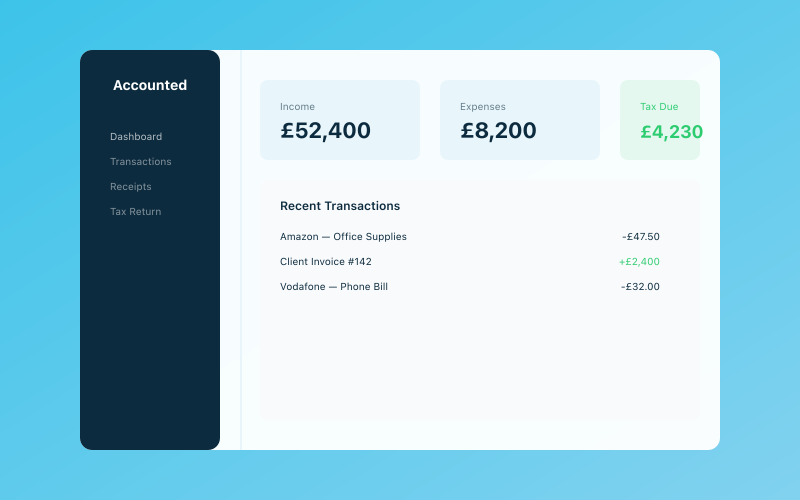 Your Accounted dashboard — income, expenses, and tax at a glance
Your total rental income includes:
- Monthly or weekly rent payments from tenants
- Advance rent — if a tenant pays several months upfront, HMRC treats it as income in the period it covers
- Insurance payouts for lost rent (for example, if you claimed on a rent guarantee policy)
- Payments from tenants for services such as cleaning communal areas or providing furnishings
- Lease premiums — if you grant a lease of less than 50 years, part of any premium received is treated as rental income
- Income from letting out parking spaces, garages, or land associated with the property
It's a common misconception that only the rent itself needs to be declared. If you receive any form of income connected to the letting, it should be included in your figures.
What About Deposits?
Tenancy deposits are generally not treated as income because they're held in a deposit protection scheme and returned at the end of the tenancy. However, if you keep all or part of a deposit (for example, to cover damage or unpaid rent), that retained amount becomes rental income in the tax year you keep it.
The Basic Profit Calculation
The formula itself is straightforward:
Rental Profit = Total Rental Income − Allowable Expenses
If your allowable expenses exceed your rental income, you'll have a rental loss instead of a profit, which we'll cover further down.
Let's break each part of this down properly.
Allowable Expenses You Can Deduct
This is the area where most landlords either leave money on the table or accidentally claim something they shouldn't. Getting your allowable expenses right is crucial for an accurate profit figure.
HMRC allows you to deduct expenses that are incurred "wholly and exclusively" for the purpose of letting the property. Here's what typically qualifies:
Day-to-Day Running Costs
- Letting agent fees and property management charges
- Accountancy fees for preparing rental accounts or your tax return
- Advertising costs for finding tenants
- Council tax, water rates, and utility bills — but only for periods when you pay them (not the tenant)
- Insurance — buildings, contents, and landlord liability policies
- Ground rent and service charges (if it's a leasehold property — more on this in our guide to ground rent and service charges)
Maintenance and Repairs
- General maintenance such as painting, decorating, and fixing broken items
- Garden maintenance for communal or external areas
- Costs of replacing domestic items like fridges, washing machines, and furniture (under the Replacement of Domestic Items Relief)
It's important to distinguish repairs from improvements. Replacing a broken boiler with a like-for-like model is a repair and fully deductible. Upgrading from a basic boiler to a smart system with additional features could be considered an improvement, and only the cost equivalent to a like-for-like replacement would be deductible.
Finance Costs and Section 24
This is where things get a little more nuanced for landlords in 2025/26. Since the full phasing-in of Section 24, you can no longer deduct mortgage interest as an expense from your rental income. Instead, you receive a basic rate tax credit at 20%.
So, if you pay £5,000 in mortgage interest during the year, your tax relief is £1,000 (20% of £5,000), applied as a credit against your tax bill rather than a deduction from your profit.
This means your calculated rental profit may look higher than it would have done under the old rules, but the tax credit brings the final tax figure down. For basic rate taxpayers, the effect is broadly the same. For higher rate (40%) and additional rate (45%) taxpayers, the impact is significant.
We've covered this in depth in our guide to Section 24 and mortgage interest relief, which is well worth reading if finance costs make up a big chunk of your outgoings.
Working Through a Practical Example
Let's put some numbers to this. Say you rent out a flat in Birmingham for £950 per month.
Total rental income for the year: £11,400
Your allowable expenses are:
| Expense | Amount | |---|---| | Letting agent fees (10% + VAT) | £1,368 | | Buildings insurance | £280 | | Landlord liability insurance | £120 | | Boiler service and minor repairs | £450 | | Replacement washing machine | £350 | | Accountancy fees | £200 | | Total allowable expenses | £2,768 |
Rental profit: £11,400 − £2,768 = £8,632
Now, let's say you also paid £4,200 in mortgage interest. Under Section 24, this does not reduce your rental profit. Your profit remains £8,632, and you'll receive a 20% tax credit of £840 against your overall tax bill.
How This Fits Into Your Personal Tax
Your rental profit is added to your other income (employment, pension, savings, and so on) to work out your total taxable income for the year. In 2025/26:
- The personal allowance is £12,570 — the first £12,570 of income is tax-free
- Income between £12,571 and £50,270 is taxed at the basic rate of 20%
- Income between £50,271 and £125,140 is taxed at the higher rate of 40%
- Income above £125,140 is taxed at the additional rate of 45%
So if you earn £35,000 from employment and £8,632 from rental profit, your total income is £43,632. After subtracting your personal allowance of £12,570, your taxable income is £31,062 — all within the basic rate band.
Dealing with Rental Losses
If your allowable expenses exceed your rental income, you'll have a rental loss. This is more common than you might think, especially in the early years of property ownership or after major repairs.
You can't offset a property rental loss against your other income (such as employment income). Instead, the loss is carried forward and set against future rental profits from your UK property business.
How to Carry Forward Losses
Let's say in Year 1, your rental income is £8,000 and your expenses are £9,500. You have a loss of £1,500. In Year 2, your rental profit (before applying the loss) is £6,000. You can deduct the £1,500 carried forward, meaning you're only taxed on £4,500.
There's no time limit on carrying forward rental losses, but you do need to report the loss on your Self Assessment return in the year it arises.
Losses and the Section 24 Interaction
One area that catches people out is how Section 24 interacts with losses. Because mortgage interest is no longer a deductible expense but a tax credit, you may find yourself in a position where you have a taxable profit on paper but are effectively making a cash loss once mortgage payments are taken into account. Unfortunately, the tax credit system doesn't create or increase a loss — it only reduces the tax you owe.
Multiple Properties — One Calculation
If you own more than one rental property, HMRC treats all your UK rental properties as a single rental business. This means you add up all the rental income and all the allowable expenses across your entire portfolio to arrive at one overall profit or loss figure.
This is actually helpful in many cases. If one property makes a profit of £5,000 and another makes a loss of £2,000, your overall rental profit is £3,000. You don't need to worry about carrying forward the loss separately.
For more on managing the tax for a portfolio, have a look at our guide on tax when you own multiple properties.
Record Keeping for Your Profit Calculation
HMRC expects you to keep records that support your rental profit calculation. This means holding on to:
- Rent records — bank statements, rent books, or letting agent statements
- Receipts and invoices for all allowable expenses
- Mortgage statements showing interest paid
- Insurance policy documents and renewal letters
- Letting agent fee statements
You're required to keep these records for at least five years after the 31 January submission deadline for that tax year. So for the 2025/26 tax year (return due by 31 January 2027), you'd need to keep records until at least 31 January 2032.
Tools like Accounted and its AI assistant Penny can help you stay on top of categorising your property income and expenses throughout the year, so you're not scrambling to piece it all together come January.
Common Mistakes to Avoid
A few pitfalls that trip landlords up when calculating their rental profit:
- Claiming mortgage capital repayments — only the interest element qualifies for the Section 24 tax credit, not the repayment of the loan itself
- Forgetting to declare non-rent income — deposit retentions, insurance payouts, and tenant contributions all count
- Confusing repairs with improvements — improvements need to be capitalised and may attract capital allowances or be added to the base cost for Capital Gains Tax purposes
- Not separating personal and business expenses — if you use a personal credit card for property repairs, make sure the expense is still clearly identifiable and recorded
- Ignoring the time-apportionment rule — if a property was only let for part of the year, expenses need to be apportioned to the letting period
Next Steps
Calculating your rental profit doesn't need to be complicated, but it does need to be accurate. Getting your income right, claiming every allowable expense, and understanding how Section 24 affects your final tax position are the keys to a correct return.
If you're unsure about any element of your calculation, it's always worth seeking advice from a property tax specialist — especially if you're a higher rate taxpayer or own multiple properties.
Accounted helps UK sole traders stay on top of their bookkeeping and tax. Start your free 30-day trial at getaccounted.co.uk
Related reading:
- What Expenses Can Landlords Claim?
- Section 24 Mortgage Interest — The Complete Guide
- Tax When You Own Multiple Rental Properties
Related Reading
- The Annual Tax on Enveloped Dwellings (ATED) — Who Pays It
- Landlord Tax When You Live Abroad — Complete Guide
- Property Developers vs Property Investors — Different Tax Rules Explained
You may also find our Buy-to-Let Tax Guide: Complete 2026 Overview helpful.
For step-by-step guidance, see our article on How to Calculate Rental Profit for Tax.
For more on this topic, read Furnished Holiday Let Tax Rules 2026.
Related reading: Landlord Allowable Expenses: Complete List.
For more on this topic, read Non-Resident Landlord Tax Rules UK.
For more on this topic, read Property Joint Ownership: Tax Rules for Couples.
See our detailed comparison: Property Trading vs Investment: Tax Differences.
For more on this topic, read Rent-a-Room Relief: £7,500 Tax-Free Income.
For more on this topic, read Tax Implications of Renting a Room in Your Own Home.
Related reading: How Accounted Manages Property Income for Landlords.
For more on this topic, read HMO Tax Implications: Houses of Multiple Occupancy.
For more on this topic, read Multiple Property Portfolios: Tax Reporting.
Explore our property features built specifically for UK landlords.
Accounted includes built-in property management — track rental income, Section 24, and allowable expenses across multiple properties. See property features →
Tax & Compliance Specialists
Our tax specialists have decades of combined experience in UK sole trader and small business taxation, MTD compliance, and HMRC submissions. All content is reviewed against current HMRC guidance before publication and updated quarterly to reflect legislative changes.
Ready to try Accounted?
Join UK sole traders who are simplifying their bookkeeping and tax.
Start your 14-day free trial