Landlord Tax When You Live Abroad — Complete Guide
Moving abroad doesn't mean you can wave goodbye to UK tax obligations on your rental properties. If you own property in the UK and live overseas, HMRC still wants its share of the rental income — and the rules for non-resident landlords come with a few extra layers of complexity that can catch people off guard.
Whether you've relocated for work, retired to sunnier shores, or simply find yourself living outside the UK while still letting a property back home, this guide covers everything you need to know about how UK landlord tax works when you live abroad.
The Non-Resident Landlord Scheme (NRLS)
The starting point for any landlord living outside the UK is the Non-Resident Landlord Scheme, commonly known as the NRLS. This is HMRC's mechanism for collecting tax from landlords whose "usual place of abode" is outside the UK.
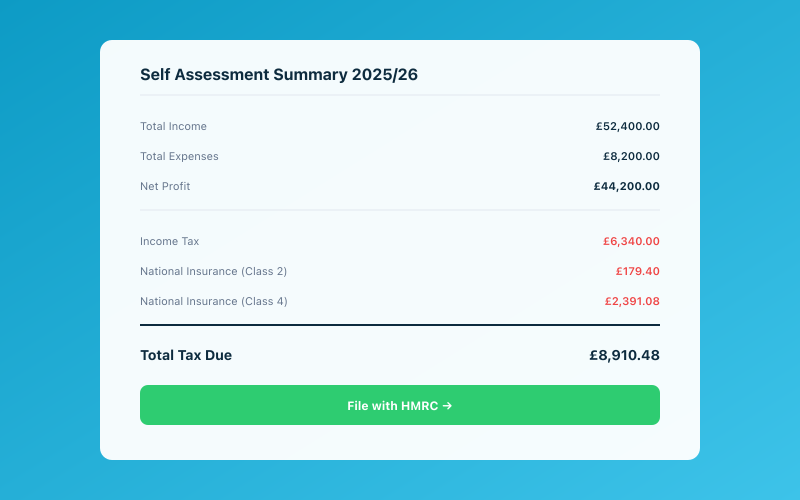 Your Accounted dashboard shows your real-time tax position
Under the NRLS, your tenant or letting agent is required by law to deduct basic rate income tax (20%) from your rent and pay it directly to HMRC on a quarterly basis. This acts as a withholding tax — essentially a way of ensuring that HMRC collects tax from non-resident landlords who might otherwise be difficult to pursue overseas.
How the Deduction Works
If your monthly rent is £1,200, your letting agent would deduct 20% (£240) and send it to HMRC, paying you the remaining £960. Over a year, that's £2,880 in tax deducted at source.
The agent can take allowable expenses into account before calculating the deduction, which reduces the amount withheld. But this is only a rough-and-ready calculation — the final tax position is determined when you file your Self Assessment tax return.
What If You Don't Use a Letting Agent?
If you manage the property yourself and the tenant pays you directly, the obligation to deduct and pay the tax falls on the tenant — provided the rent is more than £100 per week. This can put tenants in an awkward position, which is one reason many non-resident landlords choose to use a letting agent.
For a deeper dive into the mechanics of the scheme, see our dedicated guide to the Non-Resident Landlord Scheme.
Applying for Approval to Receive Rent Gross
The good news is that you don't have to accept having 20% of your rent withheld throughout the year. You can apply to HMRC for approval to receive your rent without deductions — known as receiving rent "gross."
To do this, you'll need to complete form NRL1 (for individuals) and submit it to HMRC. Approval is generally granted if:
- Your UK tax affairs are up to date
- You've never had any compliance issues with HMRC
- You file your Self Assessment returns on time
- You can demonstrate that you'll continue to meet your UK tax obligations
Once approved, HMRC will write to your letting agent (or tenant) confirming that they no longer need to deduct tax. You'll then be responsible for paying any tax due through your annual Self Assessment return instead.
This is usually the better approach from a cash flow perspective. Having 20% of your gross rent withheld quarterly can be a significant drain, especially if your actual tax liability (after deducting expenses) is much lower than the amount being withheld.
How Long Does Approval Take?
Processing times vary, but you should allow at least a few weeks. If you're planning to move abroad, it's sensible to apply for NRL1 approval well in advance of your departure to avoid any gap where tax is being deducted unnecessarily.
Filing Your Self Assessment Tax Return
Regardless of whether you're in the NRLS or receiving rent gross, you'll still need to file a UK Self Assessment tax return each year to report your rental income.
The tax return is where everything gets squared up. You'll declare your total rental income, deduct your allowable expenses, and calculate the actual tax due. If tax has been withheld under the NRLS, you'll get credit for those deductions — and if too much was withheld, you'll receive a refund.
Key Dates
For the 2025/26 tax year:
- The tax year runs from 6 April 2025 to 5 April 2026
- Paper returns must be filed by 31 October 2026
- Online returns must be filed by 31 January 2027
- Any tax due must be paid by 31 January 2027
These deadlines apply regardless of where in the world you're living. Late filing and late payment penalties apply in exactly the same way as for UK-resident taxpayers.
Allowable Expenses for Non-Resident Landlords
As a non-resident landlord, you can claim the same allowable expenses as UK-resident landlords. The rules are identical — expenses must be incurred wholly and exclusively for the purpose of letting the property.
Common allowable expenses include:
- Letting agent fees and management charges
- Insurance (buildings, contents, landlord liability)
- Maintenance and repairs
- Council tax and utility bills (for void periods)
- Ground rent and service charges
- Accountancy fees
- Legal fees for tenant disputes or new tenancy agreements
- Travel costs for property inspections (within reason — more on this below)
For a comprehensive list, our guide to allowable expenses for landlords covers everything in detail.
Section 24 and Mortgage Interest
The Section 24 restriction on mortgage interest relief applies to non-resident landlords in exactly the same way as UK residents. You cannot deduct mortgage interest from your rental income. Instead, you receive a basic rate tax credit at 20%.
This matters because the NRLS deduction is also calculated at 20%. If your letting agent is deducting tax from your gross rent and you're also paying significant mortgage interest, the interaction between the NRLS withholding and the Section 24 credit can be confusing. Filing your Self Assessment return is the only way to get the final position straight.
For the full picture on mortgage interest, see our guide to Section 24 mortgage interest.
Travel Costs
A question that comes up frequently is whether you can claim the cost of travelling back to the UK to inspect or manage your property. The answer is: it depends.
If the sole purpose of your trip is to deal with your rental property — inspecting it, meeting tenants, overseeing repairs — then the travel costs may be allowable. However, if the trip is primarily personal (visiting family, going on holiday) and you happen to pop in on the property while you're there, HMRC is unlikely to accept the travel costs as a deduction.
The key is the "wholly and exclusively" test. If the trip has a dual purpose, you'd need to apportion the costs, and HMRC can be quite strict about this.
Double Taxation Agreements
One of the biggest concerns for non-resident landlords is whether they'll end up being taxed twice — once in the UK and once in the country where they live.
The UK has double taxation agreements (DTAs) with most countries. These agreements generally provide that:
- Property income is taxable in the country where the property is located — so UK rental income is taxable in the UK
- The country of residence may also tax the same income — but must give credit for the UK tax already paid
In practice, this means you'll pay UK tax on your rental profit first, and then when you declare the income in your country of residence, you'll receive a credit (or exemption, depending on the treaty) for the UK tax paid. You shouldn't end up paying tax twice on the same income, but you may end up paying the higher of the two countries' tax rates.
The specifics vary by country, so it's worth checking the DTA between the UK and your country of residence or seeking advice from a tax adviser who understands both jurisdictions.
Capital Gains Tax When You Sell
Non-resident landlords have been subject to UK Capital Gains Tax (CGT) on the disposal of UK residential property since April 2015. If you sell your UK rental property while living abroad, you'll need to:
- Report the disposal to HMRC within 60 days of completion using the CGT on UK property service
- Pay any CGT due within 60 days of completion
- Include the disposal on your Self Assessment return for the tax year in which the sale takes place
The CGT rates for residential property are 18% for gains within the basic rate band and 24% for gains in the higher rate band (2025/26 rates). You'll get the standard annual exempt amount (£3,000 for 2025/26) if you haven't used it elsewhere.
For a full guide to property CGT, see our article on Capital Gains Tax on property.
Practical Tips for Non-Resident Landlords
Managing UK property tax from abroad requires a bit of organisation, but it's entirely doable. Here are some practical suggestions:
Use a Letting Agent
A reputable letting agent will handle the NRLS deductions, manage the property day to day, and provide you with clear income and expense statements. This makes compiling your Self Assessment return much easier, especially if you're in a different time zone.
Keep Meticulous Records
Living abroad makes it even more important to keep thorough, well-organised records. Bank statements, invoices, letting agent reports, mortgage statements, and insurance documents should all be stored digitally and backed up. Tools like Accounted can help you keep everything in order throughout the year, categorising income and expenses as they arise so that tax return time is straightforward.
Appoint a Tax Agent
If your affairs are at all complex — for example, if you own multiple properties, have other UK income, or need to navigate a double taxation agreement — appointing a UK-based tax agent or accountant is a sensible move. They can file your return on your behalf and communicate with HMRC if any queries arise.
Register for Self Assessment Early
If you've recently moved abroad and this is your first year as a non-resident landlord, make sure you register for Self Assessment with HMRC well before the filing deadline. Registration can take a few weeks, and you'll need your Unique Taxpayer Reference (UTR) number before you can file.
Keep HMRC Informed
If your circumstances change — you move to a different country, return to the UK, or start or stop letting a property — let HMRC know promptly. Keeping your records up to date with HMRC reduces the risk of unexpected correspondence or penalties.
Summary
Being a non-resident landlord adds a layer of administrative complexity, but the fundamental tax principles are the same as for UK-resident landlords. You're taxed on your rental profit, you can claim the same allowable expenses, and Section 24 applies in the same way.
The Non-Resident Landlord Scheme exists to collect tax at source, but you can apply for approval to receive your rent gross if your tax affairs are in order. You'll still need to file a Self Assessment return to report the final figures, and double taxation agreements should prevent you from being taxed twice on the same income.
Accounted helps UK sole traders stay on top of their bookkeeping and tax. Start your free 30-day trial at getaccounted.co.uk
Related reading:
- The Non-Resident Landlord Scheme Explained
- Section 24 Mortgage Interest — The Complete Guide
- Capital Gains Tax on Property — What Landlords Need to Know
Related Reading
Explore our property features built specifically for UK landlords.
Accounted includes built-in property management — track rental income, Section 24, and allowable expenses across multiple properties. See property features →
Tax & Compliance Specialists
Our tax specialists have decades of combined experience in UK sole trader and small business taxation, MTD compliance, and HMRC submissions. All content is reviewed against current HMRC guidance before publication and updated quarterly to reflect legislative changes.
Ready to try Accounted?
Join UK sole traders who are simplifying their bookkeeping and tax.
Start your 14-day free trial