Ground Rent and Service Charges — Are They Tax Deductible?
If you own a leasehold rental property — a flat, an apartment, or a house on a leasehold basis — you'll almost certainly be paying ground rent and service charges. These are costs that come with leasehold ownership, and they can add up to a significant annual outgoing. The natural question for any landlord is: can I deduct these from my rental income for tax?
The short answer is yes, in most cases. But as with many things in property tax, the detail matters. In this guide, we'll explain the tax treatment of ground rent, service charges, and related leasehold costs, including some of the more complex scenarios like sinking funds, major works levies, and the recent changes to ground rent legislation.
What Is Ground Rent?
Ground rent is a payment made by the leaseholder to the freeholder (or landlord of the building) as specified in the lease. It's essentially the cost of occupying the land on which the property sits.
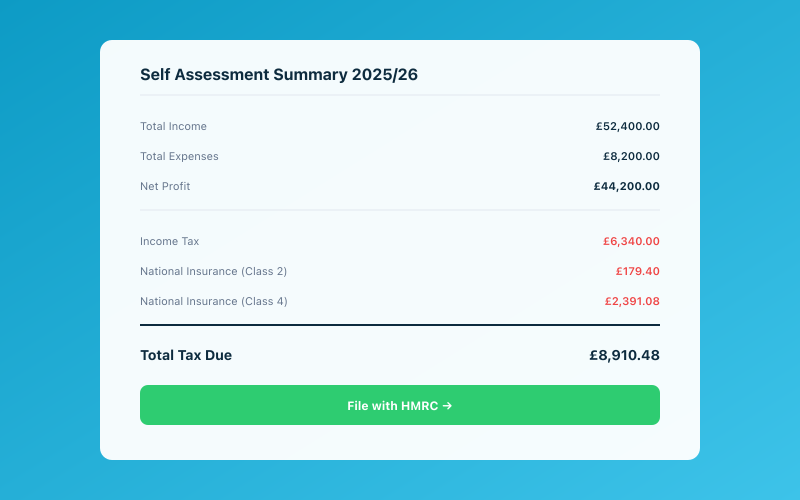 Your Accounted dashboard shows your real-time tax position
Ground rent amounts vary enormously. Some older leases have a peppercorn ground rent (a nominal amount, sometimes literally £1 per year), while newer leases may have ground rents of several hundred pounds per year — and in some notorious cases, ground rents that double at regular intervals.
Recent Changes to Ground Rent
The Leasehold Reform (Ground Rent) Act 2022 restricted ground rents on most new residential leases granted from 30 June 2022 to a peppercorn (effectively zero). This means if you've recently purchased a new-build leasehold property, you may not have any ground rent to worry about.
However, existing leases are unaffected by this legislation, so if your lease predates June 2022, your ground rent obligations remain as set out in the lease.
Is Ground Rent Tax Deductible?
Yes. Ground rent is an allowable expense for tax purposes. You can deduct the full amount of ground rent paid during the tax year from your rental income when calculating your taxable rental profit.
HMRC treats ground rent as a cost incurred wholly and exclusively for the purpose of the property rental business. Without paying the ground rent, you couldn't hold the lease, and without the lease, you couldn't let the property. The deduction is straightforward.
How to Claim It
Ground rent goes into your total allowable expenses on the UK property pages (SA105) of your Self Assessment tax return. There's no separate box for ground rent — it's included in the general "other allowable property expenses" figure.
Keep the ground rent demand notices and proof of payment as part of your records. If HMRC queries the deduction, you'll need to show that the amount was actually paid and relates to the rental property.
What Are Service Charges?
Service charges are payments made by leaseholders towards the cost of maintaining the building and communal areas. They're typically collected by the freeholder, a management company, or a residents' management company, and cover costs such as:
- Building insurance (the buildings policy for the entire block)
- Communal area maintenance — cleaning, lighting, gardening
- Lift maintenance and servicing
- Caretaker or concierge costs
- External repairs and redecoration of the building
- Health and safety compliance — fire alarm testing, emergency lighting, asbestos management
- Management fees — the cost of the managing agent or management company running the building
- Accountancy and audit fees for the service charge accounts
Service charges can vary considerably. A small conversion flat might have annual service charges of a few hundred pounds, while a large purpose-built block with a concierge, lift, and extensive communal grounds could have charges running into several thousand.
Are Service Charges Tax Deductible?
Yes, generally. Service charges are treated as allowable expenses for rental property tax purposes. You can deduct the service charges you pay from your rental income.
However, the tax treatment can become more complex depending on the nature of the expenditure included within the service charge. The key distinction — as with all property expenses — is between revenue expenditure and capital expenditure.
Revenue Elements (Deductible)
The vast majority of items covered by a typical service charge are revenue in nature and fully deductible. This includes:
- Insurance premiums
- Day-to-day maintenance and repairs
- Cleaning and gardening
- Management fees
- Utility costs for communal areas
- Routine health and safety compliance costs
Capital Elements (Not Immediately Deductible)
Occasionally, a service charge may include a contribution towards capital expenditure — for example, a levy for a major renovation project that goes beyond routine repairs. If the work involved is an improvement to the building rather than a repair (such as adding a new extension to communal areas or installing a new feature that didn't exist before), the portion of the service charge attributable to that capital work would not be deductible as a revenue expense.
In practice, most service charge expenditure is on maintenance and repairs, so the full amount is usually deductible. But if your annual service charge statement includes a line item for a significant capital project, it's worth examining whether a portion should be treated as capital expenditure instead.
Sinking Funds and Reserve Funds
Many leasehold properties have a sinking fund (sometimes called a reserve fund). This is a pot of money built up over time through regular contributions from leaseholders, intended to cover major future expenditure — such as roof replacement, external redecoration, or lift refurbishment.
Tax Treatment of Sinking Fund Contributions
The tax treatment of sinking fund contributions is a common source of confusion. HMRC's position is:
- Contributions to a sinking fund are deductible when the money is actually spent on allowable items (revenue expenditure like repairs and maintenance)
- Contributions are not deductible at the time you pay them if the money is simply being held in the fund and hasn't yet been spent
In practice, this means:
- You pay your annual sinking fund contribution (say, £500)
- At the end of the year, the management company's accounts show that £300 of the fund was spent on repairs during the year
- You can claim £300 as an allowable deduction, not £500
- The remaining £200 sits in the fund and will become deductible when it's spent on qualifying items
However, many landlords take a pragmatic approach and deduct the full sinking fund contribution in the year it's paid, on the basis that the fund will eventually be spent on deductible items. HMRC doesn't always challenge this, but strictly speaking, the deduction should align with when the expenditure occurs.
Major Works Levies
A major works levy is a one-off or periodic charge for significant planned maintenance — typically things like external redecoration, roof repairs, window replacement, or communal heating system overhaul.
The tax treatment depends on whether the work is a repair or an improvement:
- Repairs and like-for-like replacements (redecorating the exterior, replacing a worn-out roof with a similar one, repairing a communal boiler) — these are revenue expenses and fully deductible
- Improvements (adding a new lift where there wasn't one, converting an unused basement into a gym) — these are capital expenditure and not deductible from rental income
If you receive a major works levy, review the schedule of works to determine the nature of each item. In many cases, the entire levy relates to repairs and maintenance, making it fully deductible.
For more on the repair vs improvement distinction, our guide on what expenses landlords can claim has a detailed breakdown.
Practical Example: A Year of Leasehold Costs
Let's put this into context with an example. You own a two-bedroom flat that you let out for £1,100 per month (£13,200 per year). Your leasehold costs for the year are:
| Cost | Amount | Tax treatment | |---|---|---| | Ground rent | £250 | Deductible | | Service charge (routine) | £2,400 | Deductible | | Sinking fund contribution | £600 | Deductible when spent (see above) | | Major works levy (external redecoration) | £3,500 | Deductible (repair) | | Total leasehold costs | £6,750 | |
Assuming the full sinking fund was spent on qualifying repairs during the year, your total deductible leasehold costs are £6,750. Combined with your other allowable expenses (letting agent fees, landlord insurance, accountancy fees, etc.), these reduce your taxable rental profit significantly.
Section 24 and Service Charges
It's worth noting that service charges are not affected by the Section 24 restriction on finance costs. Service charges and ground rent are genuine revenue expenses that reduce your rental profit before tax. They are not treated like mortgage interest — there is no restriction on the relief.
This means that for landlords with leasehold properties, service charges and ground rent provide full, unrestricted tax relief, regardless of whether you're a basic rate, higher rate, or additional rate taxpayer.
For the background on Section 24 and how it affects mortgage interest, see our guide to Section 24 explained for landlords.
Record Keeping for Leasehold Costs
To support your tax deductions, keep the following records:
- Ground rent demand notices and proof of payment
- Annual service charge statements (these should itemise what the charge covers)
- Sinking fund accounts showing contributions and expenditure
- Major works levy demands and the schedule of works
- Management company accounts (if available — these provide a detailed breakdown of how the service charge was spent)
These records should be kept for at least five years after the filing deadline for the relevant tax year, in line with HMRC's general record-keeping requirements.
Staying on top of these records throughout the year is much easier with the right tools. Accounted helps you track and categorise property expenses as they arise, so you're not left sorting through a pile of demands and statements at the end of the year.
When You're Also a Freeholder
If you own the freehold of the building (perhaps you own a converted house split into flats and retain the freehold), the position is different. You wouldn't be paying ground rent or service charges — instead, you'd be incurring the underlying costs directly (insurance, maintenance, repairs) and claiming those as allowable expenses against your rental income.
In some cases, landlords who own the freehold and let individual flats charge service charges to the leaseholders. In that scenario, the service charge income received from leaseholders is part of your rental income, and the costs you incur on maintaining the building are your allowable expenses.
Summary
Ground rent and service charges are, for the most part, fully tax deductible for landlords. They reduce your rental profit and therefore your tax bill. The main complexities arise around sinking fund contributions (where the deduction should technically follow the expenditure rather than the contribution) and major works levies (where the repair vs improvement distinction applies).
Keep good records, review your annual service charge statements carefully, and make sure you're claiming everything you're entitled to. These costs are a significant part of being a leasehold landlord, and getting the tax treatment right ensures you're not paying more than you need to.
Accounted helps UK sole traders stay on top of their bookkeeping and tax. Start your free 30-day trial at getaccounted.co.uk
Related reading:
- What Expenses Can Landlords Claim?
- Landlord Insurance — What You Can and Can't Claim
- Section 24 Explained for Landlords
Related Reading
- The Tax Implications of Converting Commercial Property to Residential
- Property Allowance — The £1,000 Tax-Free Amount Explained
Explore our property features built specifically for UK landlords.
Accounted includes built-in property management — track rental income, Section 24, and allowable expenses across multiple properties. See property features →
Tax & Compliance Specialists
Our tax specialists have decades of combined experience in UK sole trader and small business taxation, MTD compliance, and HMRC submissions. All content is reviewed against current HMRC guidance before publication and updated quarterly to reflect legislative changes.
Ready to try Accounted?
Join UK sole traders who are simplifying their bookkeeping and tax.
Start your 14-day free trial