What Is Bookkeeping and Why Does It Matter?
If you've recently started a business — or you've been running one for a while but haven't quite got around to sorting out your financial records — the word "bookkeeping" might feel a bit daunting. It conjures up images of dusty ledgers, columns of numbers, and accountants peering over spectacles.
The reality is far simpler, and far more useful, than that.
Bookkeeping is one of those things that sounds like a chore but actually saves you time, money, and stress once you get into the habit. Whether you're a freelance copywriter, a self-employed electrician, or a part-time Etsy seller, understanding the basics of bookkeeping will make your life significantly easier.
Let's break it down.
What Is Bookkeeping, Exactly?
At its core, bookkeeping is the process of recording your business's financial transactions. Every time money comes into your business or goes out of it, bookkeeping is how you keep track of it.
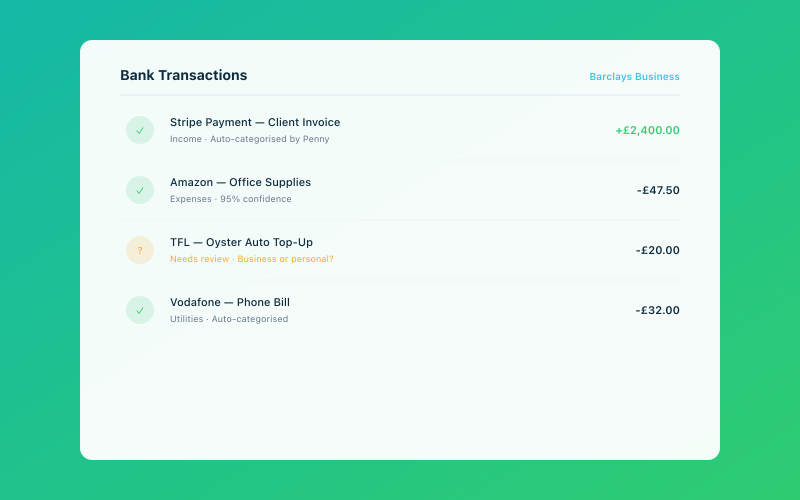 Penny auto-categorises your bank transactions with 95%+ accuracy
That means recording:
- Income — money you receive from customers for your products or services
- Expenses — money you spend on running your business (supplies, software, travel, insurance, and so on)
- Assets — things your business owns (equipment, vehicles, stock)
- Liabilities — money your business owes (loans, unpaid bills, tax)
In the old days, this was literally done in books — hence the name. Today, most people use software, spreadsheets, or apps. The principle hasn't changed, though: you're creating a reliable record of where your money has come from and where it's gone.
Bookkeeping is sometimes confused with accounting, but they're not quite the same thing. Bookkeeping is about recording transactions. Accounting takes those records and uses them to produce financial statements, calculate tax, and provide insights into business performance. Think of bookkeeping as the foundation that accounting is built on.
Why Does Bookkeeping Matter?
You might be wondering whether it's really worth the effort, especially if your business is small and straightforward. Here's why it genuinely matters:
It's a Legal Requirement
If you're self-employed in the UK, HMRC requires you to keep accurate financial records. This applies to all sole traders, regardless of how much you earn. You need to record all your income and expenses, and keep supporting documents like invoices, receipts, and bank statements.
These records must be kept for at least five years after the 31 January submission deadline for the relevant tax year. If HMRC opens an enquiry and you can't produce adequate records, you could face penalties. For the full details on what HMRC expects, see our guide to keeping business records for HMRC.
It Makes Your Tax Return Easier
Every year, sole traders need to file a Self Assessment tax return. If your bookkeeping is up to date, completing your return is largely a matter of transferring the figures. If it's not, you'll be spending January in a panic, sifting through bank statements, shoe boxes of receipts, and half-remembered invoices.
The numbers matter too. If your taxable profit exceeds the personal allowance of £12,570 for the 2025/26 tax year, you'll pay income tax at 20% on income between £12,571 and £50,270. Getting your expenses right can make a real difference to your tax bill, and good bookkeeping ensures you claim everything you're entitled to.
It Helps You Understand Your Business
Bookkeeping isn't just about satisfying HMRC. It gives you a clear picture of how your business is actually performing. Are you making money? Where is most of your income coming from? What are your biggest expenses? Are there months when cash is tight?
Without proper records, you're essentially running your business blind. With them, you can spot problems early, make informed decisions, and plan for the future.
It Supports Growth
If you ever want to apply for a business loan, take on a mortgage as a self-employed person, or bring in an investor, you'll need to show your financial records. Clean, organised bookkeeping demonstrates that you take your business seriously and that your numbers can be trusted.
What You Need to Record
For a typical sole trader, bookkeeping covers several key areas:
Income
Record every payment you receive for your work. This includes:
- Payments from clients (whether by bank transfer, cash, cheque, or card)
- Any other business income (interest, rental income from business property, etc.)
For each income transaction, note the date, amount, who paid you, and what it was for. If you issued an invoice, keep a copy and reference it. Our guide on how to invoice correctly covers what your invoices should include.
Expenses
Record every business expense. Common categories for sole traders include:
- Office costs — stationery, postage, printing
- Travel — fuel, public transport, parking (for business journeys)
- Clothing — only if it's specialist workwear or a uniform
- Staff costs — if you employ anyone
- Stock and materials — goods you buy to sell or use in your work
- Professional fees — accountant fees, legal advice, professional memberships
- Marketing — website hosting, advertising, business cards
- Insurance — public liability, professional indemnity, etc.
- Phone and internet — the business portion of your bills
- Software and subscriptions — tools you use for your business
- Bank charges — fees on your business account
Keep receipts for everything. Digital photos of receipts are perfectly acceptable — HMRC doesn't require originals as long as the details are legible.
Mileage (If Applicable)
If you use your personal vehicle for business, you can claim simplified mileage expenses rather than tracking actual costs. The approved rates are 45p per mile for the first 10,000 business miles and 25p per mile thereafter. Keep a log of each business journey, including the date, destination, purpose, and miles driven.
Bank Transactions
Your bank statement is the backbone of your bookkeeping. Every transaction on it should be accounted for — categorised as income, an expense, a transfer, or a personal drawing. Regular bank reconciliation (matching your records to your bank statement) keeps everything accurate.
How to Do Your Bookkeeping
There are several approaches, and the right one depends on your business size, complexity, and personal preference.
Option 1: Spreadsheets
A simple spreadsheet with columns for date, description, category, money in, and money out is enough for many sole traders. It's free, flexible, and gives you full control. The downsides are that it's manual, prone to errors, and doesn't automate anything.
Option 2: Accounting Software
This is where most small business owners end up, and for good reason. Software like Accounted automates much of the process — connecting to your bank account, categorising transactions, tracking invoices, and generating reports. It's faster, more accurate, and takes the pain out of bookkeeping.
With Accounted, Penny can help you categorise transactions and keep your records up to date without needing any accounting knowledge. It's designed specifically for sole traders who want to stay on top of things without becoming bookkeeping experts.
Option 3: Hire a Bookkeeper
If you'd rather not do it yourself at all, you can hire a bookkeeper. This typically costs between £150 and £400 per month for a small business, depending on the volume of transactions. It's worth it if your time is better spent on billable work, but it does add a cost.
Option 4: A Combination
Many business owners use software for day-to-day bookkeeping and bring in an accountant or bookkeeper at year-end to review everything and prepare the tax return. This can be a cost-effective middle ground.
Choosing an Accounting Method
Before you start, you'll need to decide on an accounting method. For most sole traders in the UK, there are two options:
- Cash basis — you record income when you receive the money and expenses when you pay them. This is simpler and is the default for most sole traders earning under £150,000.
- Accrual basis — you record income when you earn it (i.e., when you invoice) and expenses when you incur them, regardless of when the money actually moves. This gives a more complete picture but is more complex.
We've written a detailed guide on cash basis vs accrual accounting if you'd like to understand the pros and cons of each.
Building Good Bookkeeping Habits
The secret to bookkeeping isn't knowledge — it's consistency. Here are some habits that will serve you well:
Do It Regularly
Set aside a specific time each week — even just 15 to 30 minutes — to update your records. Categorise transactions, file receipts, and note anything that needs following up. Doing a little regularly is far easier than doing a lot once a year.
Keep Everything Digital
Photograph or scan receipts as soon as you get them. Paper receipts fade, get lost, and end up in washing machines. A digital copy stored in a logical folder structure (or in your accounting app) is far more reliable.
Reconcile Monthly
At the end of each month, check that your bookkeeping records match your bank statement. If something doesn't add up, investigate while it's still fresh in your memory.
Separate Personal and Business Finances
This one is crucial. If you're mixing personal and business transactions in one account, your bookkeeping will be a nightmare. Open a separate business account — it doesn't have to be a formal business account; a second personal current account works fine. For more on this, read our guide on separating personal and business finances.
Don't Throw Anything Away
Keep all financial records for at least five years. This includes bank statements, invoices, receipts, contracts, and any correspondence related to your finances. HMRC can open an enquiry going back several years, and you'll need documentation to support your figures.
Common Bookkeeping Mistakes to Avoid
- Leaving it until tax season. The January rush is real, and it's entirely avoidable with regular bookkeeping.
- Not recording cash transactions. If you receive cash payments, they still count as income and must be recorded.
- Forgetting to claim legitimate expenses. Many sole traders pay more tax than they need to simply because they don't record all their allowable expenses.
- Not backing up your records. If your laptop dies and your spreadsheet wasn't backed up, you're in trouble. Cloud-based software solves this automatically.
- Mixing business and personal expenses. It makes everything harder and increases the risk of errors.
Getting Started
If you've been putting off your bookkeeping, today is a good day to start. You don't need any special training or qualifications. You just need a system — whether that's a spreadsheet, an app, or a notebook — and the discipline to use it regularly.
Start by gathering your bank statements for the current tax year, categorise each transaction, and make sure you have receipts or invoices to support them. Once you're up to date, keeping on top of it going forward is much easier.
Your future self — the one who breezes through their tax return in twenty minutes rather than spending a weekend in a cold sweat — will thank you.
Accounted helps UK sole traders stay on top of their bookkeeping and tax. Start your free 30-day trial at getaccounted.co.uk
Related reading:
- How to Keep Business Records for HMRC
- Cash Basis vs Accrual Accounting — Which Should You Use?
- The Difference Between Turnover, Profit, and Income
Related Reading
- How to Improve Your Credit Score as a Sole Trader
- Understanding Financial Ratios — A Sole Trader's Guide
Try Accounted free for 30 days — no credit card required.
Accounted makes bookkeeping simple — Penny categorises your transactions automatically so you don't have to. See how →
Tax & Compliance Specialists
Our tax specialists have decades of combined experience in UK sole trader and small business taxation, MTD compliance, and HMRC submissions. All content is reviewed against current HMRC guidance before publication and updated quarterly to reflect legislative changes.
Ready to try Accounted?
Join UK sole traders who are simplifying their bookkeeping and tax.
Start your 14-day free trial