The Difference Between Turnover, Profit, and Income
Turnover, profit, income — three words that get thrown around constantly in business, often as though they mean the same thing. But they don't. And mixing them up can lead to some genuinely costly mistakes, from misunderstanding your tax position to making poor business decisions based on the wrong number.
If you've ever wondered exactly what the difference is — or worried you should already know — you're in good company. Even experienced business owners sometimes use these terms loosely. Let's clear things up once and for all.
What Is Turnover?
Turnover is the total amount of money your business earns from selling goods or services, before you deduct any costs. It's sometimes called revenue, sales, or gross income.
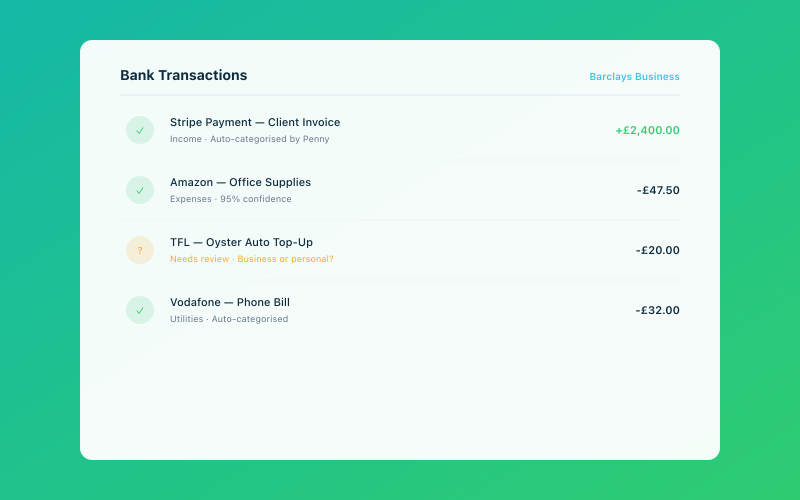 Penny auto-categorises your bank transactions with 95%+ accuracy
Think of turnover as the top line — the biggest number on your financial statements. It represents the total value of everything you've sold or billed.
For example, if you're a self-employed graphic designer and you billed clients a total of £65,000 during the 2025/26 tax year, your turnover is £65,000. It doesn't matter how much you spent on software, equipment, or travel — your turnover is purely the total sales figure.
Why Turnover Matters
Turnover is important for several reasons:
- Tax thresholds. The VAT registration threshold is currently £90,000. If your turnover exceeds this, you must register for VAT. Note that it's turnover, not profit, that counts here. A business with £95,000 turnover and only £30,000 profit still needs to be VAT registered.
- Cash basis eligibility. Sole traders can use cash basis accounting if their turnover is £150,000 or less. Again, turnover is the relevant figure.
- Business size comparisons. When people talk about a business's size or growth, they're usually referring to turnover.
- HMRC reporting. On your Self Assessment tax return, you'll report your turnover separately from your expenses and profit.
What Turnover Doesn't Tell You
Turnover on its own is a fairly blunt instrument. A business with £200,000 turnover might sound impressive, but if expenses are £195,000, the owner is only making £5,000. Turnover tells you how much money flows through the business, but not how much of it you actually keep.
This is why the saying "turnover is vanity, profit is sanity" exists. It's catchy because it's true.
What Is Profit?
Profit is what's left over after you subtract all your business expenses from your turnover. It's the money you actually get to keep (before tax, anyway).
Profit = Turnover - Expenses
Using our graphic designer example: if turnover is £65,000 and total business expenses are £12,000, then profit is £53,000.
Types of Profit
There are several types of profit, and it's worth knowing the differences:
Gross profit is turnover minus the direct costs of providing your goods or services (called cost of sales or cost of goods sold). For a sole trader providing services, gross profit and turnover are often very similar because there aren't many direct costs. For someone selling physical products, the cost of buying or making those products would be deducted.
Net profit (also called operating profit) is turnover minus all business expenses — not just direct costs, but also overheads like rent, insurance, marketing, phone bills, and everything else. This is the figure most people mean when they say "profit."
Taxable profit is the figure HMRC uses to calculate your tax. For most sole traders, it's close to net profit, but there can be adjustments — for example, capital allowances on equipment purchases, or expenses that aren't tax-deductible (like business entertaining).
Why Profit Matters
Profit is arguably the most important number in your business:
- It determines your tax bill. Your income tax and National Insurance contributions are calculated based on your taxable profit. If your profit is above the personal allowance of £12,570, you'll pay tax at the basic rate of 20% on the portion between £12,571 and £50,270.
- It shows whether your business is sustainable. A business that consistently makes a loss isn't viable in the long run.
- It's what you live on. As a sole trader, your profit (minus tax) is your personal income. It's what pays your mortgage, buys your groceries, and funds your holidays.
For a deeper look at how profit appears in your financial statements, see our guide to reading a profit and loss statement.
What Is Income?
This is where things get a bit ambiguous, because "income" is used in different ways depending on the context.
Income in a Business Context
In business terms, income usually means the same thing as turnover or revenue — the money your business receives from sales. When someone asks "what's your business income?", they're typically asking about your turnover.
Income in a Personal or Tax Context
In personal finance and tax, income means the total amount you receive from all sources. For a sole trader, this includes:
- Trading income — your business profit (not your turnover, but your profit)
- Employment income — if you also have a job
- Savings income — interest from bank accounts
- Dividend income — if you receive dividends from investments or a company
- Rental income — if you let out property
- Pension income — if you're drawing a pension
HMRC uses your total income from all sources to work out your tax band. So if you have a part-time job paying £15,000 and a side business making £10,000 profit, your total income for tax purposes is £25,000.
The Confusion Factor
The word "income" is used so loosely that it can mean almost anything depending on who's talking. A client might say "my income is £40,000" and mean their turnover. An accountant might use the same phrase to mean their taxable profit. HMRC has its own specific definitions.
The key takeaway: when someone mentions "income," always clarify whether they mean turnover, profit, or total personal income. Getting it wrong can lead to misunderstandings — particularly around tax.
A Practical Example
Let's bring it all together with a worked example.
Sarah is a self-employed photographer. In the 2025/26 tax year:
- She invoiced clients a total of £48,000 for wedding and portrait photography
- She spent £8,000 on equipment, insurance, travel, software, and marketing
- She also has a savings account that earned £200 in interest
Here's how the three terms apply:
| Term | Amount | Explanation | |---|---|---| | Turnover | £48,000 | Total amount billed to clients | | Business profit | £40,000 | Turnover minus expenses (£48,000 - £8,000) | | Total income | £40,200 | Business profit plus savings interest | | Taxable income | £40,200 | Used to calculate income tax |
Sarah's income tax calculation for 2025/26:
- First £12,570 — covered by the personal allowance, so no tax
- Next £27,630 (£12,571 to £40,200) — taxed at 20% = £5,526
So Sarah pays £5,526 in income tax (plus National Insurance on her trading profits). She'll also set aside money for her Class 2 and Class 4 National Insurance contributions.
Notice that her tax is calculated on her profit and savings interest — not her turnover. If she mistakenly thought HMRC was going to tax her on the full £48,000, she'd be in for an unpleasant surprise (or, more likely, she'd overpay).
Why Getting These Terms Right Matters
For Your Tax Return
Reporting the wrong figure in the wrong box on your Self Assessment return can trigger HMRC enquiries, penalties, or underpaid tax. Your return asks for your turnover and your expenses separately — HMRC calculates the profit from there. If you accidentally put your profit in the turnover box, your figures won't add up.
For Business Decisions
If you're trying to decide whether you can afford to hire help, invest in equipment, or take on a lease, you need to base your decision on profit, not turnover. A business with £100,000 turnover but only £20,000 profit can afford very different things from a business with £50,000 turnover and £40,000 profit.
For Conversations with Your Bank
If you're applying for a mortgage or a loan, the lender will want to know your net profit — that's what they consider your actual income. Quoting your turnover will only lead to confusion (and possibly an application rejection when the real figure comes to light).
For VAT Registration
Conversely, VAT registration is based on turnover, not profit. Some business owners mistakenly believe they don't need to register because their profit is below the threshold, when in fact it's their turnover that matters.
Keeping Track of All Three
The best way to keep on top of these figures is with consistent bookkeeping. Recording your income and expenses as they happen means you always know your turnover, your profit, and where you stand.
With a tool like Accounted, tracking these numbers happens automatically as you categorise your transactions. You can see your turnover and profit at a glance, updated in real time — no mental arithmetic needed.
It's also worth reviewing your numbers regularly, not just at tax time. A monthly check-in takes minutes and gives you a clear picture of how your business is performing. Are expenses creeping up? Is turnover growing but profit shrinking? These are things you want to catch early.
Quick Reference
To summarise the differences:
| Term | What It Means | Example | |---|---|---| | Turnover | Total sales before any deductions | £65,000 in client billings | | Profit | What's left after subtracting expenses from turnover | £65,000 - £12,000 = £53,000 | | Income | Context-dependent — could mean turnover, profit, or total personal income from all sources | £53,000 profit + £500 interest = £53,500 total income |
Remember: turnover is vanity, profit is sanity — and income depends on who's asking.
Accounted helps UK sole traders stay on top of their bookkeeping and tax. Start your free 30-day trial at getaccounted.co.uk
Related reading:
- How to Read a Profit and Loss Statement
- Profit vs Cash Flow — Why Profitable Businesses Go Bust
- What Is Bookkeeping and Why Does It Matter?
Related Reading
Try Accounted free for 30 days — no credit card required.
Accounted makes bookkeeping simple — Penny categorises your transactions automatically so you don't have to. See how →
Tax & Compliance Specialists
Our tax specialists have decades of combined experience in UK sole trader and small business taxation, MTD compliance, and HMRC submissions. All content is reviewed against current HMRC guidance before publication and updated quarterly to reflect legislative changes.
Ready to try Accounted?
Join UK sole traders who are simplifying their bookkeeping and tax.
Start your 14-day free trial