Profit vs Cash Flow — Why Profitable Businesses Go Bust
Here's a fact that catches many new business owners off guard: a business can be profitable on paper and still run out of money. It sounds contradictory, but it happens more often than you'd think. In fact, poor cash flow is one of the most common reasons businesses fail — not a lack of profit, but a lack of actual cash in the bank when bills come due.
If you've ever had a month where you invoiced plenty of work but couldn't quite cover your expenses, you've already felt this tension first-hand. Understanding the difference between profit and cash flow — and managing both — is one of the most important financial skills you can develop as a business owner.
Let's untangle the two.
What Is Profit?
Profit is what's left over after you subtract your expenses from your income. Simple enough on the surface.
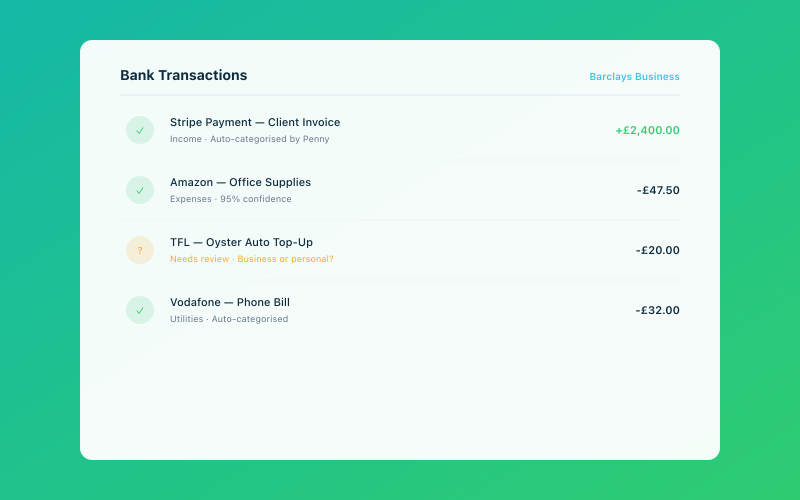 Penny auto-categorises your bank transactions with 95%+ accuracy
If you're a freelance web developer and you earn £50,000 in a year but spend £15,000 on software subscriptions, equipment, travel, and other business costs, your profit is £35,000. That's the figure you'd report on your Self Assessment tax return, and it's the amount HMRC will use to calculate your tax bill.
There are a few different types of profit worth knowing:
- Gross profit — your income minus the direct costs of delivering your product or service (sometimes called cost of sales)
- Net profit — your income minus all expenses, including overheads, admin costs, and everything else
- Taxable profit — the figure HMRC actually taxes you on, which may differ from your accounting profit due to allowances and reliefs
For most sole traders, net profit and taxable profit are fairly close. If your taxable profit exceeds the personal allowance of £12,570, you'll pay income tax at the basic rate of 20% on earnings between £12,571 and £50,270, with higher rates applying above that.
You can learn more about how profit appears in your accounts in our guide to reading a profit and loss statement.
What Is Cash Flow?
Cash flow is simply the movement of money in and out of your business. Cash comes in when customers pay you, and cash goes out when you pay suppliers, rent, subscriptions, tax, or anything else.
Positive cash flow means more money is flowing into your business than out of it during a given period. Negative cash flow means the opposite — you're spending more than you're receiving.
The critical distinction is timing. Profit is calculated over a period and doesn't necessarily reflect when money actually changes hands. Cash flow is all about when the money moves.
Why They're Not the Same Thing
This is where it gets interesting — and where many business owners come unstuck. Here are the main reasons profit and cash flow can diverge significantly:
Late-Paying Customers
You complete a project in January and send an invoice for £5,000 with 30-day payment terms. In your accounts, that £5,000 counts as income in January (assuming you use accrual accounting). But the cash doesn't arrive until February — or March, if the client pays late.
Meanwhile, your January expenses still need paying. You've got software subscriptions, perhaps a phone bill, maybe a subcontractor to pay. Your profit looks fine, but your bank account tells a different story.
Upfront Costs
Perhaps you need to buy materials or stock before you can deliver work and get paid. A carpenter, for instance, might spend £2,000 on timber and supplies for a job that won't be invoiced until completion three weeks later. The cash goes out now; the income arrives later.
Tax Timing
Your Self Assessment tax bill is based on profits from the previous tax year, but the payment is due on 31 January (with a possible second payment on account on 31 July). This means you might face a large cash outflow months after the profits were earned. If you haven't set aside the money, that's a cash flow problem, even though you were profitable.
Asset Purchases
If you buy a van for £15,000, that's a significant cash outflow. But in your accounts, you don't record the full £15,000 as an expense in one go — you depreciate it over several years, or claim capital allowances. So your profit barely changes, but your cash position takes a big hit.
Drawings and Personal Use
As a sole trader, the money you draw from the business for personal living expenses isn't an expense for profit purposes. But it's very much a cash outflow. Drawing £2,500 a month from a business making £30,000 profit is technically sustainable on paper, but if cash flow is uneven, you might struggle in quieter months.
Real-World Example: When Profit Misleads
Let's look at a practical example. Imagine you're a self-employed marketing consultant.
In March, you land three new clients and complete £12,000 worth of work. Your expenses for the month are £3,000. On paper, you've made £9,000 profit. Brilliant.
But here's the reality:
- Client A paid on time: £4,000 received
- Client B asked for 60-day terms: £5,000 still outstanding
- Client C is "chasing the invoice internally": £3,000 still outstanding
- You paid your expenses: -£3,000
- You took drawings for living costs: -£2,500
Cash position for March: -£1,500
You made £9,000 profit but ended the month £1,500 worse off in cash terms. If this pattern continues, you'll eventually hit a wall — even though your business is profitable.
This scenario plays out constantly across the UK's 4.2 million sole trader businesses. It's not a sign of failure; it's a sign that cash flow needs active management.
How to Manage Both Effectively
The good news is that once you understand the distinction, you can take practical steps to keep both profit and cash flow healthy.
Invoice Promptly and Chase Payments
The sooner you send an invoice, the sooner you'll get paid. Don't let completed work sit uninvoiced for days or weeks. And don't be shy about chasing overdue payments — it's your money, and you've earned it. Our guide on how to invoice correctly covers the essentials.
Shorten Payment Terms Where Possible
If you're currently offering 30-day terms, consider whether 14-day terms might work for some clients. Or ask for a deposit or milestone payments on larger projects. Every day you shave off payment terms improves your cash flow.
Build a Cash Buffer
Try to keep a reserve of at least one to two months' worth of expenses in your business account. This gives you breathing room when cash flow dips. It's not always easy to build up, but even a small buffer helps enormously.
Separate Your Tax Money
When income comes in, set aside a percentage for tax immediately. For basic-rate taxpayers, putting 20-25% of your profit into a separate savings account is a sensible starting point. This stops you from accidentally spending money that belongs to HMRC.
Track Cash Flow Separately
Your profit and loss statement won't warn you about cash flow problems. You need to track cash flow as a distinct metric. This can be as simple as a monthly forecast showing expected inflows and outflows. For a deeper dive, see our guide on cash flow management for sole traders.
Use the Right Accounting Method
If you're a sole trader earning under £150,000, you can use cash basis accounting, which only counts income when you receive it and expenses when you pay them. This aligns your profit calculation more closely with your actual cash position, which can simplify things considerably.
Warning Signs to Watch For
Keep an eye out for these red flags that suggest a cash flow problem is developing:
- Your bank balance is consistently falling even though you're busy and invoicing regularly
- You're regularly dipping into personal savings to cover business expenses
- You're delaying payments to suppliers because the cash isn't there
- Outstanding invoices are growing — more and more money is owed to you but not yet received
- You're surprised by tax bills because you haven't been setting money aside
If any of these sound familiar, it's time to take a closer look at your cash flow. The sooner you address it, the easier it is to fix.
Cash Flow Forecasting: Your Secret Weapon
One of the most effective things you can do is create a simple cash flow forecast. This doesn't need to be complicated. A basic spreadsheet — or a tool like Accounted, where Penny can help you visualise your cash position — will do the job.
List out your expected income and expenses for the next three to six months, week by week or month by month. Include everything: client payments, subscriptions, tax bills, insurance renewals, equipment purchases, and drawings.
This forward-looking view lets you spot potential shortfalls before they happen. If you can see that April is going to be tight, you can take action now — chasing invoices, delaying a non-essential purchase, or lining up additional work.
The Bottom Line
Profit tells you whether your business is viable. Cash flow tells you whether it can survive day to day. You need both to be healthy, and you need to track both — because they can tell very different stories.
The businesses that thrive aren't always the most profitable ones. They're the ones that manage their cash well, plan ahead, and never confuse money earned with money received. Get this right, and you'll sleep a lot better at night.
Accounted helps UK sole traders stay on top of their bookkeeping and tax. Start your free 30-day trial at getaccounted.co.uk
Related reading:
- Cash Flow Management for Sole Traders
- What Is a Balance Sheet and Why Should You Care?
- How to Read a Profit and Loss Statement
Related Reading
- Emergency Funds for Self-Employed People — How Much and Where
- What Is a UTR Number and How to Get One
Try Accounted free for 30 days — no credit card required.
Accounted makes bookkeeping simple — Penny categorises your transactions automatically so you don't have to. See how →
Tax & Compliance Specialists
Our tax specialists have decades of combined experience in UK sole trader and small business taxation, MTD compliance, and HMRC submissions. All content is reviewed against current HMRC guidance before publication and updated quarterly to reflect legislative changes.
Ready to try Accounted?
Join UK sole traders who are simplifying their bookkeeping and tax.
Start your 14-day free trial