Emergency Funds for Self-Employed People — How Much and Where
When you're employed, losing your income usually means redundancy — and that comes with notice periods, statutory pay, and time to find something new. When you're self-employed, your income can vanish overnight. A key client pulls out, you get injured, your equipment breaks, or the economy takes a turn. There's no safety net unless you build one yourself.
That's where an emergency fund comes in. It's not glamorous, it's not exciting, and it won't make you feel like a financial genius. But it will keep the lights on when everything else goes sideways. Let's talk about how much you actually need, where to keep it, and how to build it even when money feels tight.
Why Self-Employed People Need a Bigger Safety Net
The standard advice for employees is to save three to six months' worth of living expenses. That's sensible — it covers the gap between jobs and handles unexpected costs. But when you're self-employed, that guidance doesn't quite cut it.
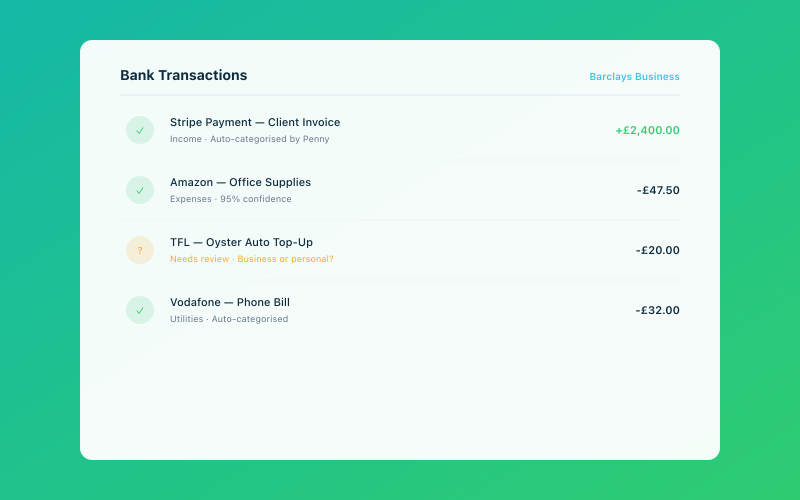 Penny auto-categorises your bank transactions with 95%+ accuracy
Here's why:
- Your income is less predictable. Even in good times, payments can arrive late, clients can reduce their orders, and seasonal fluctuations can leave quieter months.
- You don't get sick pay. If you're ill or injured, your income stops. Statutory Sick Pay doesn't apply to sole traders.
- Business costs don't pause. Software subscriptions, insurance, rent — these keep ticking even when revenue doesn't.
- You might need to invest to recover. If your laptop dies or your van breaks down, you need to get back up and running fast.
For these reasons, most financial advisers suggest that self-employed people aim for a larger emergency fund than their employed counterparts. The question is: how much larger?
How Much Should You Save?
There's no single answer that fits everyone, but here's a framework that works for most sole traders and freelancers.
Step 1: Calculate your monthly essentials. This includes rent or mortgage, utilities, food, insurance, minimum debt repayments, and any other non-negotiable costs. Don't include luxuries — this is a bare-bones survival number.
Step 2: Add your fixed business costs. Think software subscriptions, professional insurance, phone contract, and any other expenses that continue regardless of whether you're earning. If you use Accounted to track your expenses, you can pull these numbers quickly.
Step 3: Multiply by your target months. For most self-employed people, we'd recommend:
- Minimum: 3 months of combined personal and business essentials.
- Comfortable: 6 months — this gives you breathing room to weather a quiet spell or recover from illness.
- Gold standard: 9–12 months — if your industry is particularly volatile or you have dependants relying on your income.
So if your monthly essentials (personal plus business) come to £2,500, you'd be looking at:
- Minimum fund: £7,500
- Comfortable fund: £15,000
- Gold standard: £22,500–£30,000
Those numbers might feel daunting, and that's perfectly normal. The important thing is to start, even if you're putting away £50 a month. We'll cover how to build up gradually in a moment.
Where Should You Keep Your Emergency Fund?
Your emergency fund needs to be two things: accessible and safe. This isn't money you should be investing in stocks or locking away for five years. It needs to be there when you need it — which could be tomorrow.
Here are the best options:
Easy-access savings accounts
This is the most common and arguably the best choice. An easy-access savings account lets you withdraw money the same day (or next day) without penalties. You'll earn some interest — not a fortune, but enough to offset inflation slightly.
Look for accounts that:
- Pay a competitive interest rate (check comparison sites regularly, as rates shift).
- Don't penalise you for withdrawals.
- Are protected by the Financial Services Compensation Scheme (FSCS) up to £85,000.
Cash ISAs
If you're a higher earner and you've already used your Personal Savings Allowance (£1,000 for basic rate taxpayers, £500 for higher rate), a Cash ISA can shelter your emergency fund interest from tax. Just make sure you choose a flexible ISA that lets you withdraw and replace funds within the same tax year without losing your allowance. For a deeper look at which ISA might suit you, keep an eye on our upcoming guides.
Premium Bonds
NS&I Premium Bonds are another option. Your capital is 100% government-backed, and instead of earning interest, you're entered into a monthly prize draw. The odds aren't spectacular, but you can withdraw within a few working days and your capital is completely safe. Some people like the gamification aspect — it makes saving feel a bit less boring.
Where NOT to keep it
- Current accounts — too easy to spend, and typically no interest.
- Fixed-term savings accounts — you can't access the money quickly without penalties.
- Investments (stocks, funds, crypto) — the value can drop right when you need the money most.
- Under the mattress — no interest, no FSCS protection, and your insurance probably won't cover it.
How to Build Your Emergency Fund From Scratch
If you're starting from zero, the idea of saving several thousand pounds might feel impossible. But the trick is to make it automatic and gradual. Here's a step-by-step approach:
Set a monthly savings target. Even £100 a month gets you to £1,200 in a year. If that feels like a stretch, start with £50 — or even £25. The amount matters less than the consistency.
Automate the transfer. Set up a standing order from your business account to your emergency savings account. Make it go out on the day you typically receive your largest client payment, or on the first of the month. If the money moves before you see it in your current account, you won't miss it.
Save windfalls. Got a tax refund? An unexpectedly large project fee? A rebate from a supplier? Channel a portion (or all of it) straight into your emergency fund. These irregular windfalls can supercharge your savings.
Cut one thing. Find one recurring expense you can eliminate or reduce. Cancel a subscription you barely use, switch to a cheaper phone plan, or renegotiate your insurance. Redirect the savings.
Use the profit-first method. When income comes in, pay your emergency fund first — before expenses, before paying yourself. It sounds counterintuitive, but it reframes saving as a non-negotiable cost of running your business, rather than something you do with whatever's left over.
If cash flow is genuinely tight, start by reading our guide on managing financial anxiety as a sole trader. Sometimes the first step is getting a clear picture of where you actually stand.
When Should You Use Your Emergency Fund?
This is where discipline comes in. An emergency fund is for genuine emergencies — not for a new laptop because yours is a bit slow, or for a holiday because you're feeling burnt out (tempting as that may be).
Good reasons to dip into your emergency fund:
- A major client stops paying or terminates your contract unexpectedly.
- You're ill or injured and can't work for a sustained period.
- Essential equipment fails and needs immediate replacement.
- An unexpected tax bill or fine arrives.
- A genuine household emergency (boiler breaks down, emergency car repair, etc.).
Not-so-good reasons:
- Upgrading equipment that still works fine.
- Covering a slow month that was entirely predictable (seasonal businesses, take note).
- Investing in a new business opportunity — that should come from a separate pot.
The rule of thumb is simple: if the expense is unexpected and would cause genuine financial hardship if you didn't pay it, that's what the fund is for. Everything else should come from your operating budget or a separate savings pot.
Replenishing After You've Used It
Using your emergency fund isn't a failure — it's the entire point of having one. But once you've dipped into it, replenishing it should become your top financial priority.
Treat it the same way you built it: set a monthly amount, automate the transfer, and stick to it until you're back to your target level. If possible, temporarily increase your contributions to rebuild faster. For example, if you normally save £150 a month, bump it to £200 or £250 until you've recovered.
It also helps to reflect on what caused the emergency. If a client's departure wiped out half your income, that's a signal to diversify your client base. If equipment failure cost you thousands, perhaps a maintenance plan or extended warranty would be worthwhile insurance. Penny, your AI assistant in Accounted, can help you spot patterns in your spending that might highlight vulnerabilities before they become emergencies.
Emergency Fund vs. Tax Savings — Keep Them Separate
One common mistake is lumping your emergency fund together with your tax savings. They're two very different pots with two very different purposes, and mixing them creates problems.
Your tax money isn't yours — it's HMRC's. If you dip into it for an emergency, you'll face a new emergency when your tax bill arrives. Keep these in separate accounts, clearly labelled, so there's never any confusion about what money is earmarked for what.
A clean three-pot system works well: business current account, tax savings account, and emergency fund. Some people add a fourth pot for planned business investment. The more clearly you separate your money by purpose, the better your financial decisions will be.
Related Reading
Accounted helps UK sole traders stay on top of their bookkeeping and tax. Start your free 30-day trial at getaccounted.co.uk.
Further Reading
- Check the current income tax rates on GOV.UK.
- HMRC outlines record-keeping requirements for businesses.
Try Accounted free for 30 days — no credit card required.
Accounted makes bookkeeping simple — Penny categorises your transactions automatically so you don't have to. See how →
Tax & Compliance Specialists
Our tax specialists have decades of combined experience in UK sole trader and small business taxation, MTD compliance, and HMRC submissions. All content is reviewed against current HMRC guidance before publication and updated quarterly to reflect legislative changes.
Ready to try Accounted?
Join UK sole traders who are simplifying their bookkeeping and tax.
Start your 14-day free trial