Start Up Loans — The Government-Backed Scheme Explained
Starting a business is exciting, but it's also expensive. Whether you need to buy equipment, build a website, stock up on supplies, or simply cover your costs while you find your first clients, the early days almost always require some investment. And that's where many aspiring business owners hit a wall — they've got the idea and the drive, but not the capital.
The Start Up Loans scheme was created to solve exactly that problem. It's a government-backed programme that provides affordable loans and free mentoring to people starting or growing new businesses in the UK. Since its launch in 2012, the scheme has supported tens of thousands of businesses, and it remains one of the most accessible forms of funding for new sole traders, freelancers, and small business owners.
Here's everything you need to know.
What Is the Start Up Loans Scheme?
Start Up Loans is a government-funded initiative, delivered by the British Business Bank through a network of delivery partners across the UK. It provides unsecured personal loans to individuals who are starting a new business or have been trading for up to three years.
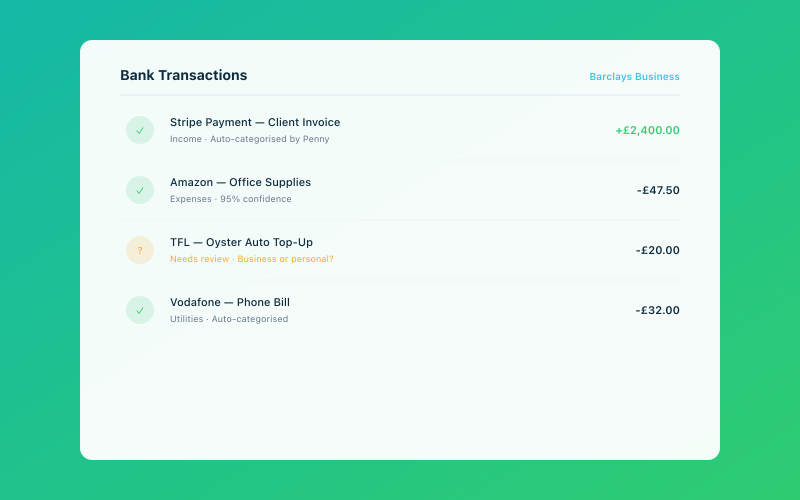 Penny auto-categorises your bank transactions with 95%+ accuracy
The key features:
- Loan amount: £500 to £25,000 per person. If there are multiple founders, each can apply individually, up to a combined maximum of £100,000 per business.
- Interest rate: Fixed at 6% per year for the life of the loan. This is significantly lower than most commercial lenders offer to new businesses.
- Repayment term: 1 to 5 years, with fixed monthly repayments.
- Unsecured: You don't need to put up your home or other assets as security.
- No early repayment fees: You can pay off the loan early without penalty.
On top of the finance, every successful applicant receives 12 months of free mentoring from an experienced business adviser. This is arguably as valuable as the money itself — having someone to bounce ideas off and hold you accountable can make a real difference in those crucial early months.
Who Is Eligible?
The scheme is broadly accessible, but there are some key eligibility requirements:
- You must be aged 18 or over.
- You must be a UK resident.
- Your business must be based in the UK.
- Your business must be either pre-launch or have been trading for no more than 36 months at the time of application.
- You must be able to demonstrate that you'll be able to repay the loan.
- You must not be currently bankrupt or subject to an Individual Voluntary Arrangement (IVA).
The scheme is open to all industries and business types, including sole traders, partnerships, and limited companies. It's also available to people who are currently employed and starting a business on the side, as well as those who are unemployed.
There's no minimum credit score requirement, though your credit history will be considered as part of the assessment. The scheme is deliberately designed to be more accessible than traditional bank lending, so don't assume you'll be turned down just because your credit isn't perfect.
What Can You Use the Loan For?
Start Up Loans can be used for a wide range of legitimate business purposes, including:
- Equipment and tools
- Stock and supplies
- Marketing and advertising
- Website design and development
- Professional certifications or training
- Business insurance
- Initial operating costs (rent, utilities, etc.)
- Vehicle purchase or lease (for business use)
- Software and technology
You'll need to specify in your application how you plan to use the funds, and the money should be spent on business purposes only. It's a personal loan, so you're personally responsible for repayment regardless of how the business performs.
How to Apply
The application process is straightforward but thorough. Here's what to expect:
Step 1: Check your eligibility
Visit the Start Up Loans website (startuploans.co.uk) and use their eligibility checker. This takes a couple of minutes and won't affect your credit score.
Step 2: Prepare your business plan
This is the most important part of the application. You'll need to submit a business plan that covers:
- What your business does and who your customers are.
- Your market research and competitive landscape.
- Your marketing strategy.
- Financial forecasts — including a cash flow forecast for at least 12 months.
- How you'll use the loan funds.
- How you plan to repay the loan.
The plan doesn't need to be a 50-page document, but it does need to be clear, realistic, and well-researched. If you've never written a business plan before, our guide on how to write a business plan walks you through it step by step.
Step 3: Complete the online application
You'll fill in an application form with your personal details, business information, loan amount requested, and how you plan to use the funds. You'll also upload your business plan and cash flow forecast.
Step 4: Speak with an adviser
After submitting your application, you'll be assigned to a delivery partner in your area. An adviser will review your plan, discuss your business with you, and may suggest improvements. This isn't a test — it's a collaborative process designed to strengthen your application and your business.
Step 5: Decision
If your application is approved, the loan is typically paid into your bank account within a few days. You'll then set up a Direct Debit for the monthly repayments.
The whole process usually takes two to four weeks from initial application to receiving the funds, though it can be quicker if your paperwork is in good order.
The Mentoring Programme
Every Start Up Loans recipient gets 12 months of free mentoring from a volunteer business mentor. Your mentor will be matched to your industry and experience level, and you'll typically meet (in person or virtually) once a month.
Mentors can help with:
- Refining your business strategy.
- Setting and tracking goals.
- Problem-solving and decision-making.
- Networking and introductions.
- Accountability — having someone who checks in on your progress.
This mentoring is genuinely one of the best parts of the scheme. Starting a business can be isolating, and having an experienced guide in your corner makes the early days significantly less daunting.
Repaying Your Start Up Loan
Repayments are fixed monthly amounts over the term you've chosen (1 to 5 years). The 6% fixed interest rate means your repayments are predictable and won't change if the Bank of England rate moves.
Here's what the monthly repayments look like for common loan amounts over different terms:
| Loan amount | 3-year term | 5-year term | |---|---|---| | £5,000 | ~£152/month | ~£97/month | | £10,000 | ~£304/month | ~£193/month | | £15,000 | ~£456/month | ~£290/month | | £25,000 | ~£760/month | ~£483/month |
These are approximate figures — use the calculator on the Start Up Loans website for exact numbers.
Make sure your cash flow forecast includes these repayments. Falling behind on repayments can affect your credit score, so it's important to be realistic about what you can afford. If you're also saving for your tax bill (which you should be), factor that in too.
Advantages of the Scheme
Below-market interest rate. 6% fixed is excellent for an unsecured loan to a new business. Most commercial lenders would charge significantly more — if they'd lend to a new business at all.
No security required. You don't need to put your house on the line. The loan is unsecured, though you are personally liable for repayment.
Free mentoring. Twelve months of professional mentoring is a significant benefit that you'd otherwise have to pay for.
Accessible eligibility criteria. The scheme is designed for people who might not qualify for traditional bank finance.
Builds credit history. Making regular repayments on a Start Up Loan helps build your credit profile, which will benefit you when you need finance in the future.
No early repayment penalties. If your business takes off and you can pay the loan back early, you won't be charged extra for doing so.
Things to Consider Before Applying
It's a personal loan, not a business loan. Even though it's for business purposes, the loan is in your name and you're personally responsible for repayment. If the business fails, you still owe the money.
You need a realistic business plan. The application won't succeed without a credible plan and financial forecast. Take the time to get this right — it's good discipline for running your business anyway.
The maximum is £25,000 per person. If you need more than that, you'll need to look at additional funding sources alongside or after your Start Up Loan.
You need to track your spending. The loan should be used for the purposes stated in your application. Keep records of how the money is spent. This is where having Accounted set up from day one is invaluable — Penny can help you track every pound, keeping your records clean and audit-ready from the start.
Repayments start immediately. Unlike some business loans that offer a repayment holiday, Start Up Loan repayments begin in the month following disbursement. Make sure your cash flow can handle this from the outset.
After the Loan — What Next?
A Start Up Loan can get your business off the ground, but it's just the beginning. As you grow, you'll need to think about:
- Building financial habits — regular bookkeeping, tax saving, and cash flow management will serve you far better in the long run than any single injection of cash.
- Planning for tax — don't forget that your business income is taxable. Start setting money aside for your Self Assessment from day one.
- Growing sustainably — use the mentoring programme to set realistic growth targets and avoid overextending yourself.
Many successful businesses started with a Start Up Loan and grew from there. The combination of affordable finance, professional mentoring, and the discipline of creating a business plan gives you a stronger foundation than most new businesses have.
Related Reading
Accounted helps UK sole traders stay on top of their bookkeeping and tax. Start your free 30-day trial at getaccounted.co.uk.
Further Reading
- Check the current income tax rates on GOV.UK.
- HMRC outlines record-keeping requirements for businesses.
Try Accounted free for 30 days — no credit card required.
Accounted makes bookkeeping simple — Penny categorises your transactions automatically so you don't have to. See how →
Tax & Compliance Specialists
Our tax specialists have decades of combined experience in UK sole trader and small business taxation, MTD compliance, and HMRC submissions. All content is reviewed against current HMRC guidance before publication and updated quarterly to reflect legislative changes.
Ready to try Accounted?
Join UK sole traders who are simplifying their bookkeeping and tax.
Start your 14-day free trial