Cash Flow Forecasting for Beginners
If you've ever had a month where you were technically profitable on paper but still couldn't quite cover your bills, you've already discovered the difference between profit and cash flow. It's a distinction that trips up a lot of sole traders and freelancers, and it's exactly why cash flow forecasting matters.
Cash flow forecasting sounds like something big companies do in boardrooms with spreadsheets the size of bedsheets. But at its heart, it's really just answering one question: "Will I have enough money in the bank to cover what I need to pay, when I need to pay it?" That's it. And the good news is, you don't need an MBA or a fancy financial model to do it well.
In this guide, we'll break down what cash flow forecasting is, why it matters, and how to create a simple forecast that actually helps you run your business better.
What Is Cash Flow, and Why Does It Matter?
Cash flow is simply the movement of money in and out of your business. Money comes in when clients pay you. Money goes out when you pay for expenses, software subscriptions, supplies, tax, or anything else your business needs.
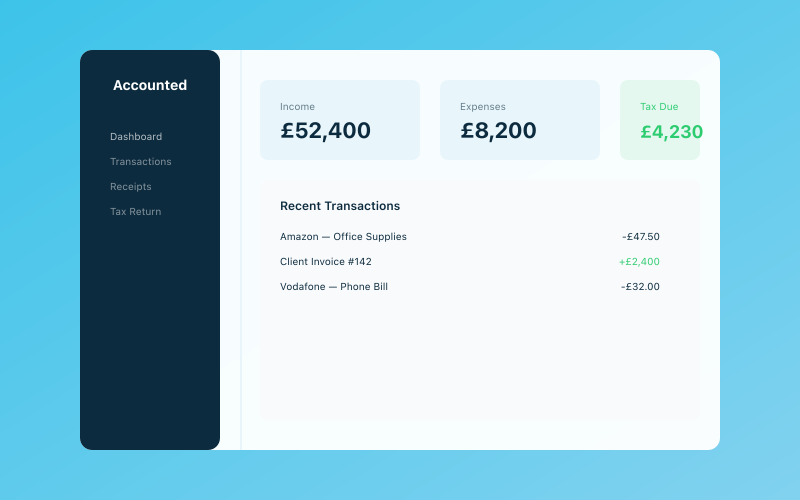 Your Accounted dashboard — income, expenses, and tax at a glance
Positive cash flow means more money is coming in than going out. That's the goal.
Negative cash flow means more money is going out than coming in. This isn't always a crisis — it can happen during a slow month or when you're making a big investment — but if it goes on for too long, you've got a problem.
The tricky thing about cash flow is timing. You might invoice a client for £3,000 in March, but they don't pay until May. Meanwhile, your rent, software, and phone bill are all due in April. On paper, you're doing fine. In reality, your bank account is looking worryingly thin.
This is why profit and cash flow are not the same thing. You can be profitable on an annual basis but still run out of money in a given month because the timing of your income and expenses doesn't line up.
A cash flow forecast helps you see these gaps coming, so you can plan around them instead of being blindsided.
The Basics of a Cash Flow Forecast
A cash flow forecast is a projection of when money will come in and when it will go out, usually broken down by week or month. It doesn't need to be complicated. At its simplest, a cash flow forecast has three columns:
- Money in — all the income you expect to receive, and when
- Money out — all the expenses you expect to pay, and when
- Running balance — the difference between the two, showing how much cash you'll have at any given point
Here's a very simple example for a freelance designer:
| | March | April | May | |---|---|---|---| | Opening balance | £2,000 | £1,500 | £3,200 | | Income | £3,000 | £4,500 | £3,500 | | Expenses | -£3,500 | -£2,800 | -£3,000 | | Closing balance | £1,500 | £3,200 | £3,700 |
In this example, March is a tight month — expenses exceed income, and the balance drops. But because our designer could see that coming, they might have chased up an outstanding invoice in February, delayed a non-essential purchase, or dipped into savings to bridge the gap.
That's the power of forecasting. It doesn't prevent problems, but it gives you time to deal with them.
How to Create Your Own Cash Flow Forecast
You don't need special software to create a cash flow forecast (though it helps — more on that later). A simple spreadsheet will do the job. Here's how to build one:
Step 1: List Your Expected Income
Go through the next three to six months and estimate when you'll receive payments. Include:
- Confirmed work — projects you've already won, with estimated payment dates based on your invoice terms
- Recurring income — retainer clients, regular contracts, or any predictable monthly income
- Likely work — projects you're pitching for or expect to win, but mark these as tentative so you don't rely on them too heavily
Be realistic, not optimistic. If a client typically pays you 14 days late, factor that into your forecast. If a project is still in the proposal stage, include it at a reduced probability — or leave it out altogether and treat it as a bonus if it comes through.
Step 2: List Your Expected Expenses
Go through the same period and list everything you'll need to pay. Include:
- Fixed costs — rent, insurance, software subscriptions, phone bill, broadband. These are predictable and happen every month.
- Variable costs — materials, travel, subcontractors, marketing spend. These fluctuate, so estimate based on your recent history.
- One-off costs — equipment purchases, training courses, annual subscriptions that come up once a year. These are easy to forget, so check your records from last year.
- Tax — your Self Assessment payment on account (31 January and 31 July), plus any VAT if you're registered. These can be significant amounts, so make sure they're in your forecast. For a refresher on how payments on account work, see our guide on cash flow management for sole traders.
Step 3: Calculate Your Running Balance
For each month, add your income to the opening balance and subtract your expenses. The result is your closing balance, which becomes the opening balance for the next month.
If your closing balance goes negative at any point, that's a red flag. It means you're forecasting a period where you won't have enough cash to cover your costs, and you need to act before that happens.
Step 4: Review and Update Regularly
A forecast is only useful if it's up to date. Set a reminder to review yours at least once a month — weekly is even better if your cash flow is tight. Update it with actual figures as they come in, adjust your projections, and extend the forecast forward.
Over time, you'll get better at predicting your cash flow patterns. You'll spot seasonal trends, learn which clients pay promptly and which don't, and develop a feel for when quiet periods are coming.
Common Cash Flow Traps for Sole Traders
Even with a forecast, there are some common traps that catch people out:
Late-paying clients. This is the big one. You've done the work, you've sent the invoice, but the money doesn't arrive when you expected it. If you're struggling with late payments, our guide on getting paid faster has some practical tips.
Forgetting about tax. Your tax bill doesn't arrive every month — it lands twice a year in large chunks (if you're making payments on account). It's easy to forget about it until the deadline approaches and then panic. Set aside a percentage of every payment in a separate pot or savings account. Between 25% and 30% is a good rule of thumb.
Seasonal dips. Most businesses have quieter periods. For some it's summer, for others it's Christmas, for many it's January. If you know a dip is coming, you can build up a buffer in the months beforehand.
Over-investing too soon. New equipment, a fancy website, an expensive course — these can all be worthwhile investments, but not if they drain your cash reserves at the wrong time. Use your forecast to time big purchases for when you can afford them.
Scope creep and undercharging. If projects take longer than expected or you're not charging enough, your actual income will fall short of your forecast. Track your time and review your pricing regularly. Our guide on setting your rates as a freelancer is a good starting point.
Tools to Help
You can absolutely create a cash flow forecast in a spreadsheet. Google Sheets or Excel work perfectly well, and there are plenty of free templates available online. The advantage of a spreadsheet is that it's flexible and you can customise it however you like.
But if you want something more automated, bookkeeping software can do a lot of the heavy lifting for you. Accounted, for example, tracks your income and expenses in real time, so you've always got an accurate starting point for your forecast. Penny, the AI assistant, can flag potential issues — like an unusually large upcoming expense or a client who's overdue on a payment — so you can act before they become problems.
The best tool is whichever one you'll actually use consistently. A perfect spreadsheet that you never open is less useful than a basic one you check every week.
What to Do When Cash Flow Is Tight
If your forecast shows a cash shortfall coming, don't panic. You've got options:
- Chase outstanding invoices. Sometimes all it takes is a polite reminder to get a late payment moving. Don't be shy about following up.
- Negotiate payment terms. If you've got a large expense coming, ask your supplier whether you can spread the cost or delay the payment. Many are more flexible than you'd think.
- Adjust your spending. Can you delay a non-essential purchase? Cut back on a subscription you're not using? Every little bit helps when cash is tight.
- Line up new work. If the shortfall is caused by a gap in your project pipeline, focus your energy on winning new business now rather than later.
- Use savings or a credit line. This should be a last resort, not a regular strategy, but having a business savings buffer or an arranged overdraft gives you a safety net for genuine emergencies.
The key is acting early. A cash shortfall that you can see coming three months away is manageable. The same shortfall discovered two days before rent is due is a crisis.
Make It a Habit
Cash flow forecasting isn't a one-off exercise. It's a habit — one that gets easier and more accurate the more you do it. Most successful sole traders and freelancers spend a few minutes each week reviewing their cash position and updating their forecast. It becomes as routine as checking your email.
And here's the thing: once you've got a handle on your cash flow, everything else in your business feels more manageable. You can say yes to opportunities with confidence, plan investments sensibly, and sleep better at night knowing you've got enough to cover next month's bills.
It's not glamorous, but it's one of the most valuable skills you can develop as a business owner.
Related Reading
Accounted helps UK sole traders stay on top of their bookkeeping and tax. Start your free 30-day trial at getaccounted.co.uk
Accounted keeps your books sorted automatically so you can focus on running your business. See Accounted →
Business & Operations Advisors
Our business advisors cover the practical side of running a UK sole trader business — from HMRC registration to managing growth. Content is written for real business owners in plain English, not accountants.
Ready to try Accounted?
Join UK sole traders who are simplifying their bookkeeping and tax.
Start your 14-day free trial