What Is a UTR Number and How to Get One
If you've recently become self-employed or started a side business, you've probably come across the term "UTR number." It pops up on HMRC forms, in articles about Self Assessment, and in conversations with accountants. But what actually is it, why do you need one, and how do you get hold of it?
Let's clear all of that up. Your UTR number is one of those things that takes five minutes to understand but makes your entire tax journey smoother. Here's everything you need to know.
What Is a UTR Number?
UTR stands for Unique Taxpayer Reference. It's a 10-digit number that HMRC assigns to every individual or entity that needs to file a Self Assessment tax return. Think of it as your personal tax ID — it's how HMRC identifies you in their system and links all your tax affairs together.
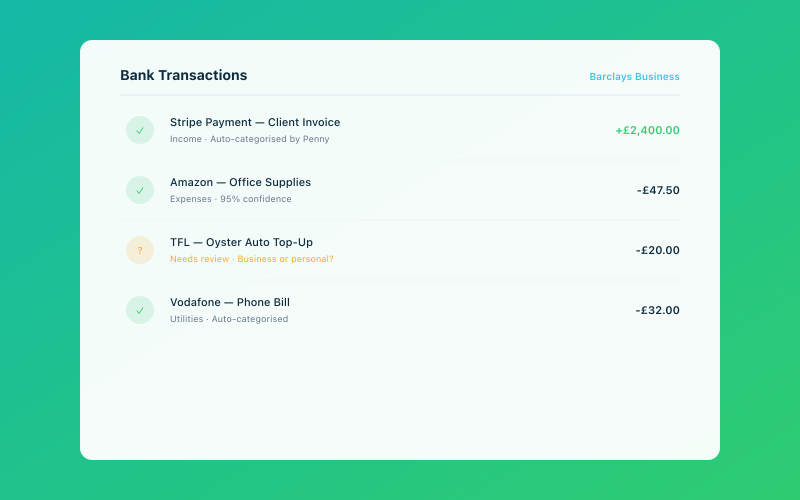 Penny auto-categorises your bank transactions with 95%+ accuracy
Your UTR number looks something like this: 1234567890 — ten digits, sometimes formatted with spaces (e.g., 12345 67890).
It's important to understand that a UTR number is different from your National Insurance (NI) number. Your NI number is assigned to you for life and is used for National Insurance contributions, benefits, and employment records. Your UTR number is specifically for Self Assessment tax purposes.
Some people have both — for example, if you're employed and also run a business on the side, you'll have your NI number (which you've had since you were around 16) and a UTR number (which you'll get when you register for Self Assessment).
Who Needs a UTR Number?
You need a UTR number if you're required to file a Self Assessment tax return. The most common reasons include:
- You're self-employed — whether as your sole source of income or alongside a job
- You're a partner in a business partnership
- You're a company director (though the company itself also gets its own separate UTR)
- You have untaxed income — such as rental income, significant savings interest, or overseas income
- You earn over £150,000 per year
- You need to claim certain tax reliefs or allowances
- You receive child benefit and you or your partner earn over £60,000
For most people reading this guide, the reason will be self-employment. If you've started working for yourself — even if it's just a side hustle alongside your main job — you'll need to register with HMRC and get a UTR number.
How to Get Your UTR Number
Getting a UTR number is straightforward, though it does require a bit of patience as HMRC processes your registration.
Step 1: Register as Self-Employed with HMRC
The most common way to get a UTR number is to register as self-employed with HMRC. You should do this as soon as possible after you start trading — HMRC's official deadline is 5 October in the second tax year after you started your business, but registering early is strongly recommended.
For example, if you started self-employment in June 2025 (during the 2025/26 tax year), you should register by 5 October 2026 at the latest. But don't wait that long — registering promptly means you'll have your UTR number well before you need to file your first return.
To register online:
- Go to the HMRC website (gov.uk)
- Navigate to "Register for Self Assessment"
- You'll need a Government Gateway account — if you don't have one, you can create one during the process
- Complete the registration form with your personal details, the date you started self-employment, and the nature of your business
The online registration takes about 15 to 20 minutes if you have all your details to hand.
You can also register by post by completing form SA1 (for individuals) and sending it to HMRC. This is slower but works if you prefer not to register online.
Step 2: Wait for Your UTR Letter
After you register, HMRC will send your UTR number to you by post. This typically takes 7 to 10 working days if you're in the UK, or up to 21 working days if you're abroad.
The letter will arrive at the address you provided during registration. It confirms your UTR number and includes information about your Self Assessment obligations.
Step 3: Keep It Safe
Once you have your UTR number, store it somewhere secure and accessible. You'll need it every time you file a tax return, contact HMRC about your Self Assessment, or deal with certain financial matters. Write it down, save it in a secure note on your phone, or store it in your accounting software.
Where to Find Your UTR Number If You've Lost It
Losing track of your UTR number is more common than you'd think, and it's not the end of the world. Here are several ways to find it:
Check Previous Correspondence from HMRC
Your UTR number appears on any letters HMRC has sent you about Self Assessment. Check previous tax returns, payment reminders, or your original registration letter.
Log Into Your HMRC Online Account
If you have a Government Gateway account, you can find your UTR number by logging in and viewing your Self Assessment details. It's displayed on your account homepage.
Check Previous Tax Returns
If you've filed a Self Assessment return before, your UTR number will be on the front page. Check any saved copies — digital or paper.
Check Your Accounting Software
If you use accounting software like Accounted, your UTR number may be stored in your account settings or tax filing section.
Call HMRC
As a last resort, you can call HMRC's Self Assessment helpline on 0300 200 3310. You'll need to verify your identity, but they can confirm your UTR number over the phone. Be prepared for potential hold times — HMRC helplines can be busy, particularly between January and March.
For a more comprehensive guide on tracking down your UTR number, see our article on how to find your UTR number.
When You'll Need Your UTR Number
Your UTR number crops up in more situations than you might expect:
Filing Your Self Assessment Tax Return
This is the most obvious one. Whether you file online or on paper, you'll need your UTR number to access and submit your return. The deadline for online filing is 31 January following the end of the tax year (so 31 January 2027 for the 2025/26 tax year).
Making Tax Payments to HMRC
When you pay your tax bill — whether by bank transfer, direct debit, or through your online account — your UTR number is used as the payment reference. Using the wrong reference can mean your payment isn't allocated to your account, which can lead to unnecessary penalties.
When paying by bank transfer, HMRC asks you to use your UTR number followed by the letter "K" as your payment reference (e.g., 1234567890K).
Registering for Making Tax Digital
As Making Tax Digital for Income Tax Self Assessment rolls out from April 2026 for those earning over £50,000, you'll need your UTR number to sign up for the service and link your compatible software.
Providing Information to Clients or Agencies
Some clients or agencies (particularly in the construction industry under the CIS scheme) may ask for your UTR number. This is normal and legitimate — it helps them verify your tax status.
Applying for a Mortgage or Loan
Lenders often ask for your UTR number when you apply for a mortgage or business loan as a self-employed person. It allows them to verify your income directly with HMRC (with your permission).
Important Things to Know About Your UTR Number
It Stays the Same
Your UTR number is assigned to you permanently. It doesn't change if you move house, change your business, or stop and restart self-employment. If you were self-employed five years ago and are starting again, your original UTR number is still valid.
Keep It Confidential
Your UTR number is sensitive personal information. Don't share it publicly, post it on social media, or give it to anyone who doesn't have a legitimate reason to ask for it. Treat it with the same care as your National Insurance number.
It's Different from a Company UTR
If you set up a limited company, the company will receive its own UTR number — separate from your personal one. As a director, you may need both: your personal UTR for your individual Self Assessment (to report your salary and dividends) and the company UTR for the company's Corporation Tax returns.
You Only Get One
You can't have multiple UTR numbers. If you run several businesses as a sole trader, they all go on the same Self Assessment return under the same UTR number.
What Happens After You Register?
Once you've registered and received your UTR number, here's what to expect:
Your First Tax Return
You'll need to file a Self Assessment tax return for the tax year in which you started self-employment. For the 2025/26 tax year (6 April 2025 to 5 April 2026), the filing deadline is:
- 31 October 2026 for paper returns
- 31 January 2027 for online returns
Setting Up for Tax
Start keeping proper business records from day one. Record all your income and expenses, keep receipts and invoices, and separate your business finances from your personal ones.
Remember that you'll owe income tax on profits above the personal allowance of £12,570. At the basic rate, that's 20% on profits between £12,571 and £50,270. You'll also pay Class 2 National Insurance (£3.45 per week for 2025/26 if profits exceed the Small Profits Threshold of £6,725) and Class 4 National Insurance (6% on profits between £12,570 and £50,270, and 2% above that).
Payment on Account
If your tax bill exceeds £1,000, HMRC will ask you to make "payments on account" — advance payments towards next year's tax bill. These are calculated at 50% of your current year's bill and are due on 31 January and 31 July. This can be a surprise in your second year of self-employment, so it's worth planning for.
Frequently Asked Questions
How Long Does It Take to Get a UTR Number?
Typically 7 to 10 working days after registration. Allow up to 21 days if you're overseas. If you haven't received it after three weeks, contact HMRC.
Do I Need a UTR Number If I Only Earn a Small Amount?
If your self-employed income is below £1,000, you may not need to register for Self Assessment at all — the Trading Allowance covers the first £1,000 of trading income tax-free. But if you earn above this, or if you want to claim expenses against your income, you'll need to register and get a UTR number.
Wrapping Up
Your UTR number is a small but essential part of being self-employed in the UK. Getting one is straightforward — register with HMRC, wait for the letter, and keep the number safe. You'll use it every time you interact with HMRC about your Self Assessment, make a tax payment, or apply for financial products as a self-employed person.
The key is not to leave registration until the last minute. Register as soon as you start trading, and you'll have your UTR number well before you need it. It's one less thing to worry about when tax season rolls around.
Accounted helps UK sole traders stay on top of their bookkeeping and tax. Start your free 30-day trial at getaccounted.co.uk
Related reading:
- How to Register as Self-Employed with HMRC
- How to Find Your UTR Number
- How to Keep Business Records for HMRC
Related Reading
- How to Improve Your Credit Score as a Sole Trader
- Gross Margin vs Net Margin — What's the Difference?
Try Accounted free for 30 days — no credit card required.
Accounted makes bookkeeping simple — Penny categorises your transactions automatically so you don't have to. See how →
Tax & Compliance Specialists
Our tax specialists have decades of combined experience in UK sole trader and small business taxation, MTD compliance, and HMRC submissions. All content is reviewed against current HMRC guidance before publication and updated quarterly to reflect legislative changes.
Ready to try Accounted?
Join UK sole traders who are simplifying their bookkeeping and tax.
Start your 14-day free trial