Business Loans for Sole Traders — What's Available
There comes a point in many sole traders' journeys when they need an injection of cash. Maybe you want to buy new equipment, take on bigger projects, bridge a gap in cash flow, or simply invest in growing your business. Whatever the reason, the question is the same: where do you find the money?
Business loans are one of the most common answers, but the landscape can be confusing. There are banks, online lenders, government-backed schemes, and peer-to-peer platforms, each with different terms, rates, and eligibility criteria. As a sole trader, you also face the added complication that most lenders view you and your business as the same entity — which affects how they assess risk and what they're willing to offer.
Let's cut through the noise and look at what's actually available to you.
Types of Business Loans for Sole Traders
Traditional bank loans
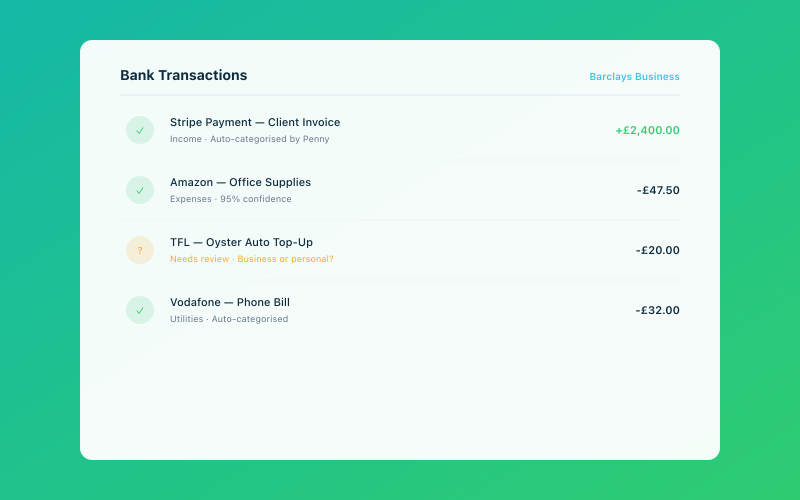 Penny auto-categorises your bank transactions with 95%+ accuracy
These are the loans most people think of first. You borrow a fixed amount, repay it over an agreed period (usually 1 to 10 years), and pay interest on the balance. High-street banks like Barclays, HSBC, NatWest, and Lloyds all offer business loans to sole traders, though the application process can be rigorous.
Typical amounts: £1,000 to £250,000+ Interest rates: 3% to 15% APR, depending on your creditworthiness and the loan term. Pros: Competitive rates, structured repayment, relationship with an established bank. Cons: Lengthy application process, often requires two or more years of accounts, may require security.
Online and alternative lenders
The rise of fintech has opened up a huge number of online lending options. Providers like Funding Circle, iwoca, Tide, and Liberis offer faster applications and more flexible criteria than traditional banks. Some can approve and disburse funds within 24 to 48 hours.
Typical amounts: £1,000 to £500,000 Interest rates: 5% to 30%+ APR — the convenience comes at a price. Pros: Fast applications, often no need for extensive trading history, flexible criteria. Cons: Higher interest rates, shorter repayment terms, some charge daily or weekly rather than monthly.
Government-backed loans
The UK government supports several lending schemes designed to help small businesses access finance. The most relevant for sole traders include:
- Start Up Loans — for businesses trading for less than three years (we cover this in detail in our separate guide).
- Recovery Loan Scheme — originally launched post-pandemic, check gov.uk for current availability and terms.
- British Business Bank — while they don't lend directly, they accredit and support various lending partners.
Government-backed loans often come with lower interest rates and more favourable terms, but the application process can be more involved.
Peer-to-peer (P2P) lending
Platforms like Funding Circle connect borrowers directly with individual investors. You apply for a loan, investors fund it (or part of it), and you repay with interest over the agreed term. Rates can be competitive, and the process is generally faster than traditional banks.
Typical amounts: £5,000 to £500,000 Interest rates: 4% to 15%+ APR Pros: Competitive rates for strong applicants, transparent process. Cons: Credit checks still apply, fees can be significant, not always available to very new businesses.
Invoice finance
If your cash flow problem is specifically caused by clients who are slow to pay, invoice finance might be a better fit than a traditional loan. With invoice finance, a lender advances you a percentage (usually 80–90%) of your outstanding invoices immediately, and collects the payment from your client directly. You receive the remainder (minus fees) when the client pays.
Pros: Unlocks cash tied up in unpaid invoices, grows with your business. Cons: Only works if you invoice other businesses (not consumers), fees can add up, your clients may need to be notified.
Overdrafts and credit lines
Rather than borrowing a fixed lump sum, a business overdraft or revolving credit line gives you access to funds up to an agreed limit. You only pay interest on what you actually use. This can be useful for managing short-term cash flow fluctuations rather than funding major investments.
Typical limits: £500 to £50,000+ Interest rates: 5% to 20%+ APR (often variable) Pros: Flexible, only pay for what you use, good for cash flow smoothing. Cons: Can be expensive if used heavily, limits can be reduced or withdrawn by the lender.
What You'll Need to Apply
Requirements vary between lenders, but most will ask for some combination of the following:
- Business bank statements — usually 3 to 12 months.
- Tax returns or accounts — typically 1 to 3 years (SA302s for sole traders).
- Business plan — especially for larger loans or government-backed schemes. If you need help with this, check out our guide on writing a business plan.
- Proof of identity and address — passport, driving licence, utility bills.
- Details of how you'll use the funds — lenders want to know the money is going to something productive.
- Credit check — both personal and business (though as a sole trader, these are effectively the same).
The better prepared you are, the faster the process. Having your financial records organised and up to date is essential — and that's where keeping your books in order with Accounted throughout the year pays dividends. When a lender asks for your last 12 months of income and expenses, you can pull the numbers in minutes rather than spending days reconstructing them from bank statements and shoeboxes of receipts.
How to Decide If a Loan Is Right for You
Borrowing money always has a cost, and it's important to make sure the benefit outweighs that cost. Before applying, ask yourself:
What specifically do I need the money for? A clear purpose — new equipment, hiring help, bridging a cash flow gap — is much better than a vague sense that more money would be nice.
Will the investment generate more income than it costs? If a £10,000 loan at 8% interest lets you take on projects worth £30,000 that you couldn't otherwise handle, the maths works. If you're borrowing to cover everyday running costs, that's a warning sign.
Can I afford the repayments? Model this carefully. What are the monthly repayments, and can your business comfortably cover them even in a quiet month? Don't assume your best month's income as the baseline.
Are there alternatives? Could you manage your cash flow better to avoid needing to borrow? Could you negotiate better payment terms with clients? Could a smaller investment achieve the same goal?
What happens if things go wrong? As a sole trader, you're personally liable for business debts. If the investment doesn't pay off and you can't repay the loan, your personal assets (including your home, if it's not protected) could be at risk. Understand the worst-case scenario before you commit.
Comparing Loan Offers
When you have multiple offers on the table, here's what to compare:
Total cost of borrowing. Don't just look at the interest rate — calculate the total amount you'll repay over the life of the loan. A lower rate over a longer term might actually cost you more than a slightly higher rate over a shorter term.
APR vs. factor rate. Some online lenders quote a "factor rate" (e.g., 1.2) rather than an APR. A factor rate of 1.2 on a £10,000 loan means you repay £12,000 — but the effective APR depends on the repayment schedule. Always convert to APR for a fair comparison.
Fees. Arrangement fees, early repayment charges, late payment penalties — these all add to the cost. Read the small print.
Repayment schedule. Monthly repayments are standard, but some online lenders require weekly or even daily repayments. Make sure the schedule works for your cash flow.
Security requirements. Some loans require you to put up assets (property, equipment) as security. Unsecured loans don't require collateral but typically come with higher interest rates.
Flexibility. Can you repay early without penalty? Can you borrow more if needed? What happens if you miss a payment?
Tips for Getting Approved
Lenders assess risk, and your job is to demonstrate that you're a low-risk borrower. Here's how:
Present clean, well-organised accounts. Messy finances suggest a messy business. Keep your records in Accounted so they're always presentable.
Show consistent or growing income. Lenders prefer upward trends. If your income has grown year on year, make sure that's clearly visible in your accounts.
Have a clear plan for the money. "I want to grow my business" is vague. "I need £15,000 to purchase a commercial-grade oven that will allow me to double my production capacity" is specific and investable.
Maintain a healthy credit score. Check your reports, fix errors, and avoid unnecessary credit applications in the months before you apply.
Borrow what you need, not what you want. Asking for exactly the right amount shows you've thought it through. Asking for the maximum available looks impulsive.
Consider a guarantor. If your credit history or trading history is thin, having a guarantor (someone who agrees to cover the debt if you can't) can significantly improve your chances.
A Word of Caution
Borrowing can be a powerful tool for growing your business, but it can also create problems if used carelessly. Before signing any loan agreement, make sure you fully understand the terms, the total cost, and the consequences of defaulting.
If you're in financial difficulty, borrowing more is rarely the answer. Speak to a debt adviser (StepChange and National Debtline offer free, confidential advice) and get your finances stabilised before taking on new debt.
And remember — not every business needs external funding to grow. Sometimes the best path forward is improving your cash flow, reducing costs, or growing organically at a pace your existing resources can support.
Related Reading
Accounted helps UK sole traders stay on top of their bookkeeping and tax. Start your free 30-day trial at getaccounted.co.uk.
Further Reading
- Check the current income tax rates on GOV.UK.
- HMRC outlines record-keeping requirements for businesses.
- See the rules on dividends on GOV.UK.
Try Accounted free for 30 days — no credit card required.
Accounted makes bookkeeping simple — Penny categorises your transactions automatically so you don't have to. See how →
Tax & Compliance Specialists
Our tax specialists have decades of combined experience in UK sole trader and small business taxation, MTD compliance, and HMRC submissions. All content is reviewed against current HMRC guidance before publication and updated quarterly to reflect legislative changes.
Ready to try Accounted?
Join UK sole traders who are simplifying their bookkeeping and tax.
Start your 14-day free trial