Business Continuity Planning for Sole Traders
Here's a question most sole traders would rather not think about: what happens to your business if you can't work? Maybe it's illness, an injury, a family emergency, or even something as mundane as your laptop dying at the worst possible moment. When you are the business, any disruption to your ability to work is a disruption to your income.
Business continuity planning sounds like something only big companies need to worry about — the kind of thing that involves emergency operations centres and colour-coded crisis protocols. But for sole traders and freelancers, it's actually much simpler and arguably more important. Because when you're the only person doing the work, generating the income, and keeping the clients happy, even a short period of downtime can have serious consequences.
In this guide, we'll walk through what business continuity planning actually means for a sole trader, the key risks you should plan for, and the practical steps you can take to protect yourself and your business.
What Is Business Continuity Planning?
At its core, business continuity planning is just thinking ahead about what could go wrong and having a plan to deal with it. It's about asking "what if?" before you have to ask "what now?"
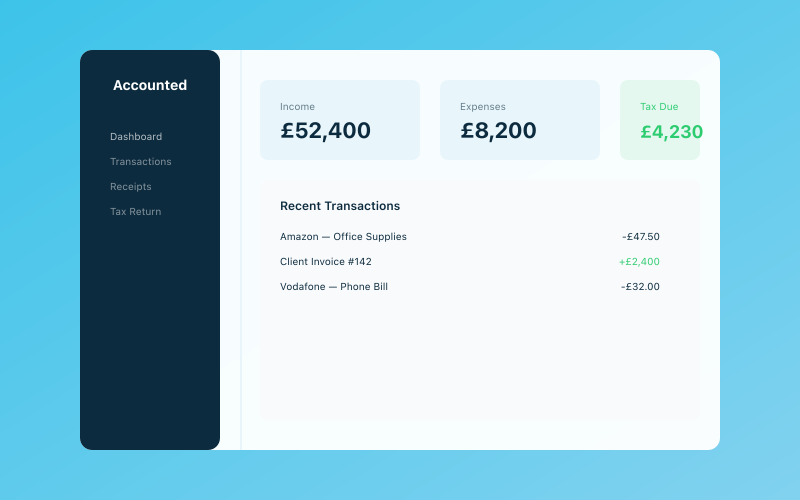 Your Accounted dashboard — income, expenses, and tax at a glance
For sole traders, a business continuity plan doesn't need to be a formal document (though writing things down is always a good idea). It's more of a set of arrangements, safeguards, and backup plans that mean your business can survive disruptions — or at least recover from them quickly.
Think of it as insurance for your operations. You probably already have insurance for your car and your home. A continuity plan is about insuring your ability to earn a living.
The Key Risks to Plan For
Every business faces different risks, but there are some common ones that affect most sole traders:
Illness or Injury
This is the big one. As a sole trader, you don't get sick pay. If you can't work, you don't earn. A bad flu might cost you a week's income. A serious illness or injury could cost you months.
According to government statistics, the average UK worker takes around 5.7 sick days per year. But averages hide the extremes — some people go years without missing a day, while others face extended periods of ill health. The question isn't whether it will happen, but whether you're prepared if it does.
Equipment Failure
Your laptop, your phone, your tools, your vehicle — whatever you depend on to do your work. If it breaks down, how quickly can you get back up and running? A freelance writer whose laptop dies might be back in action within a day if they've got backups and can borrow a machine. A tradesperson whose van breaks down could lose days of work.
Data Loss
Client files, financial records, project work, email archives — if you lost all of it tomorrow, what would happen? Data loss can result from hardware failure, theft, accidental deletion, ransomware, or just spilling coffee on your laptop. The impact ranges from inconvenient to catastrophic.
Client Dependency
If a large proportion of your income comes from a single client, losing that client could cripple your business overnight. This isn't just about the client choosing to go elsewhere — it could be that they face their own financial difficulties, change direction, or simply restructure.
Cash Flow Crises
A sudden drop in income, an unexpected tax bill, a late-paying client, or an unforeseen expense can all create a cash flow crisis. Without reserves or a plan, even a temporary shortfall can spiral into serious problems.
Bereavement or Family Emergency
Sometimes life throws something at you that makes work impossible for a while. Having a plan in place means you can focus on what matters without worrying about whether your business will survive.
Building Your Continuity Plan
You don't need to address every possible scenario — that would be overwhelming. Focus on the risks that are most likely to affect you and the ones that would have the biggest impact. Here's a practical framework:
1. Get Your Finances in Order
Financial resilience is the foundation of business continuity. If you've got money in the bank, you can survive almost anything in the short term. If you're living month to month with no reserves, even a minor disruption becomes a crisis.
Build an emergency fund. Aim for three to six months' worth of essential expenses — both personal and business. This is your buffer for when things go wrong. Start small if you need to — even £100 a month adds up over time. Keep it in a separate savings account so you're not tempted to dip into it.
Know your numbers. You need a clear, up-to-date picture of your finances — what's coming in, what's going out, what you owe, and what you're owed. If you don't know where you stand financially, you can't make good decisions under pressure.
Accounted makes this straightforward. By keeping your bookkeeping up to date (Penny handles most of it automatically), you've always got an accurate snapshot of your financial position. If something goes wrong, you know immediately what you can afford and how long your reserves will last.
Diversify your income sources. If you can, avoid relying on a single client for more than 25-30% of your income. Diversification protects you from the sudden loss of any one client. It also gives you more stability during quiet periods.
2. Protect Your Income With Insurance
Insurance can't prevent bad things from happening, but it can soften the financial blow. There are several types of insurance worth considering:
Income protection insurance. This pays a proportion of your income (typically 50-70%) if you're unable to work due to illness or injury. Policies vary in terms of waiting periods, payment duration, and what counts as "unable to work," so read the fine print carefully. It's not cheap, but for sole traders who have no other safety net, it can be a lifesaver.
Critical illness cover. This pays a lump sum if you're diagnosed with a specified serious illness (such as cancer, heart attack, or stroke). It's different from income protection — it's a one-off payment rather than an ongoing income.
Professional indemnity insurance. If your work involves giving advice, creating designs, or producing content that a client might later claim caused them a loss, professional indemnity insurance covers your legal costs and any damages.
Public liability insurance. If you work with clients in person or on their premises, this covers you if someone is injured or their property is damaged as a result of your work.
Equipment and contents insurance. Covers the cost of replacing tools, equipment, and stock if they're damaged, lost, or stolen.
For a more detailed look at which policies are right for your situation, read our sole trader insurance guide.
3. Back Up Everything
Data loss is one of the most preventable risks, yet many sole traders don't have proper backups in place. Here's the minimum you should be doing:
Use cloud storage. Services like Google Drive, Dropbox, or OneDrive automatically sync your files to the cloud, so even if your laptop dies, your files are safe. Most offer free tiers that are sufficient for basic business use.
Set up automatic backups. Don't rely on remembering to back up manually — automate it. Both macOS (Time Machine) and Windows (File History) have built-in backup tools. Use them.
Follow the 3-2-1 rule. Keep three copies of your important data, on two different types of storage (e.g., your computer and the cloud), with one copy stored off-site. This protects against almost any failure scenario.
Back up your financial records. HMRC requires you to keep records for at least five years. If those records are only on your laptop and it gets stolen, you've got a serious problem. Cloud-based bookkeeping tools like Accounted store your data securely online, so it's always accessible and always backed up.
4. Document Your Processes
If you were suddenly unable to work for a month, could someone step in and handle the basics? Probably not, if everything is in your head.
Take some time to document your key processes — how you invoice clients, where important files are stored, login details for essential services, your client contact list, and any ongoing commitments or deadlines. Store this information securely (a password manager is ideal for credentials) and make sure someone you trust knows how to access it.
This isn't just useful in an emergency. It also makes your day-to-day work more efficient and sets you up for future growth. If you ever bring on help — whether that's a virtual assistant, a subcontractor, or an employee — having documented processes makes onboarding far easier.
5. Build a Support Network
Sole trading can be isolating, and that isolation becomes a vulnerability when things go wrong. Build relationships with people who could help you in a crisis:
Trusted colleagues or peers. Other freelancers in your field who could take on urgent work if you're unable to. You might set up an informal reciprocal arrangement — you cover for them, they cover for you.
A good accountant. If something goes wrong with your finances or tax, having a relationship with an accountant you trust means you can get help quickly.
Key suppliers and clients. If you need to take unexpected time off, having good relationships with your clients means they're more likely to be understanding. Communicate early and honestly if you're facing disruption.
6. Plan for the Worst Case
This isn't a comfortable topic, but it's an important one. If you were permanently unable to work, or worse, what would happen to your business? Do you have life insurance? Is your will up to date? Does your partner or family know how to access your business accounts, contact your clients, and wind things down if necessary?
For sole traders, the business and the person are so closely intertwined that personal planning and business planning overlap significantly. Making sure your affairs are in order protects the people you care about.
Reviewing Your Plan
A continuity plan is only useful if it's current. Set a reminder to review yours at least once a year — or whenever something significant changes in your business. New clients, new services, new equipment, or changes to your personal circumstances all warrant a quick review.
Think of it as a health check for your business. Spend an hour once a year making sure your backups are working, your insurance is adequate, your emergency fund is on track, and your documentation is up to date. It's a small investment of time that could save your livelihood.
You Don't Have to Plan for Everything
The goal isn't to anticipate every possible disaster. It's to build enough resilience that your business can weather the most likely disruptions without falling apart. A few hours of planning now could save you months of stress later.
Most sole traders who take the time to think about continuity find that the exercise itself is reassuring. Knowing that you've got a plan — even a simple one — takes a weight off your shoulders and lets you focus on what you do best: running your business.
Related Reading
Start your free trial and see how Accounted simplifies your bookkeeping.
Accounted helps UK sole traders stay on top of their bookkeeping and tax. Start your free 30-day trial at getaccounted.co.uk
Accounted keeps your books sorted automatically so you can focus on running your business. See Accounted →
Business & Operations Advisors
Our business advisors cover the practical side of running a UK sole trader business — from HMRC registration to managing growth. Content is written for real business owners in plain English, not accountants.
Ready to try Accounted?
Join UK sole traders who are simplifying their bookkeeping and tax.
Start your 14-day free trial