The Psychology of Pricing — Why £9.99 Works
You have seen it a thousand times. The price tag reads £9.99 instead of £10. The monthly subscription is £29 rather than £30. The consultancy day rate is £495, not £500. You know, intellectually, that the difference is negligible. And yet something in your brain responds differently to the lower number.
Welcome to the psychology of pricing — a field that sits at the fascinating intersection of economics, neuroscience, and behavioural science. Understanding how and why certain prices "feel" right (or wrong) is not just academic curiosity. For sole traders and small business owners, it is a practical tool that can directly influence your income.
Because here is the uncomfortable truth: the price you charge is not just a number. It is a message. And the way you frame that message can be the difference between a customer who buys and one who walks away.
The Left-Digit Effect: Why £9.99 Beats £10
The most famous pricing trick in the book has a proper name: the left-digit effect. When we read a price, our brains give disproportionate weight to the leftmost digit. So £9.99 is processed as "nine-something" rather than "essentially ten." The penny difference is financially meaningless, but psychologically, it shifts the price into a different mental category.
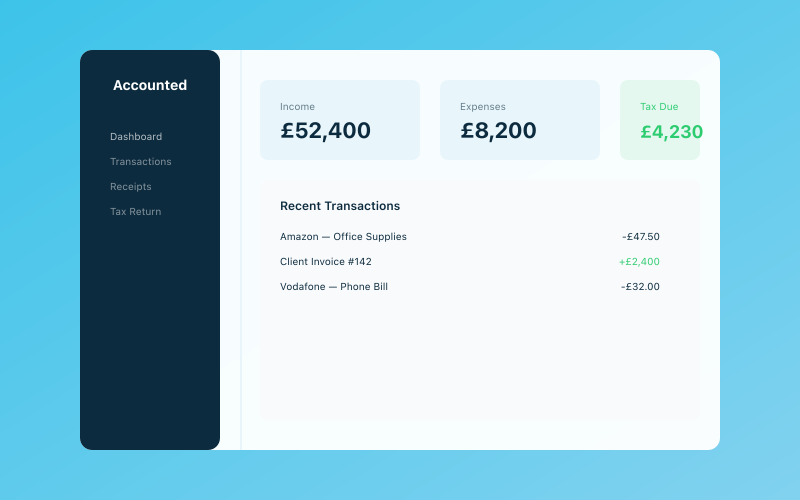 Your Accounted dashboard — income, expenses, and tax at a glance
Research by Manoj Thomas and Vicki Morwitz, published in the Journal of Consumer Research, demonstrated this effect convincingly. They found that consumers perceived a significantly larger difference between £3.00 and £2.99 than between £3.60 and £3.59 — even though the absolute difference is identical. The left digit changes in the first example (from 3 to 2) but not in the second, and that is what drives the perception.
For sole traders, this has direct implications. If you are pricing a product at £100, consider whether £99 might perform better. If your hourly rate is £50, would £49 make potential clients more comfortable without meaningfully affecting your income? Over the course of a year, the difference in revenue is tiny. The difference in conversion rates can be substantial.
That said, charm pricing (as it is known in the trade) is not universally appropriate. It works best for consumer-facing products and services where price sensitivity is high. For premium services where you want to signal quality and confidence, round numbers can actually be more effective — but we will come to that shortly.
Anchoring: The Power of the First Number
Anchoring is one of the most powerful cognitive biases in pricing, and it is almost embarrassingly easy to exploit. The principle is simple: the first number a person sees becomes a reference point (or "anchor") against which all subsequent numbers are judged.
This is why restaurants put an outrageously expensive dish at the top of the menu. It is not there to sell — it is there to make everything else look reasonable by comparison. A £38 steak seems extravagant until you have just read about the £95 wagyu tasting menu.
For service-based sole traders, anchoring can be used in several ways:
Present your premium option first. If you offer three tiers of service, lead with the most expensive. The mid-tier option will seem like excellent value by comparison — and it is usually the one you want most clients to choose anyway.
Reference market rates. "Most agencies charge £5,000 for this. My rate is £2,500." You have just set an anchor that makes your price feel like a bargain, even if £2,500 is actually above average for a sole trader.
Use your old prices. "This service was previously £600. It is now £450." The old price serves as an anchor that makes the current price feel like a deal.
The ethical note here is important: anchoring should involve genuine reference points, not fabricated ones. Inflating a "normal" price so you can offer a fake discount is not just unethical — it is illegal under UK consumer protection law. But using real comparisons to help clients understand the value of your pricing is perfectly legitimate.
The Decoy Effect: Guiding Choices
The decoy effect (also called asymmetric dominance) is a pricing strategy that uses a deliberately unattractive option to make another option look more appealing.
The classic example comes from The Economist, which once offered three subscription options:
- Online only: £59
- Print only: £125
- Print + online: £125
Nobody chose the print-only option (why would you, when print + online costs the same?). But its presence made the combined option look like an incredible deal. When the print-only option was removed and only two choices were offered, far fewer people chose the expensive combined subscription.
For sole traders offering packages, the decoy effect can be powerful. Add a middle option that is clearly inferior to your premium offering, and watch more clients choose the premium. The decoy does not need to sell — it just needs to make the right option obvious.
Price-Quality Heuristic: You Get What You Pay For
We have all been taught that higher prices mean higher quality. This is sometimes true and sometimes nonsense, but the psychological association is deep and persistent. Research consistently shows that people rate identical products as higher quality when they carry a higher price tag.
In a famous wine study, participants rated the same wine as significantly more enjoyable when told it cost £45 rather than £5. Brain scans showed that the "expensive" wine actually activated more pleasure centres in the brain. The price did not just change their report — it changed their experience.
For sole traders, this has profound implications. Underpricing your services does not just cost you money — it actively makes potential clients perceive your work as lower quality. If you are the cheapest option in your market, many clients will assume there is a reason for that, and it will not be "impressively efficient overhead."
This does not mean you should charge more than your services are worth. It means you should charge what they are worth and not be afraid that the price will put people off. The right clients — the ones who value quality and are willing to pay for it — will actually be attracted by a price that signals competence and confidence.
If you are wrestling with what to charge, our guide on pricing your services walks through the process step by step. And if you are worried about existing clients' reactions, our piece on how to raise prices without losing clients addresses that directly.
The Pain of Paying
Behavioural economist Dan Ariely has written extensively about the "pain of paying" — the actual psychological discomfort we experience when parting with money. This pain is not constant; it varies depending on how and when payment occurs.
Payment timing matters. Paying before consumption (like a deposit or upfront fee) is less painful than paying afterwards, because by the time you experience the service, the pain of payment has faded. This is why all-inclusive holidays feel so relaxing — you have already paid, so everything feels "free."
Payment method matters. Paying with a card is less painful than paying with cash, because the physical act of handing over notes makes the loss more tangible. Digital payments are even less painful, which partly explains the growth of contactless and subscription models.
Frequency matters. A single annual payment of £300 feels more painful than twelve monthly payments of £25, even though the latter costs you exactly the same (and in some cases more). This is why subscription pricing has become so dominant.
For sole traders, these insights suggest:
- Offering monthly payment options can increase uptake compared to requiring a single large payment
- Taking deposits or upfront payments reduces the likelihood of late payment and disputes
- Making your invoicing process smooth and digital (which Accounted handles automatically) reduces friction and gets you paid faster
Round Numbers vs. Precise Numbers
Here is a counterintuitive finding: for certain types of purchases, precise prices (like £497) can be more effective than round prices (like £500).
Research by Manoj Thomas, Daniel Simon, and Vrinda Kadiyali found that consumers associate round numbers with emotional purchases and precise numbers with rational purchases. When buying something based on feeling (a luxury item, a gift), round numbers feel right. When making a considered, rational decision (business services, software), precise numbers signal that the price has been carefully calculated rather than arbitrarily chosen.
This is why you see enterprise software priced at £1,247 per month rather than £1,250. The precision implies that the price reflects the actual cost of delivering the service, which feels more justified and harder to negotiate.
For sole traders offering professional services, using precise pricing can subtly communicate that your rates are based on careful calculation of your costs, expertise, and value — not pulled from thin air.
Bundling: The Whole Is Worth More Than the Parts
Bundling — combining multiple products or services into a single package at a combined price — is one of the most effective pricing strategies available, and it is particularly suited to sole traders.
The psychology works like this: when items are priced individually, each one triggers a separate "pain of paying" evaluation. The customer mentally weighs whether each item is worth its price. When bundled, there is only one evaluation, and the overall value feels greater because the individual components are not being scrutinised in isolation.
For a freelance designer, "logo + brand guidelines + social media kit for £1,200" is more appealing than pricing each element separately at £500 + £400 + £400 (even though the total is higher in the second scenario). The bundle feels like a complete solution, while the individual items feel like costs to be minimised.
Bundling also gives you an opportunity to include lower-cost items that have high perceived value, boosting the overall attractiveness of the package without significantly increasing your costs.
Putting It Into Practice
Understanding pricing psychology is valuable, but it only matters if you apply it. Here are practical steps for sole traders:
Audit your current pricing. Are you using round numbers when charm pricing might convert better? Are you presenting options without an anchor? Are you underpricing and inadvertently signalling low quality?
Test different approaches. You do not need to commit to a single strategy immediately. Try charm pricing for one month, then round pricing the next. Offer a three-tier package to some clients and a single price to others. Track the results and let the data guide you.
Know your numbers. You cannot price effectively if you do not know your costs, your margins, and your target income. This is where good bookkeeping is essential. With Accounted tracking your income and expenses in real time, you always know exactly where you stand — which means your pricing decisions are based on data, not guesswork.
Do not compete on price alone. The cheapest provider is rarely the most successful. Compete on value, quality, reliability, and the client experience. Then price accordingly.
Review regularly. Your costs change. Your experience grows. The market evolves. Reviewing your pricing at least annually — and adjusting it upwards when justified — is essential. Most sole traders undercharge for far too long.
Price Is a Story
Every price tells a story. £9.99 says "affordable." £10,000 says "premium." £497 says "precisely calculated." £500 says "confident and straightforward." The question is not which price is "correct" — it is which story you want to tell.
Get that story right, and your pricing becomes one of your most powerful business tools. Get it wrong, and you will forever feel like you are working too hard for too little.
Your work has value. Price it that way.
Accounted helps UK sole traders stay on top of their bookkeeping and tax. Start your free 30-day trial at getaccounted.co.uk.
Related reading:
- Pricing Your Services — A Complete Guide
- How to Raise Prices Without Losing Clients
- What Your Accountant Wishes You Knew
Related Reading
- Exit Strategies — What Happens When You Want to Stop
- Client Onboarding — How to Start New Projects Professionally
Accounted keeps your books sorted automatically so you can focus on running your business. See Accounted →
Business & Operations Advisors
Our business advisors cover the practical side of running a UK sole trader business — from HMRC registration to managing growth. Content is written for real business owners in plain English, not accountants.
Ready to try Accounted?
Join UK sole traders who are simplifying their bookkeeping and tax.
Start your 14-day free trial