How to Raise Your Prices Without Losing Clients
You know you need to raise your prices. Perhaps you've been charging the same rates for two years while your costs have risen. Perhaps you've gained experience and qualifications that make your work more valuable. Perhaps you've simply done the maths and realised that your current rates don't support the lifestyle — or the tax bill — you need them to.
But every time you think about actually telling your clients, a wave of anxiety hits. What if they leave? What if they think you're greedy? What if they find someone cheaper? So you put it off for another month, another quarter, another year.
This reluctance is completely understandable, but it's also costing you. If you're earning £35 per hour when you should be charging £45, that's £10 lost on every single hour you work. Over a year of 1,200 billable hours, that's £12,000 left on the table — money that could be covering your tax bill, building your savings, or simply giving you the option to work fewer hours.
Let's talk about how to raise your prices confidently, professionally, and without the client exodus you're dreading.
Why You Need to Raise Your Prices
Before we get to the "how," let's address the "why" — because being clear about your reasons makes the conversation much easier.
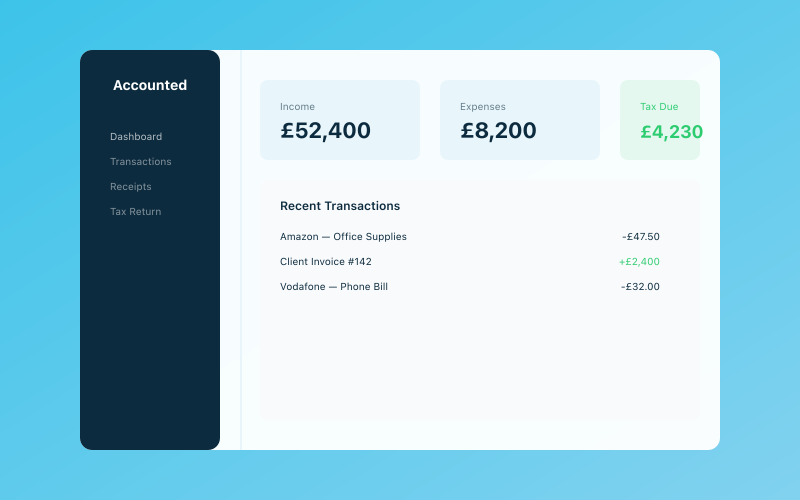 Your Accounted dashboard — income, expenses, and tax at a glance
Inflation Is Real
Between 2022 and 2026, cumulative inflation in the UK has been significant. The cost of everything — from your broadband to your professional insurance to your morning coffee — has increased. If your prices haven't kept pace, you're effectively earning less in real terms than you were three years ago.
Your Tax Obligations Increase With Income
As a sole trader, you keep 100% of the first £12,570 you earn (the personal allowance). Above that, you pay income tax at 20% on earnings up to £50,270, and 40% above that. You also pay Class 4 National Insurance at 6% on profits between £12,570 and £50,270. If you're VAT-registered (turnover above £90,000), there's an additional administrative and financial burden.
The point is: the money you charge isn't the money you keep. You need your prices to account for your tax obligations, business expenses, pension contributions, holiday cover, and sick pay provision — none of which an employer would expect you to fund from your salary alone.
Your Skills Have Grown
If you're better at what you do than when you started, your prices should reflect that. Experience, training, and a track record of delivering results all add value. A photographer with five years of experience and a portfolio of satisfied clients is worth more than they were when they were just starting out. Pricing should evolve with competence.
Undercharging Attracts the Wrong Clients
There's a well-documented phenomenon in freelancing: the lowest-paying clients are often the most demanding. They haggle over every invoice, request endless revisions, and treat your time as if it has no value. Raising your prices tends to filter out these difficult clients and attract ones who understand the value of professional work and are willing to pay for it.
When to Raise Your Prices
Timing matters. While there's never a perfect moment, some are better than others.
Annually
The simplest approach is to raise prices once a year, ideally at a natural business milestone — the start of a new calendar year, the beginning of the tax year in April, or the anniversary of your working relationship with a client. Annual increases are expected in most industries and are easy for clients to understand.
When You're at Capacity
If you have more work than you can handle, that's the market telling you your prices are too low. Raising prices when you're fully booked is low-risk — if a client leaves, you have the space; if they stay, you're earning more.
When You Add Value
Have you gained a new qualification? Invested in better equipment? Expanded your service offering? These are natural triggers for a price increase and give you something concrete to point to when explaining the change.
When Costs Increase
If your business costs have risen significantly — new software subscriptions, increased insurance premiums, higher material costs — passing some of that increase to clients is reasonable and expected.
How to Communicate a Price Increase
The communication itself is where most people stumble. Here's how to do it well.
Give Adequate Notice
Never surprise a client with a price increase on an invoice. Give at least 30 days' notice for ongoing relationships, and ideally 60-90 days for long-standing clients. This shows respect for their budget planning and gives them time to adjust.
Be Direct and Confident
Don't apologise. Don't over-explain. Don't use hedging language like "I'm sorry, but I'm afraid I might need to..." Instead, be clear and professional:
"I'm writing to let you know that from [date], my rates will be increasing to [new rate]. This reflects [brief reason — increased costs, expanded services, market alignment]. I really enjoy working with you and look forward to continuing our relationship at the new rate."
That's it. No lengthy justification needed.
Explain the Value, Not Just the Price
Frame the increase in terms of what the client gets, not what they pay. If you've improved your processes, added services, or invested in better tools, mention this. "As part of this change, I've also invested in [tool/training/process] which means [benefit to client]."
Offer Options Where Appropriate
For clients you particularly value or who you know are budget-constrained, consider offering options:
- A smaller increase now with a further adjustment in six months
- A locked-in rate for a longer commitment (e.g., a 12-month retainer)
- A slightly reduced scope at the current rate, with the full scope at the new rate
This shows flexibility without undermining your position.
Communicate in Writing
Even if you discuss the increase verbally, follow up in writing. This avoids misunderstandings and gives the client a reference document. Email is fine — you don't need to send a formal letter.
Handling Pushback
Some clients will push back. This is normal and doesn't mean you should back down.
"That's More Than I Budgeted For"
A reasonable response: "I understand budgets are always a consideration. The new rate reflects the current market rate for this level of service. I'm happy to discuss whether we can adjust the scope to better fit your budget."
"Your Competitor Charges Less"
This is a classic negotiation tactic. The response: "There will always be cheaper options available, and I appreciate that price is a factor. My rates reflect the quality, reliability, and experience I bring. I'm confident the value justifies the investment."
"I've Been a Loyal Client"
This one can feel guilt-inducing, but loyalty works both ways. "I really value our relationship, which is why I wanted to give you plenty of notice. The increase applies across all my clients, and I've kept your rate lower than market rate for [period]. I hope we can continue working together."
When a Client Leaves
It happens. And that's OK. Not every client relationship is meant to last forever. If a client leaves over a reasonable price increase, they were likely to leave eventually anyway — either because a cheaper option appeared or because they never truly valued your work.
More importantly, the client who leaves creates capacity for a new client who's willing to pay your actual rate. This is almost always a net positive.
Strategies for Different Business Models
Hourly/Day Rate
This is the most straightforward — you simply communicate the new rate. "My day rate will increase from £350 to £400 from [date]."
Project-Based Pricing
For project-based work, price increases happen naturally with each new project. You don't need to announce an increase — you simply quote higher for the next piece of work. If a client queries why the quote is higher than last time, explain that your rates have been updated to reflect current costs and market conditions.
Retainer Clients
Retainer relationships require the most careful handling because the client has committed to an ongoing arrangement. Give maximum notice, acknowledge the value of the ongoing relationship, and consider offering a modest loyalty discount compared to your standard rate increase.
Subscription or Package Pricing
If you offer fixed packages, update the pricing on your website and marketing materials. Existing clients should be given notice and, ideally, the option to lock in their current rate for a defined period.
The Maths of Price Increases
Let's make the case with numbers. Suppose you currently charge £40 per hour and work 25 billable hours per week, 46 weeks per year. That's £46,000 annual revenue.
After deducting the £12,570 personal allowance, you'd pay income tax of approximately £6,686 on the remaining £33,430 (at 20%), plus Class 4 National Insurance of approximately £2,006. Your take-home is roughly £37,308.
Now suppose you raise your rate to £45 per hour. Same hours, same weeks. Revenue jumps to £51,750. After tax (now partly in the higher bracket) and NI, your take-home is approximately £40,415 — an increase of over £3,100, for doing exactly the same work.
Alternatively, you could earn the same £46,000 at the new rate but work fewer hours — roughly 22 billable hours per week instead of 25. That's three extra hours per week for rest, professional development, or the administrative tasks that keep your business running smoothly. Understanding these numbers clearly is much easier when your bookkeeping is up to date — tools like Accounted keep your financial picture clear so you can make informed pricing decisions.
Building Pricing Confidence
Confidence in your pricing comes from three places:
-
Knowing your numbers — understanding your costs, tax obligations, and desired income. Our guide on how much tax you'll pay as a sole trader is a good starting point.
-
Knowing your market — researching what others in your field charge. This doesn't mean matching the cheapest competitor; it means understanding the range and where your experience and quality position you.
-
Knowing your value — being clear about what you deliver and the results you achieve for clients. If your work generates £10,000 of value for a client, charging £2,000 for it is entirely reasonable.
Price increases are a normal part of running a business. Every supplier your clients use — from their office cleaners to their software providers — raises prices regularly. You're not doing anything unusual or unreasonable. You're running a sustainable business.
And a sustainable business is one that can continue to deliver excellent work for years to come. That's in your clients' interest as much as yours.
Related reading:
- Pricing Your Services — A Complete Guide
- Cash Flow Management for Sole Traders
- How Much Tax Will I Pay as a Sole Trader?
Accounted helps UK sole traders stay on top of their bookkeeping and tax. Start your free 30-day trial at getaccounted.co.uk
Related Reading
- Direct Debit vs Bank Transfer — Which Is Better for Collecting Payment?
- Sustainable Business Practices That Also Save You Money
Accounted keeps your books sorted automatically so you can focus on running your business. See Accounted →
Business & Operations Advisors
Our business advisors cover the practical side of running a UK sole trader business — from HMRC registration to managing growth. Content is written for real business owners in plain English, not accountants.
Ready to try Accounted?
Join UK sole traders who are simplifying their bookkeeping and tax.
Start your 14-day free trial