Sustainable Business Practices That Also Save You Money
There's a persistent myth that running a sustainable business is more expensive than the alternative. And sure, some eco-friendly choices do come with a premium. But the reality is that many of the most impactful sustainable practices actually save you money. Less waste means lower costs. Less energy consumption means smaller bills. Less paper means less filing.
If you're a sole trader looking to reduce your environmental impact without denting your profits, you're in the right place. Here are the practical, money-saving green changes that are worth making.
Go Paperless (Seriously, This Time)
You've probably heard this one before, but it bears repeating because so many sole traders are still printing, filing, and posting things that could exist entirely digitally. Every sheet of paper you don't print is money saved — not just on paper, but on ink, postage, envelopes, and filing space.
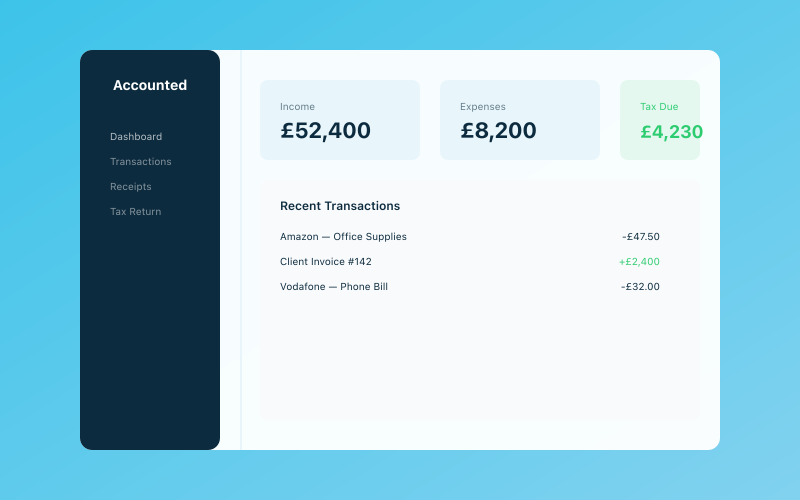 Your Accounted dashboard — income, expenses, and tax at a glance
Digital invoicing is the obvious starting point. If you're still creating invoices in Word and printing them out, switching to a tool like Accounted means your invoices are created, sent, and stored digitally. Penny tracks what's been paid and what's outstanding, so there's no need for a filing cabinet full of paper copies.
The same goes for receipts. HMRC accepts digital records, and they're actually easier to maintain than paper ones. Snap a photo of a receipt when you get it, and it's stored securely in the cloud. No more shoeboxes of crumpled receipts, and no more panicking when you can't find that one receipt from eight months ago.
Going paperless also means your record-keeping is automatically more organised. Digital files are searchable, timestamped, and backed up. Paper gets lost, fades, and takes up space. The savings are real: a typical small business spends £200-£400 a year on printing supplies alone, and that's before you count the time spent managing paper.
Cut Your Energy Bills
Energy costs have been a sore point for UK businesses in recent years, and reducing your consumption is both a financial win and an environmental one. For sole traders working from home, even small changes add up.
LED lighting uses roughly 75% less energy than traditional bulbs and lasts many times longer. If you haven't made the switch yet, it's one of the easiest upgrades you can do. A set of LED bulbs for your home office might cost £15-£20, and you'll recoup that within a few months through lower electricity bills.
If you use equipment that draws power even when idle — monitors, printers, phone chargers — plugging them into a smart power strip that cuts standby power can save 5-10% on your electricity costs. It's a tiny change, but it's free money.
For those with dedicated business premises, the savings from energy efficiency can be dramatic. Improving insulation, upgrading to a more efficient heating system, or installing solar panels involves an upfront cost but pays for itself over time — and much of the expenditure qualifies for tax relief through capital allowances. Our guide on capital allowances and the annual investment allowance explains how to claim these costs.
Rethink Your Travel
Business travel is often one of the largest expenses for sole traders, and it's also one of the easiest areas to make greener, cheaper choices.
Start with the simplest question: do you actually need to travel? The pandemic proved that many meetings work perfectly well over video call. Every client meeting you conduct online instead of driving to their office saves you fuel, parking, time, and wear on your vehicle. It also means you can fit more productive work into your day.
When you do need to travel, consider the alternatives. Trains can be cheaper than driving, especially if you book in advance and can use off-peak fares. You can also work on the train, which you can't do while driving — so the journey time isn't wasted.
If you drive regularly for business, an electric vehicle can cut your fuel costs significantly. Electricity is cheaper per mile than petrol or diesel, and EVs have lower maintenance costs. Combined with the generous tax relief available (100% first-year capital allowances for new zero-emission vehicles), the total cost of ownership can be lower than a conventional car. For the full picture on EV costs and tax relief, our complete list of sole trader expenses covers vehicle-related claims.
Cycling is the cheapest option of all. If your business involves local travel — deliveries, client visits, site inspections — an electric bike might be all you need. No fuel, no parking, no congestion charges, and the bike itself is a tax-deductible capital expense.
Buy Less, Choose Better
Consumer culture encourages us to buy cheap and replace often. But for business equipment, the opposite approach is usually more cost-effective. A well-made, durable item that lasts five years is cheaper in the long run than a flimsy one that needs replacing every eighteen months.
This applies to everything from office furniture to tools and equipment. A quality office chair might cost £300 upfront, but if it lasts a decade, that's £30 a year. A cheap one at £80 that needs replacing every two years costs £40 a year — and you've spent more time shopping for chairs.
The same principle applies to technology. A robust laptop that meets your needs for four or five years is better value than replacing a budget machine every two years, even if the upfront cost is higher. And keeping equipment for longer means less electronic waste ending up in landfill.
When you do need to replace something, consider refurbished equipment. Refurbished laptops, monitors, and phones are typically 30-50% cheaper than new, come with a warranty, and keep perfectly good electronics out of the waste stream. The tax treatment is the same — you can claim the cost through capital allowances regardless of whether the item is new or refurbished.
Reduce Packaging (If You Sell Products)
If you sell physical products, packaging is a significant cost — and often a significant source of waste. Rethinking your packaging can save money in several ways.
First, right-size your packaging. Using a box that's much bigger than the product inside means you're paying for unnecessary cardboard, more void fill, and higher shipping costs (since couriers charge by volumetric weight as well as actual weight). Smaller, better-fitted packaging reduces all three.
Second, simplify your materials. Do you really need tissue paper, a sticker, a thank-you card, a custom box, and a branded ribbon? Each element adds cost and waste. Many customers actually prefer minimal, recyclable packaging — it signals that you're thoughtful about your environmental impact.
Third, buy packaging materials in bulk from sustainable suppliers. Recycled cardboard and paper tape are often comparable in price to conventional materials when bought in quantity. And switching from plastic bubble wrap to paper-based alternatives can actually be cheaper, especially as plastic packaging levies make conventional plastics more expensive.
Embrace the Sharing Economy
Not every piece of equipment needs to be owned. Renting, borrowing, or sharing tools and resources can save money while reducing the overall demand for new products.
Co-working spaces are a good example. Instead of renting a full-time office (with all the associated costs of heating, lighting, internet, and furniture), a co-working membership gives you access to a professional workspace only when you need it. Many co-working spaces also provide shared equipment like printers, meeting rooms, and even kitchen facilities, which means fewer things for you to buy and maintain.
For tradespeople, tool libraries and equipment hire services can be more cost-effective than buying specialist tools you'll only use occasionally. Why spend £500 on a tile cutter you'll use twice a year when you can hire one for £30 a day?
The same logic applies to vehicles. If you only need a van occasionally — for deliveries, collections, or moving equipment — hiring one when you need it is cheaper than owning one full-time. You avoid insurance, road tax, MOT costs, and depreciation.
Water Conservation
If you operate from business premises, water costs can be reduced with some straightforward measures. Low-flow taps and dual-flush toilets are cheap to install and reduce consumption. If you use water in your business — cleaning, food preparation, manufacturing — a water audit can identify where you're using more than necessary.
For home-based sole traders, water savings are smaller but still worth pursuing. A water butt in the garden, using the eco setting on your dishwasher, and fixing dripping taps all reduce your bills. Since you can claim a proportion of your household water bill as a business expense (if you work from home), lower water use means a lower bill overall — and your business expense claim remains proportionate.
Maintain What You Have
Regular maintenance extends the life of your equipment and prevents costly breakdowns. This is both financially sensible and environmentally sound — keeping equipment running well means buying less new stuff and sending less to landfill.
Simple habits make a difference. Clean your laptop fans to prevent overheating. Service your vehicle regularly to maintain fuel efficiency. Sharpen tools rather than replacing them. Update your software to keep your computer running smoothly.
Maintenance costs are fully deductible as a business expense, and they're almost always cheaper than replacement. A £150 service on your van is a lot less than a £3,000 engine repair caused by neglected oil changes.
Track Your Savings
One of the most satisfying aspects of sustainable business practices is seeing the savings add up. But you can only measure your savings if you're tracking your expenses properly.
Using Accounted, you can see your spending across every category — energy, travel, materials, subscriptions — and compare it month by month or year by year. When you switch to LED lighting and your electricity costs drop, you'll see it in your figures. When you go paperless and your stationery spending falls, it's right there in the data.
Penny makes it easy to categorise expenses as they come in, so you're not doing a big reconciliation exercise at the end of the year. You can also tag expenses to track specific initiatives — like tagging all your sustainability-related changes to see the total impact.
This kind of visibility isn't just useful for your own planning. It's also valuable if you want to communicate your sustainability efforts to clients, include environmental commitments in proposals, or simply feel good about the progress you're making. For more ideas on managing your money effectively, have a look at our guide to tax-efficient investments for the self-employed.
Start Small, Build Up
You don't need to overhaul your entire business overnight. The most sustainable approach to sustainability (if you'll forgive the circularity) is to make changes gradually, starting with the ones that save the most money for the least effort.
Go paperless. Switch to LED bulbs. Review your travel habits. These three changes alone can save a typical sole trader several hundred pounds a year, and they take almost no effort to implement. Once you've built those habits, you can move on to bigger changes — upgrading equipment, rethinking packaging, or switching to an electric vehicle.
The point is that sustainability and profitability aren't in conflict. More often than not, they pull in the same direction. The greenest choice is frequently the cheapest one, and when it isn't, the tax system often bridges the gap.
Accounted helps UK sole traders stay on top of their bookkeeping and tax. Start your free 30-day trial at getaccounted.co.uk
Related reading:
- Sole Trader Expenses — The Complete List
- Capital Allowances and the Annual Investment Allowance
- Tax-Efficient Investments for the Self-Employed
Related Reading
- How to Deal With Non-Paying Clients — A Step-by-Step Guide
- Striking Off a Company vs Liquidation — Which to Choose
Start your free trial and see how Accounted simplifies your bookkeeping.
Accounted keeps your books sorted automatically so you can focus on running your business. See Accounted →
Business & Operations Advisors
Our business advisors cover the practical side of running a UK sole trader business — from HMRC registration to managing growth. Content is written for real business owners in plain English, not accountants.
Ready to try Accounted?
Join UK sole traders who are simplifying their bookkeeping and tax.
Start your 14-day free trial