Tax-Efficient Investments for Self-Employed People
When you're self-employed, investing for the future often takes a back seat to the daily demands of running your business. There's always another invoice to chase, another expense to track, another tax deadline on the horizon. But here's the thing — the earlier you start putting money to work in a tax-efficient way, the bigger the difference it makes over time.
The good news is that the UK tax system offers several genuinely attractive options for self-employed people looking to grow their wealth while keeping their tax bill in check. From ISAs and pensions to more specialist schemes like EIS and VCTs, there's something to suit almost every situation and risk appetite.
In this guide, we'll walk through the main tax-efficient investment options available in the 2025/26 tax year, explain how each one works, and help you figure out which might be right for you.
Pensions — The Most Powerful Tax Break Going
If there's one tax-efficient investment every self-employed person should consider, it's a pension. The tax relief on pension contributions is arguably the most generous tax break available in the UK, and yet a surprising number of self-employed people don't make the most of it.
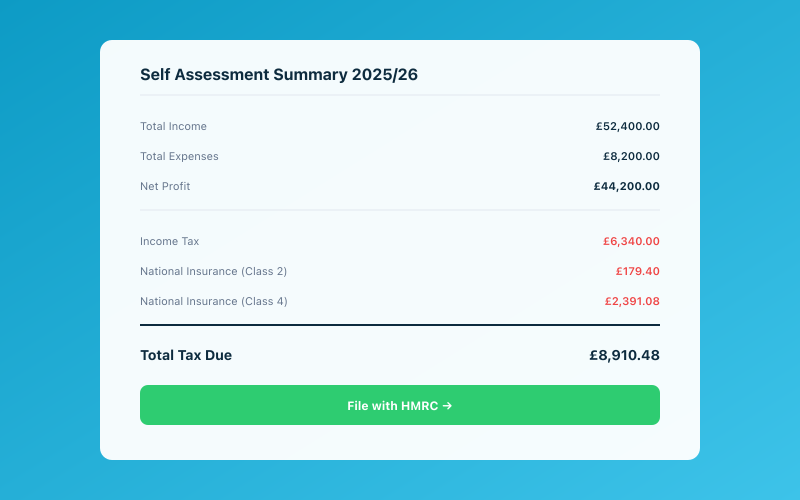 Your Accounted dashboard shows your real-time tax position
How Pension Tax Relief Works
When you contribute to a pension, you receive tax relief at your marginal rate. For the 2025/26 tax year:
- Basic rate taxpayers (20%): A £1,000 contribution effectively costs you £800, because the government adds £200 in tax relief.
- Higher rate taxpayers (40%): The same £1,000 contribution costs just £600 after claiming back the additional relief through your Self Assessment return.
- Additional rate taxpayers (45%): Your effective cost drops to £550.
The annual allowance for pension contributions is £60,000 in 2025/26, or 100% of your relevant UK earnings — whichever is lower. And if you haven't used your full allowance in the previous three tax years, you can carry forward the unused amount, potentially allowing you to make a much larger contribution.
Which Pension Is Right for Self-Employed People?
As a sole trader, you won't have a workplace pension, but you have several options:
- Personal pensions: Available from most major providers, these are straightforward to set up and manage.
- Self-invested personal pensions (SIPPs): These give you more control over your investments, allowing you to choose from a wider range of funds, shares, and other assets.
- Stakeholder pensions: These have capped charges and low minimum contributions, making them a solid choice if you're just getting started.
For a deeper dive into pension options, have a look at our guide to pensions for sole traders.
ISAs — Tax-Free Growth and Income
Individual Savings Accounts (ISAs) are another cornerstone of tax-efficient investing. Unlike pensions, you don't get tax relief on the money going in, but everything inside an ISA — growth, dividends, and interest — is completely free from income tax and capital gains tax.
The ISA Allowance
For 2025/26, you can put up to £20,000 into ISAs each tax year. This allowance can be split across different types of ISA, but the total across all ISAs cannot exceed £20,000.
Types of ISA
- Stocks and Shares ISA: Invest in funds, shares, bonds, and other securities. Over the long term, this tends to offer better returns than a Cash ISA, though your capital is at risk.
- Cash ISA: A straightforward savings account where interest is tax-free. Useful for short-term savings or your emergency fund.
- Innovative Finance ISA: Holds peer-to-peer lending investments. Higher potential returns but also higher risk.
- Lifetime ISA: Available if you're between 18 and 39, this adds a 25% government bonus (up to £1,000 per year) on contributions up to £4,000. The catch is it's designed for buying your first home or retirement, and there's a 25% withdrawal charge if you take money out for other reasons.
Why ISAs Matter for the Self-Employed
ISAs are particularly valuable for self-employed people because they offer flexibility that pensions don't. You can withdraw money from a Cash ISA or Stocks and Shares ISA at any time without penalty, making them ideal for building a buffer against irregular income or saving for medium-term goals like business expansion.
Enterprise Investment Scheme (EIS)
The Enterprise Investment Scheme is designed to encourage investment in small, higher-risk companies. If you're willing to accept the risk, the tax benefits are substantial.
Key Benefits
- 30% income tax relief on investments up to £1,000,000 per tax year (or £2,000,000 if at least £1,000,000 is invested in knowledge-intensive companies).
- Capital gains tax (CGT) exemption on any gains when you sell the shares, provided you've held them for at least three years.
- Loss relief: If the investment doesn't work out, you can offset the loss against your income tax bill, cushioning the blow.
- CGT deferral: You can defer capital gains from other assets by reinvesting into EIS-qualifying companies.
Who Is It For?
EIS is best suited to higher earners and those with a higher tolerance for risk. The companies that qualify tend to be small, early-stage businesses — exciting, but inherently risky. You need to hold your shares for at least three years to keep the tax relief, and there's no guarantee you'll get your money back.
For a full breakdown, see our guide to the Enterprise Investment Scheme.
Seed Enterprise Investment Scheme (SEIS)
SEIS is like EIS's younger sibling — aimed at even earlier-stage companies with even more generous tax relief.
Key Benefits
- 50% income tax relief on investments up to £200,000 per tax year.
- CGT exemption on gains after three years.
- Loss relief similar to EIS.
- CGT reinvestment relief: 50% exemption on capital gains reinvested into SEIS-qualifying companies.
SEIS is a powerful option if you're comfortable with high-risk investing and want to support the UK startup ecosystem while reducing your tax bill. Our complete guide to SEIS covers the details.
Venture Capital Trusts (VCTs)
VCTs offer another way to invest in small, unquoted companies, but through a managed fund rather than picking individual companies yourself.
Key Benefits
- 30% income tax relief on investments up to £200,000 per tax year.
- Tax-free dividends from the VCT.
- CGT exemption on gains when you sell your VCT shares.
The main advantage of VCTs over EIS and SEIS is diversification — your money is spread across a portfolio of companies, which reduces the risk of any single investment failing. The trade-off is that you need to hold VCT shares for at least five years to keep the income tax relief, and VCT shares can be difficult to sell on the secondary market.
Learn more in our guide to Venture Capital Trusts.
National Savings and Investments (NS&I)
NS&I products are backed by the UK government, making them among the safest investments available. While the returns are typically modest, some products offer tax-free interest:
- Premium Bonds: No interest, but tax-free prize draws each month. The effective "interest rate" varies, but the maximum prize is £1,000,000.
- Direct ISAs and savings products are also available through NS&I from time to time.
For self-employed people looking for a no-risk home for their tax savings fund, NS&I can be a sensible option.
Building a Tax-Efficient Investment Strategy
The best approach for most self-employed people is to use a combination of these options, tailored to your circumstances:
-
Start with a pension. The tax relief is unmatched, and the long-term compounding benefits are enormous. Even modest contributions early on can grow into a substantial retirement pot. Work out how much you should be putting away and try to increase it each year.
-
Max out your ISA. If you can afford to save beyond your pension contributions, filling your ISA allowance gives you tax-free growth with full flexibility to access your money when you need it.
-
Consider EIS, SEIS, or VCTs if you're a higher earner looking for additional tax relief and you're comfortable with higher-risk investments.
-
Keep a cash buffer. Before tying money up in investments, make sure you have enough liquid savings to cover your tax bills and at least three to six months of living expenses. This is especially important for self-employed people, whose income can be unpredictable.
Don't Forget Your Tax Bills
One thing that catches many self-employed people out is investing too aggressively and then not having enough cash to pay their tax bill. If you have payments on account to make, factor these into your plans before committing money to longer-term investments.
Using a tool like Penny — the AI assistant inside Accounted — can help you keep track of your tax position in real time, so you always know how much you need to set aside before investing the rest.
Getting Started
Tax-efficient investing doesn't have to be complicated. Start with the basics — pension and ISA — and build from there as your income and confidence grow. The most important thing is to start, even if it's with small amounts. Time in the market beats timing the market, as the saying goes.
And remember, the end of the tax year is a natural checkpoint to review your investments and make sure you're using your allowances before they reset on 6 April.
Accounted helps UK sole traders stay on top of their bookkeeping and tax. Start your free 30-day trial at getaccounted.co.uk
Related reading:
- How to Pay Less Tax Legally in the UK
- Pensions for Sole Traders — Your Complete Guide
- Pension Carry Forward — How to Use Unused Allowances
Related Reading
- Northern Ireland Business Tax — The Unique Rules
- National Insurance Credits — Gaps You Might Not Know You Have
You may also find our Annual Investment Allowance Explained for Small Businesses helpful.
For step-by-step guidance, see our article on How to Handle an HMRC Tax Investigation.
Related reading: National Insurance Calculator for Self-Employed.
Related reading: Should I Register for VAT? Decision Framework.
For more on this topic, read Tax Implications of Closing Your Business.
For more on this topic, read Tax Relief on Charitable Donations for Business Owners.
Related reading: Am I Inside IR35? Self-Assessment Checklist.
For more on this topic, read Capital Gains Tax Planning for Business Owners.
For more on this topic, read Dividend Tax for Director-Shareholders: 2026.
You may also find our Employee Share Schemes — EMI, CSOP, SIP Explained helpful.
For more on this topic, read How Much Should I Set Aside for Tax Each Month?.
For more on this topic, read Inheritance Tax Planning for Self-Employed.
See our detailed comparison: Inside IR35 vs Outside IR35: Financial Impact.
Related reading: Protecting Your Business from Invoice Fraud.
You may also find our IR35 Explained: The Complete Guide for Contractors helpful.
Related reading: IR35 for Agencies: Responsibilities and Compliance.
For more on this topic, read IR35 Tax Calculations: What You'll Actually Pay.
Related reading: Marriage Allowance: Transfer £1,260 to Your Partner.
For step-by-step guidance, see our article on How to Prepare Your Bookkeeping for MTD Quarterly Submissions.
See our detailed comparison: Sole Trader vs Ltd Calculator: Which Saves Tax.
For step-by-step guidance, see our article on How to Spot HMRC Scam Emails, Texts, and Calls.
For more on this topic, read Tax on Business Grants and Government Subsidies.
For more on this topic, read Year-End Tax Planning Tips for Sole Traders.
For more on this topic, read Tax When a Spouse Dies — What Self-Employed People Need to Know.
For more on this topic, read Starting a Business Mid-Year: How Tax Works in Your First Year.
Related reading: Voluntary NI Contributions: When It's Worth It.
Start your free trial and let Penny handle your bookkeeping automatically.
Penny, your AI bookkeeper, tracks your tax position in real time and flags opportunities to reduce your bill. Meet Penny →
Tax & Compliance Specialists
Our tax specialists have decades of combined experience in UK sole trader and small business taxation, MTD compliance, and HMRC submissions. All content is reviewed against current HMRC guidance before publication and updated quarterly to reflect legislative changes.
Ready to try Accounted?
Join UK sole traders who are simplifying their bookkeeping and tax.
Start your 14-day free trial