Starting a Business Mid-Year: How Tax Works in Your First Year
Starting a business is exciting, but it also means navigating the UK tax system for the first time. If you begin trading partway through the tax year — which most people do — there are specific rules about registration deadlines, your first tax return, how profits are taxed, and what expenses you can claim for the period before you officially started.
This guide covers everything you need to know about tax in your first year of self-employment, particularly when you start mid-year.
Registering with HMRC
When you start working for yourself, you must register with HMRC for Self Assessment. The deadline is 5 October following the end of the tax year in which you started trading.
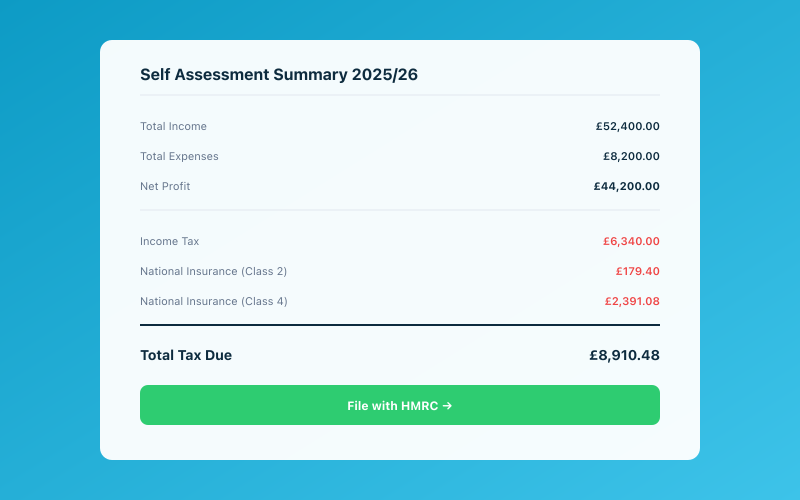 Your Accounted dashboard shows your real-time tax position
The UK tax year runs from 6 April to 5 April. So if you started your business in September 2025, you are in the 2025/26 tax year (6 April 2025 to 5 April 2026), and your registration deadline is 5 October 2026.
However, there is no advantage in waiting. Registering early means you receive your Unique Taxpayer Reference (UTR) sooner, which you may need for client onboarding, platform verification, or opening a business bank account. Registration is done online through GOV.UK's Self Assessment registration service.
What Happens If You Register Late
If you miss the 5 October deadline, HMRC may charge a penalty. More practically, a late registration can delay your UTR, which in turn delays your ability to file your tax return on time. Filing late triggers automatic penalties starting at £100, so the knock-on effects of late registration can be costly.
Your First Tax Return
Your first Self Assessment tax return covers the period from when you started trading to the end of the tax year (5 April).
If you started your business on 1 September 2025, your first accounting period runs from 1 September 2025 to 5 April 2026 — a period of just over seven months. You report the income earned and expenses incurred during this period on your 2025/26 tax return.
The Filing Deadline
Your tax return for 2025/26 is due by:
- 31 October 2026 if filing on paper
- 31 January 2027 if filing online
The vast majority of people file online, so in practice the deadline you need to remember is 31 January 2027.
Payment Deadlines
Any tax owed for 2025/26 must be paid by 31 January 2027. If your tax bill is over £1,000, HMRC will also require you to make payments on account — advance payments towards your next year's tax bill. Each payment on account is 50% of the previous year's liability, due on 31 January and 31 July.
This can come as a shock in your second year. If your first year's tax bill is £3,000, you will need to pay £3,000 plus £1,500 on account — a total of £4,500 on 31 January 2027. The second payment on account of £1,500 is then due on 31 July 2027.
Basis Periods and Tax Year Alignment
Before April 2024, the rules about which profits were taxed in which year were complicated, involving basis periods and potential overlap profits. The good news is that from the 2024/25 tax year onwards, HMRC moved to tax year basis. This means your profits are taxed based on the tax year in which they arise, regardless of your accounting date.
If you are starting a new business now, the tax year basis applies to you from day one. Your profits from when you start trading until 5 April are simply reported on that year's tax return.
Choosing Your Accounting Date
Under tax year basis, your accounting date still matters for organising your records, but it no longer creates the complications it once did. Most new sole traders choose either:
- 5 April (aligning perfectly with the tax year)
- 31 March (which HMRC treats as equivalent to 5 April for practical purposes)
- 31 December (aligning with the calendar year)
If you choose an accounting date that does not align with the tax year (say 30 June), you will need to apportion profits across tax years. For simplicity, 31 March or 5 April is recommended for new sole traders.
Overlap Relief: What You Need to Know
If you started your business before April 2024 under the old basis period rules, you may have generated overlap profits — profits that were taxed twice because of how basis periods worked. Under the transitional rules for the move to tax year basis (which applied in 2023/24), any outstanding overlap relief should have been used.
If you are starting a business now, overlap relief does not apply to you. The tax year basis means profits are only taxed once, in the year they arise.
Pre-Trading Expenses
One of the most valuable rules for new businesses is the ability to claim pre-trading expenses. These are costs you incurred before you officially started trading, as long as they would have been allowable expenses had the business already been running.
The Rules
You can claim expenses incurred up to seven years before you start trading, provided:
- The expense was incurred wholly and exclusively for the purpose of the trade
- The expense would have been deductible if the business had already been operating
- You have receipts or records to support the claim
Common Pre-Trading Expenses
Here are expenses that new business owners frequently overlook:
- Market research — surveys, competitor analysis, focus groups
- Training courses — relevant to your intended business activity
- Professional fees — accountant's advice on business structure, solicitor's costs for contracts
- Website development — domain registration, design and build costs
- Equipment — laptop, tools, software licences purchased before launch
- Travel — trips to meet potential suppliers or view premises
- Insurance — professional indemnity or public liability cover arranged before trading
- Stationery and supplies — business cards, office supplies, branding materials
How to Claim
Pre-trading expenses are treated as if they were incurred on the first day of trading. You include them in your first year's expenses on your Self Assessment return. They are not reported separately — they simply form part of your total allowable expenses for the period.
Claiming Setup Costs
Beyond pre-trading expenses, your first year will likely include significant setup costs that are ongoing business expenses:
Capital Expenditure
Large purchases like computers, vehicles, or machinery are capital expenditure. You cannot deduct the full cost as a revenue expense. Instead, you claim capital allowances:
- Annual Investment Allowance (AIA): You can claim 100% of the cost of qualifying plant and machinery in the year of purchase, up to £1,000,000. For most small businesses, this covers everything.
- Cars: Separate rules apply. Cars are not eligible for AIA. Instead, you claim writing down allowances at 18% (CO2 emissions up to 50g/km) or 6% (over 50g/km). Electric cars qualify for 100% first year allowance.
Revenue Expenditure
Day-to-day running costs are deductible in full in the period they are incurred. For your first year, these include:
- Rent and utilities (or a proportion if working from home)
- Phone and broadband
- Software subscriptions
- Postage and stationery
- Marketing and advertising
- Professional subscriptions
- Bank charges on your business account
National Insurance in Your First Year
As well as income tax, self-employed people pay National Insurance contributions:
- Class 2 NICs: A flat rate of £3.45 per week (2025/26). You only pay if your profits exceed the Small Profits Threshold (£6,725 in 2025/26). These are collected through Self Assessment.
- Class 4 NICs: 6% on profits between £12,570 and £50,270, and 2% on profits above £50,270 (2025/26 rates).
In your first year, if you started mid-year, your Class 2 NICs are proportional to the number of weeks you were self-employed.
Let Accounted Handle the Complexity
Starting a business involves enough challenges without worrying about tax deadlines and compliance rules. Accounted takes care of this for you — from tracking your pre-trading expenses to preparing your first tax return. Penny, your AI bookkeeper, automatically categorises your transactions, flags what is claimable, and ensures nothing slips through the cracks. Start your free trial today and get your first year right from the beginning.
Related Reading
Start your free trial and let Penny handle your bookkeeping automatically.
Penny, your AI bookkeeper, tracks your tax position in real time and flags opportunities to reduce your bill. Meet Penny →
Tax & Compliance Specialists
Our tax specialists have decades of combined experience in UK sole trader and small business taxation, MTD compliance, and HMRC submissions. All content is reviewed against current HMRC guidance before publication and updated quarterly to reflect legislative changes.
Ready to try Accounted?
Join UK sole traders who are simplifying their bookkeeping and tax.
Start your 14-day free trial