Seed Enterprise Investment Scheme (SEIS) — Complete Guide
If you've heard of the Enterprise Investment Scheme (EIS) and thought the tax relief sounded generous, wait until you see its younger sibling. The Seed Enterprise Investment Scheme — SEIS — offers an astonishing 50% income tax relief on investments in very early-stage UK companies, making it one of the most generous tax incentive schemes anywhere in the world.
SEIS was introduced in 2012 to encourage investment in seed-stage startups — businesses that are right at the beginning of their journey. These are inherently high-risk investments, and the generous tax relief is designed to cushion that risk and persuade investors to back the companies that traditional funding sources often overlook.
In this guide, we'll explain how SEIS works in the 2025/26 tax year, the tax reliefs available, the qualifying conditions, and how to approach SEIS investing as part of a broader tax planning strategy.
How SEIS Works
The basic concept is straightforward: you invest in qualifying shares issued by a qualifying company, and in return, you receive substantial tax reliefs. The company must be at an early stage — much earlier than EIS — and the investment limits are smaller, reflecting the seed-stage nature of the businesses involved.
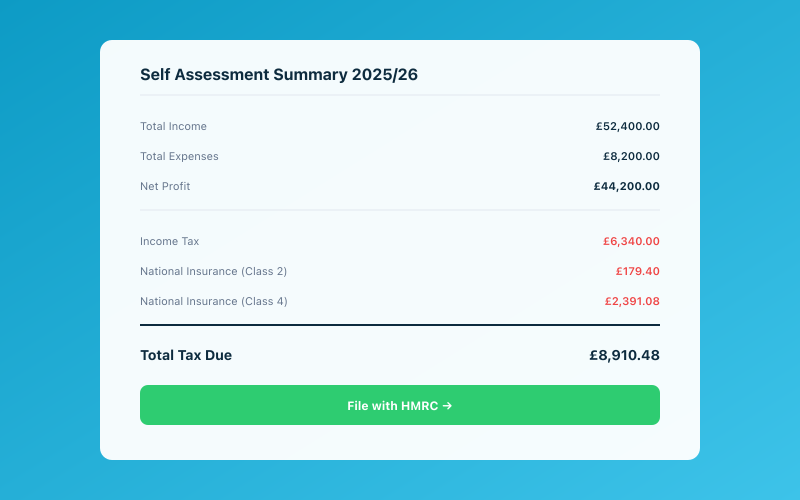 Your Accounted dashboard shows your real-time tax position
SEIS and EIS are complementary schemes. A company might raise initial funding through SEIS and then, as it grows, raise further funding through EIS. As an investor, you can hold both SEIS and EIS investments simultaneously, each with their own separate relief limits.
The Tax Reliefs — A Breakdown
SEIS offers four key tax benefits, and the combined effect is remarkably powerful.
1. Income Tax Relief — 50%
You can claim income tax relief of 50% on investments up to £200,000 per tax year. That means a maximum income tax reduction of £100,000.
Example: You invest £40,000 in a SEIS-qualifying company. Your income tax bill for the year is reduced by £20,000 — half the amount invested. That's an immediate return of 50% before the underlying investment has done anything at all.
Like EIS, the relief is given as a reduction in your income tax liability, so you need to have sufficient tax to pay. You can also carry the investment back to the previous tax year if that gives you a better result.
2. Capital Gains Tax Exemption
Sell your SEIS shares at a profit after holding them for at least three years, and the gain is completely free from CGT. Combined with the 50% income tax relief, this means you could potentially invest £40,000, receive £20,000 back in income tax relief, and then sell the shares years later for, say, £80,000 — with the entire £40,000 gain being tax-free.
3. Capital Gains Tax Reinvestment Relief
This is unique to SEIS and doesn't exist for EIS in the same form. If you invest a capital gain into SEIS-qualifying shares in the same tax year that you realised the gain, 50% of the reinvested amount is exempt from CGT.
Example: You sell a buy-to-let property and realise a £100,000 capital gain. You invest £100,000 into SEIS-qualifying companies in the same tax year. £50,000 of the original gain is exempt from CGT, saving you up to £14,000 in CGT (at 28% for residential property gains) or £10,000 (at 20% for other assets).
Note that this relief is separate from the income tax relief — you can claim both on the same investment.
4. Loss Relief
If the investment fails, you can offset the loss (after accounting for the income tax relief received) against your income tax or capital gains tax.
Example: You invested £40,000 and received £20,000 in income tax relief. The company goes bust and your shares are worthless. Your allowable loss is £40,000 – £20,000 = £20,000. As a 40% taxpayer, offsetting this against income saves you £8,000.
Your total tax benefits are £20,000 (income tax relief) + £8,000 (loss relief) = £28,000, meaning your net cost on a total loss of £40,000 is just £12,000. That's a remarkable safety net for what is undeniably a high-risk investment.
Qualifying Conditions
SEIS has stricter qualifying conditions than EIS, reflecting the earlier stage of the companies involved.
Company Requirements
The company must:
- Have been incorporated within the past three years (recently extended from two years)
- Have fewer than 25 employees
- Have gross assets of no more than £350,000
- Not have previously raised more than £250,000 through SEIS (the lifetime SEIS limit per company)
- Be carrying on, or preparing to carry on, a new qualifying trade
- Not be listed on a recognised stock exchange
- Be UK-based (permanent establishment in the UK)
- Not be controlled by another company
The qualifying trade restrictions are similar to EIS — most trades qualify, but property development, financial services, farming, and certain other activities are excluded.
Investor Requirements
As an investor, you must:
- Not be connected with the company (broadly, no more than 30% of shares, voting rights, or assets on winding up)
- Not be an employee of the company (though you can be a director, provided you weren't previously connected)
- Subscribe for new shares (not buy existing shares from another shareholder)
- Hold the shares for at least three years
SEIS vs EIS — Which Is Better?
It's not a case of one being "better" than the other — they serve different purposes and can be used alongside each other.
| Feature | SEIS | EIS | |---|---|---| | Income tax relief | 50% | 30% | | Maximum annual investment | £200,000 | £1,000,000 (£2,000,000 for knowledge-intensive) | | CGT reinvestment relief | 50% exemption | Deferral | | Company size (employees) | <25 | <250 (or <500 knowledge-intensive) | | Company age | <3 years | <7 years (or <10 knowledge-intensive) | | Company gross assets | <£350,000 | <£15 million | | Maximum SEIS/EIS raised | £250,000 lifetime | £12 million lifetime | | Minimum holding period | 3 years | 3 years |
In practice, many investors use SEIS for the earliest-stage investments (where the risk is highest but the tax relief is most generous) and EIS for slightly more established companies.
How to Find SEIS Opportunities
Direct Investment
If you have connections to the startup world — perhaps through your professional network, industry events, or angel investing groups — you may find SEIS opportunities directly. This gives you full control over your investment choices but requires significant time and expertise to evaluate opportunities properly.
SEIS Funds
Several specialist fund managers run SEIS funds, pooling investor money across a portfolio of seed-stage companies. This provides diversification (typically 10–20 companies per fund), professional due diligence, and ongoing portfolio management. Fees are higher than direct investment, but the reduced risk from diversification can be worthwhile.
Angel Networks and Platforms
Angel investor networks like the UK Business Angels Association and online platforms connect investors with startups seeking SEIS funding. These can provide a curated pipeline of opportunities with varying levels of due diligence already completed.
Practical Considerations
Liquidity
SEIS shares are illiquid — there's no stock exchange to sell them on, and finding a buyer for shares in a tiny startup can be extremely difficult. You should assume your money is locked up for many years, potentially five to ten or more. The three-year minimum holding period for tax relief is just the starting point.
Diversification
Given the high failure rate of seed-stage companies (industry estimates suggest around 60–90% of startups fail), diversification is crucial. Investing your full £200,000 allowance in a single company is a very concentrated bet. Spreading your investment across multiple companies — either directly or through a fund — significantly improves your odds of at least one investment delivering a strong return.
Due Diligence
Even with generous tax relief cushioning the downside, you should still conduct thorough due diligence before investing. Look at the management team, the market opportunity, the business model, the competitive landscape, and how the company plans to use the funds raised. If it doesn't make sense as an investment without the tax relief, the tax relief alone shouldn't change your mind.
SEIS for Self-Employed Investors
If you're self-employed and have had a particularly profitable year, SEIS can be an attractive way to reduce your tax bill significantly. The 50% income tax relief means that for every £10,000 you invest, your tax bill drops by £5,000.
Combined with pension contributions and other tax-efficient investments, SEIS can form part of a comprehensive approach to managing a high tax liability. Just make sure you've set aside enough to cover your Self Assessment payments before committing funds to illiquid investments.
Using Accounted to track your income and tax position throughout the year helps you see exactly how much headroom you have for investments like SEIS. Penny can give you a running estimate of your tax bill, so you know when a profitable quarter opens up an opportunity for tax-efficient investing.
Claiming SEIS Relief
To claim the relief, you'll need an SEIS3 certificate from the company you've invested in. The company applies to HMRC to confirm the shares qualify, and once approved, issues the certificate to investors.
You then claim the relief on your Self Assessment tax return (boxes on the SA101 supplementary pages). Remember to keep the certificate safe — HMRC may ask to see it.
If you want to carry the investment back to the previous tax year, you can do this on your return for the earlier year (or by amending it if already filed).
Key Takeaways
SEIS is an extraordinary tax relief scheme, but it comes with commensurately high risk. The 50% income tax relief, CGT exemption, reinvestment relief, and loss relief combine to create a safety net that significantly softens the blow if an investment fails — and amplifies the return if it succeeds.
If you're considering SEIS, approach it with open eyes: diversify, do your homework, and only invest money you can genuinely afford to lose. The tax benefits are the icing on the cake, not the cake itself.
For a broader perspective on tax-efficient investing options, have a look at our guide to VCTs, which offer a lower-risk way to invest in small companies through a diversified, managed portfolio.
Accounted helps UK sole traders stay on top of their bookkeeping and tax. Start your free 30-day trial at getaccounted.co.uk
Related reading:
- Enterprise Investment Scheme (EIS) — Tax Relief Guide
- Venture Capital Trusts (VCTs) — Tax-Efficient Investing
- How to Pay Less Tax Legally in the UK
Related Reading
Start your free trial and let Penny handle your bookkeeping automatically.
Penny, your AI bookkeeper, tracks your tax position in real time and flags opportunities to reduce your bill. Meet Penny →
Tax & Compliance Specialists
Our tax specialists have decades of combined experience in UK sole trader and small business taxation, MTD compliance, and HMRC submissions. All content is reviewed against current HMRC guidance before publication and updated quarterly to reflect legislative changes.
Ready to try Accounted?
Join UK sole traders who are simplifying their bookkeeping and tax.
Start your 14-day free trial