Enterprise Investment Scheme (EIS) — Tax Relief Guide
The Enterprise Investment Scheme (EIS) is one of the UK government's flagship programmes for encouraging investment in small, growing businesses. For investors, it offers some of the most generous tax reliefs available anywhere in the UK tax system. For businesses, it provides a crucial source of early-stage funding that might otherwise be impossible to secure.
But EIS isn't for everyone. The investments are high-risk, the rules are detailed, and getting it wrong can mean losing the tax reliefs entirely. In this guide, we'll walk through everything you need to know about EIS in the 2025/26 tax year — the benefits, the risks, the qualifying conditions, and how to make the most of it if you decide it's right for you.
What Is the Enterprise Investment Scheme?
EIS was introduced in 1994 to help smaller, higher-risk trading companies raise finance by offering tax incentives to investors who buy new shares in those companies. It's designed to bridge the funding gap that many early-stage businesses face — the point where they've outgrown friends-and-family funding but aren't yet attractive to institutional investors.
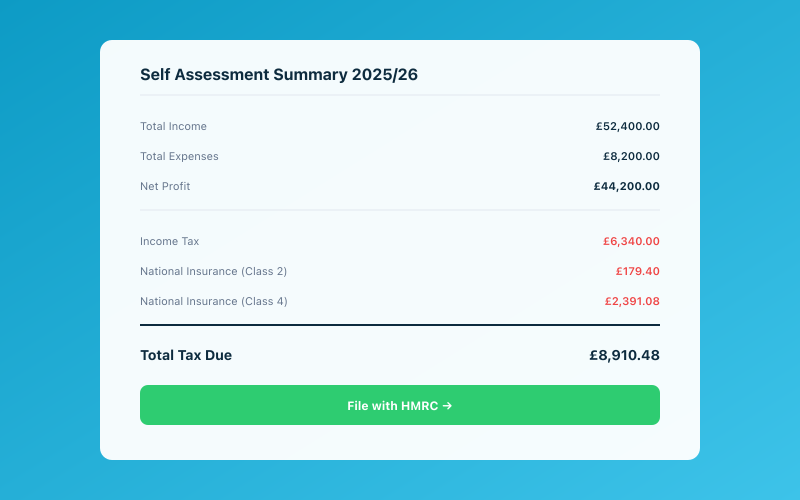 Your Accounted dashboard shows your real-time tax position
The scheme is administered by HMRC, and companies must apply for advance assurance (or retrospective confirmation) that they qualify. As an investor, you'll receive an EIS3 certificate from the company confirming that the shares qualify and allowing you to claim the tax reliefs.
The Tax Reliefs Explained
EIS offers four distinct tax benefits to investors. Let's look at each one in detail.
1. Income Tax Relief — 30%
When you invest in EIS-qualifying shares, you can claim income tax relief of 30% of the amount invested, up to a maximum investment of £1,000,000 per tax year. That rises to £2,000,000 if at least £1,000,000 is invested in knowledge-intensive companies (broadly, companies carrying out significant research and development).
Example: You invest £50,000 in an EIS-qualifying company. You can claim income tax relief of £15,000, reducing your tax bill for the year by that amount.
The relief is given as a reduction in your income tax liability, so you need to have at least £15,000 of income tax to pay in order to benefit fully. You can also carry back the investment to the previous tax year, claiming relief against that year's tax instead — useful if your current year's income is lower than usual.
2. Capital Gains Tax Exemption
If you sell your EIS shares at a profit after holding them for at least three years, the gain is completely free from capital gains tax. Given that CGT rates are 10% for basic rate taxpayers and 20% for higher rate taxpayers (on most assets), this is a meaningful benefit on top of the initial income tax relief.
3. Capital Gains Tax Deferral
You can defer capital gains from the disposal of any asset by reinvesting the gain into EIS-qualifying shares. The reinvestment must be made within the period starting one year before and ending three years after the original disposal.
This is particularly powerful if you've sold a business, property, or other asset and face a large CGT bill. The deferred gain only becomes chargeable when you dispose of the EIS shares (unless it's exempt under the CGT exemption described above).
4. Loss Relief
If your EIS investment doesn't work out and you sell the shares at a loss, you can offset that loss against your income tax (not just your capital gains). The loss is calculated after accounting for the income tax relief you received.
Example: You invested £50,000 and received £15,000 in income tax relief. The company fails, and your shares become worthless. Your allowable loss is £50,000 – £15,000 = £35,000. If you're a 40% taxpayer, offsetting this against income saves you £14,000.
So your total tax benefits are £15,000 (initial relief) + £14,000 (loss relief) = £29,000, meaning your effective cost on a total loss of £50,000 is just £21,000. This safety net is a major attraction of EIS.
Qualifying Conditions
Not every investment qualifies for EIS. There are rules for both the company and the investor.
Company Requirements
The company must:
- Be a UK-based trading company (or the parent of a trading group)
- Have fewer than 250 employees (or 500 for knowledge-intensive companies)
- Have gross assets of no more than £15 million before the investment (£16 million after)
- Be less than seven years old (or ten years for knowledge-intensive companies) from its first commercial sale
- Not be listed on a main stock exchange (AIM-listed companies can qualify)
- Be carrying on a qualifying trade (most trades qualify, but some — like property development, financial services, and energy generation — are excluded)
- Use the funds raised for a qualifying business purpose within a specified period
Investor Requirements
As an investor, you must:
- Not be connected with the company — this generally means you can't hold more than 30% of the shares or voting rights, and you can't be an employee or director (though there are some exceptions for directors who weren't previously connected)
- Hold the shares for at least three years to retain the income tax relief and qualify for the CGT exemption
- Subscribe for new shares (you can't buy existing shares from another investor and claim EIS relief)
How to Invest Through EIS
There are several ways to access EIS investments:
Direct Investment
You identify a qualifying company yourself, subscribe for shares, and receive an EIS3 certificate. This approach gives you full control over where your money goes but requires you to source and evaluate individual opportunities — which can be time-consuming and requires expertise.
EIS Funds
Many investment managers offer EIS funds that pool money from multiple investors and spread it across a portfolio of qualifying companies. This provides diversification and professional management, though you'll pay management fees and potentially performance fees.
EIS Platforms
Online platforms have emerged that connect investors with EIS-qualifying companies, often with lower fees than traditional fund managers. These can be a good middle ground between direct investment and a managed fund.
EIS and the Self-Employed
If you're self-employed and have had a profitable year, EIS can be a powerful way to reduce your tax bill while potentially growing your wealth. The 30% income tax relief is immediate, and the possibility of tax-free gains (or loss relief if things don't work out) makes the risk-reward profile more attractive than investing without tax incentives.
However, it's important to be realistic about the risks. EIS-qualifying companies are, by definition, small and early-stage. Many will fail. You should only invest money you can afford to lose, and EIS should form part of a diversified portfolio rather than your entire investment strategy.
For a broader view of tax-efficient investment options, see our guide to tax-efficient investments for the self-employed.
Common Mistakes to Avoid
Breaking the Three-Year Holding Period
If you sell your EIS shares within three years, you'll lose the income tax relief and the CGT exemption. The relief is clawed back, and you'll need to pay back the tax you saved. Make sure you're comfortable locking your money away for at least three years — and realistically, many EIS investments take much longer than that to deliver a return.
Exceeding the Annual Limit
Keep track of your total EIS investments across the tax year. The maximum is £1,000,000 (or £2,000,000 with knowledge-intensive companies). If you also invest in SEIS or VCTs in the same year, remember that each scheme has its own separate limits.
Not Claiming the Relief
You'd be surprised how many investors forget to actually claim the relief on their Self Assessment return. Your EIS3 certificate needs to be submitted to HMRC, and the relief claimed on your tax return. Don't just file the certificate away and forget about it.
Ignoring the Underlying Investment
The tax benefits of EIS are attractive, but they shouldn't be the primary reason you invest. A 30% tax break on an investment that loses all its value is still a net loss. Always evaluate the business case, management team, and market opportunity before committing your money.
Record-Keeping and Compliance
HMRC takes EIS compliance seriously, and the company you invest in has ongoing obligations to maintain its qualifying status. As an investor, you should:
- Keep your EIS3 certificate safe — you'll need it to claim the relief.
- Record the date you acquired the shares and the amount invested.
- Track the three-year holding period carefully.
- Report any disposals of EIS shares on your Self Assessment return.
If you use Accounted for your bookkeeping, keeping a note of your EIS investments alongside your other financial records makes it easy to stay on top of the reporting requirements at Self Assessment time.
Is EIS Right for You?
EIS is best suited to investors who:
- Pay income tax at 20%, 40%, or 45% and want to reduce their tax bill
- Have capital gains they want to defer
- Are comfortable with high-risk investments
- Can afford to lock away money for at least three years (and ideally much longer)
- Have a diversified portfolio and are using EIS for a portion of their higher-risk allocation
If that sounds like you, EIS can be an excellent addition to your tax planning toolkit. If not, there are plenty of other ways to invest tax-efficiently — from pensions and ISAs to SEIS and VCTs — that might be a better fit.
Accounted helps UK sole traders stay on top of their bookkeeping and tax. Start your free 30-day trial at getaccounted.co.uk
Related reading:
- Seed Enterprise Investment Scheme (SEIS) — Complete Guide
- Venture Capital Trusts (VCTs) — Tax-Efficient Investing
- Tax-Efficient Investments for Self-Employed People
Related Reading
- Dividend Allowance Cuts — What It Means for Company Directors
- Tax When Selling to EU Customers After Brexit
Start your free trial and let Penny handle your bookkeeping automatically.
Penny, your AI bookkeeper, tracks your tax position in real time and flags opportunities to reduce your bill. Meet Penny →
Tax & Compliance Specialists
Our tax specialists have decades of combined experience in UK sole trader and small business taxation, MTD compliance, and HMRC submissions. All content is reviewed against current HMRC guidance before publication and updated quarterly to reflect legislative changes.
Ready to try Accounted?
Join UK sole traders who are simplifying their bookkeeping and tax.
Start your 14-day free trial